

On this page
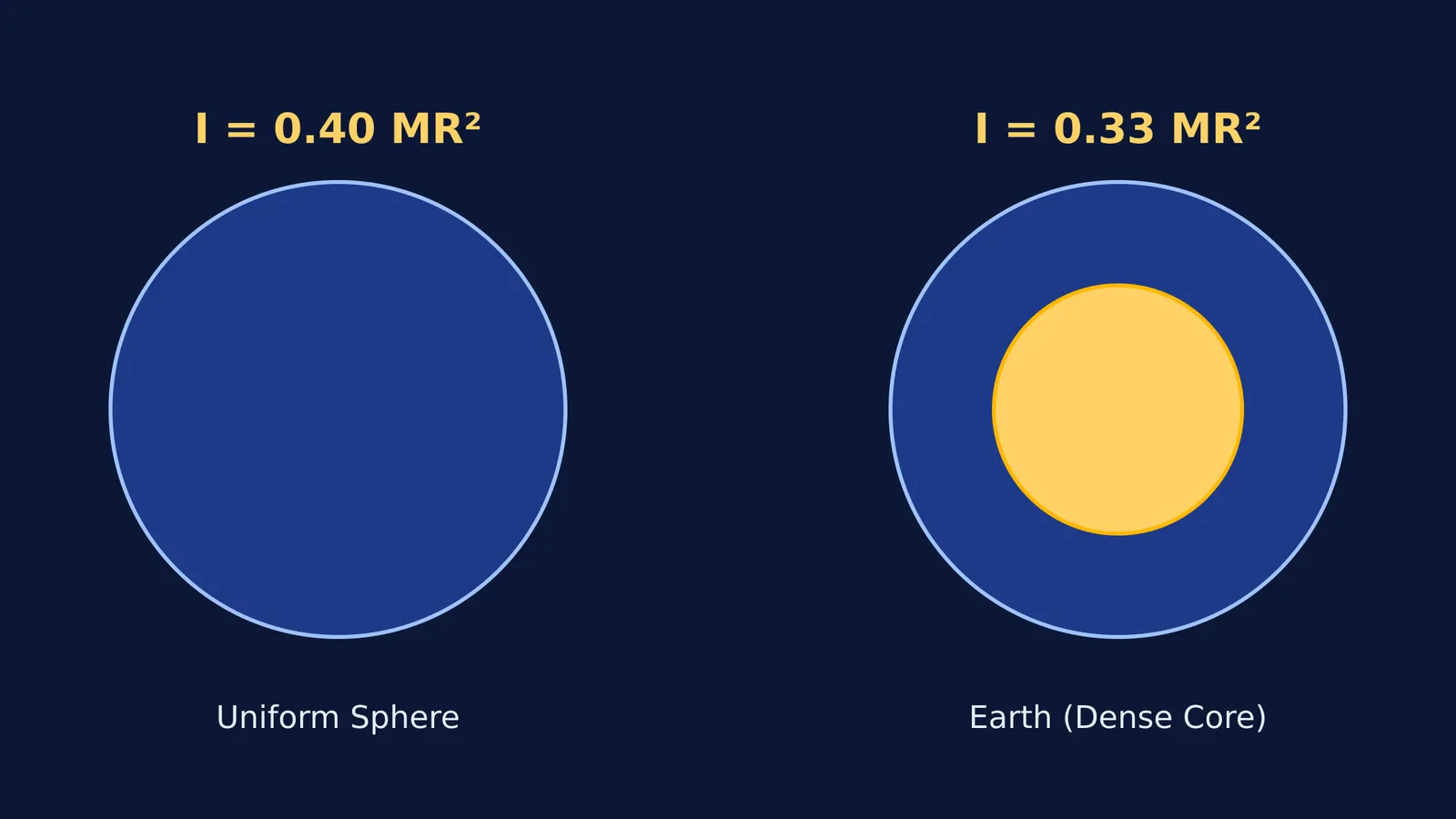
If you open a standard physics textbook, you will find that the moment of inertia of a uniform solid sphere is I = 2/5 M R², or 0.4 M R². But if you check planetary data, Earth's moment of inertia factor is 0.3308. This significant deviation from the theoretical ideal provides some of the strongest evidence for the internal structure of our planet.
Where did the missing 0.07 go? The answer lies not in a mathematical error, but deep beneath our feet.
What does 0.33 MR² mean for Earth?
The moment of inertia of an object tells us how difficult it is to change its rotational motion. This value depends entirely on how the object's mass is distributed relative to its axis of rotation.
If a sphere has the same uniform density all the way through—like a solid steel ball—its moment of inertia factor is exactly 0.4. If the mass is mostly concentrated near the surface (like a hollow tennis ball), the factor is higher, climbing towards 0.67.
Conversely, if the mass is concentrated at the centre, the factor drops below 0.4. Earth's factor of 0.3308 is the primary physical proof that our planet is not uniform. Instead, it has a dense metallic core made mostly of iron and nickel, surrounded by a lighter rocky mantle and crust.
While you can find the density of Earth from g and its radius to get an average value of 5513 kg/m³ from NASA data, the moment of inertia reveals how that density changes with depth. The core takes up roughly 3,485 km of Earth's 6,371 km radius, yet it packs a massive density (up to 13,000 kg/m³ for the inner core, according to Earth's inner core data) compared to the lighter surface rocks.
Measuring the exact value of 0.3308 involves observing how Earth responds to the gravitational pull of the Moon and the Sun, which is why understanding planetary orbits with a gravity simulation is a great way to build intuition for celestial mechanics.
How does Earth's moment of inertia compare to other planets?
The moment of inertia factor acts as a structural fingerprint for every planet and moon in our solar system.
The Moon: With a factor of 0.394, the Moon is nearly a uniform sphere. This tells geophysicists that it has a very small or less dense core compared to its total size.
Mars: At 0.366, Mars is somewhat differentiated but has a lower proportion of core mass than Earth.
Jupiter: The largest planet has a factor of just 0.254. This indicates an extreme concentration of mass at its dense centre, enveloped by a vast, low-density atmosphere of hydrogen and helium.
The Sun: The Sun's factor is roughly 0.070, meaning almost all its mass is packed into the extreme pressures of its central fusion core.
How do you solve non-uniform density problems?
In standard mechanics problems, it is usually assumed that density is uniform, so you can safely use I = 0.4 M R². If you want to dive deeper into the underlying physics principles, you can explore the Fermi Concept Library.
However, advanced problems may give you a variable density, such as ρ(r) = ρ₀(1 - r/R). To find the moment of inertia in these cases, you cannot use the standard formula. You must build the integral from scratch by slicing the sphere into thin hollow shells. A spherical shell of radius r and mass dm has a moment of inertia of 2/3 (dm) r², so the total moment is ∫ 2/3 r² dm.
If a problem gives you a variable density and you are not sure how to slice the object, the Fermi Problem Library explains the reasoning step by step, so you learn to build the calculus yourself rather than memorising the final formula.
How can you model Earth's moment of inertia?
If you want to model Earth without calculus, you can treat it as two simple shapes: a dense solid sphere (the core) and a thick spherical shell (the mantle).
The Core: Calculate the moment of inertia of the core just like a uniform solid sphere: I_core = 2/5 m_core (r_core)².
The Mantle: To find the moment of inertia of the thick mantle, use the subtraction method—the same reasoning used to find the moment of inertia of a disc with a hole. You calculate the moment of a full uniform sphere extending to Earth's surface, and then subtract the moment of the inner sphere that was removed to make room for the core.
The Total: Add them together: I_total = I_core + I_mantle.
When geophysicists plug the true densities and radii into layered models like this, the result matches the observed 0.3308 value perfectly.


