

On this page
A disc with a hole is a full disc minus a smaller disc, and its moment of inertia subtracts the same way. Here is a four-step method and three worked problems in the style of JEE Main questions.
Why can you subtract the removed piece?
OpenStax University Physics states that a compound object's moment of inertia is the sum of the moments of its parts, taken about a common axis. A body with a hole is the full body plus a piece of "negative mass" where the hole is, so:
I(remaining) = I(full body) − I(removed piece), both about the same axis.
Most wrong answers come from the removed mass or the axis.
How do you find the removed mass and its shift?
OpenStax defines surface mass density as σ = m/A. For a uniform plate, the removed mass is σ multiplied by the area removed. For a solid, use mass per volume in the same way.
Disc of radius R, hole of radius R/2: the area ratio is 1/4, so the removed mass is M/4.
Sphere of radius R, cavity of radius R/2: the volume ratio is 1/8, so the removed mass is M/8.
The formulas below need the full-body mass, not the mass that is left.
The hole is usually off-centre, so you shift it. The parallel axis theorem says I = I_cm + md², where d is the distance from an axis through the piece's centre of mass to the parallel axis you want (OpenStax). Our guide to the parallel and perpendicular axis theorems covers it in more depth.
You also need three standard results from the list of moments of inertia on Wikipedia: a disc about its central perpendicular axis is ½MR², a solid sphere about a diameter is (2/5)MR², and a rectangular plate about its central perpendicular axis is M(h² + w²)/12. To see where they come from, read moment of inertia by integration.
How do you find the moment of inertia of a disc with a hole cut out?
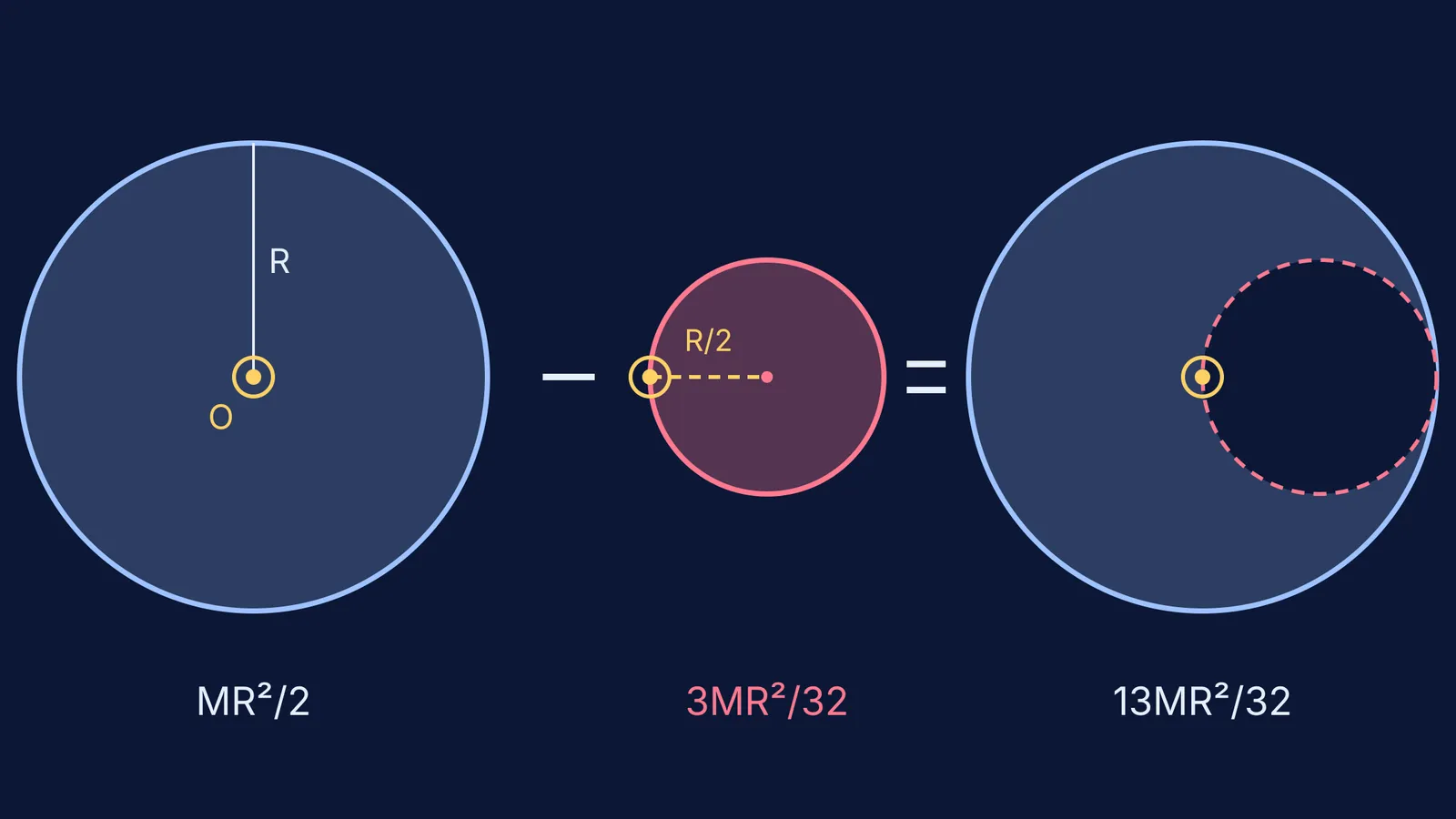
A uniform disc has mass M and radius R. A circular hole of radius R/2 is cut so that its edge passes through the centre O. Find I about the axis through O, perpendicular to the disc.
Full disc: I = MR²/2 = 16MR²/32.
Removed mass: σ = M/(πR²), so m = σ × π(R/2)² = M/4.
Removed piece about its own centre: ½(M/4)(R/2)² = MR²/32. Shift by d = R/2: (M/4)(R/2)² = 2MR²/32. Total: 3MR²/32.
Subtract: I = 16MR²/32 − 3MR²/32 = 13MR²/32.
If the question gives the mass of the remaining disc as M′ instead, then M′ = 3M/4, so M = 4M′/3 and I = 13M′R²/24.
What about a plate with a corner cut away?
A uniform square plate has mass M and side a. A square of side a/2 is removed from one corner. Find I about the axis through the plate's original centre O, perpendicular to it.
Full plate: M(a² + a²)/12 = Ma²/6.
Removed mass: one quarter of the area, so M/4.
Removed square about its own centre: (M/4)(2 × a²/4)/12 = Ma²/96. Its centre sits a/4 along each side from O, so d² = a²/8 and md² = Ma²/32 = 3Ma²/96. Total: 4Ma²/96 = Ma²/24.
Subtract: I = Ma²/6 − Ma²/24 = Ma²/8.
Does the axis matter for a sphere with a cavity?
A uniform solid sphere (mass M before the cavity, radius R) has a cavity of radius R/2 touching its surface, centred R/2 from O.
Full sphere: (2/5)MR² = 64MR²/160.
Removed mass: M/8.
Cavity piece about its own centre: (2/5)(M/8)(R/2)² = 2MR²/160.
Now the axis decides the answer.
Axis through O and the cavity's centre: d = 0, so I = 64MR²/160 − 2MR²/160 = 31MR²/80.
Axis through O, perpendicular to the line joining the centres: add (M/8)(R/2)² = 5MR²/160, so the removed part is 7MR²/160 and I = 57MR²/160.
Underline the axis before you start.
Which mistakes cost marks on these questions?
Subtracting the hole's I about its own centre without adding md².
Putting the remaining mass into the full-body formula.
Applying the parallel axis theorem from a point that is not the piece's centre of mass.
The same negative-mass trick also finds the centre of mass of a cut body; see our guide to centre of mass problems.
If your fraction keeps differing, the Fermi Problem Library has worked problems with a step-by-step solver that explains the reasoning rather than printing an answer, so you can see which step went wrong. To revise the ideas underneath, the Fermi Concept Library gives each physics concept its own lesson.
Try the disc problem with a smaller hole of radius R/4, first touching the centre (d = R/4), then touching the rim (d = 3R/4), and check that the second answer is smaller.


