

On this page
Why does a contracting planet spin faster?
When a celestial body rotates freely in space, its spin is governed by angular momentum. In Newtonian mechanics, angular momentum for a rigid body rotating about a symmetry axis is L = Iω, where I is the moment of inertia and ω is the angular velocity. According to The Feynman Lectures on Physics, the net external torque equals the time rate of change of angular momentum: τ_ext = dL/dt. Because Earth experiences no net external torque opposing its daily spin, dL/dt = 0, meaning angular momentum remains constant over time.
As detailed in OpenStax University Physics, when a rotating body contracts, its mass moves closer to the rotation axis, reducing its moment of inertia I. Because Iω cannot change, this reduction demands an immediate increase in angular speed ω. You see this when an ice skater draws their arms inward to spin faster without any external push. This same conservation principle explains Kepler's area law, as seen in areal velocity derivations for planetary orbits.
How does halving the radius cut the day to 6 hours?
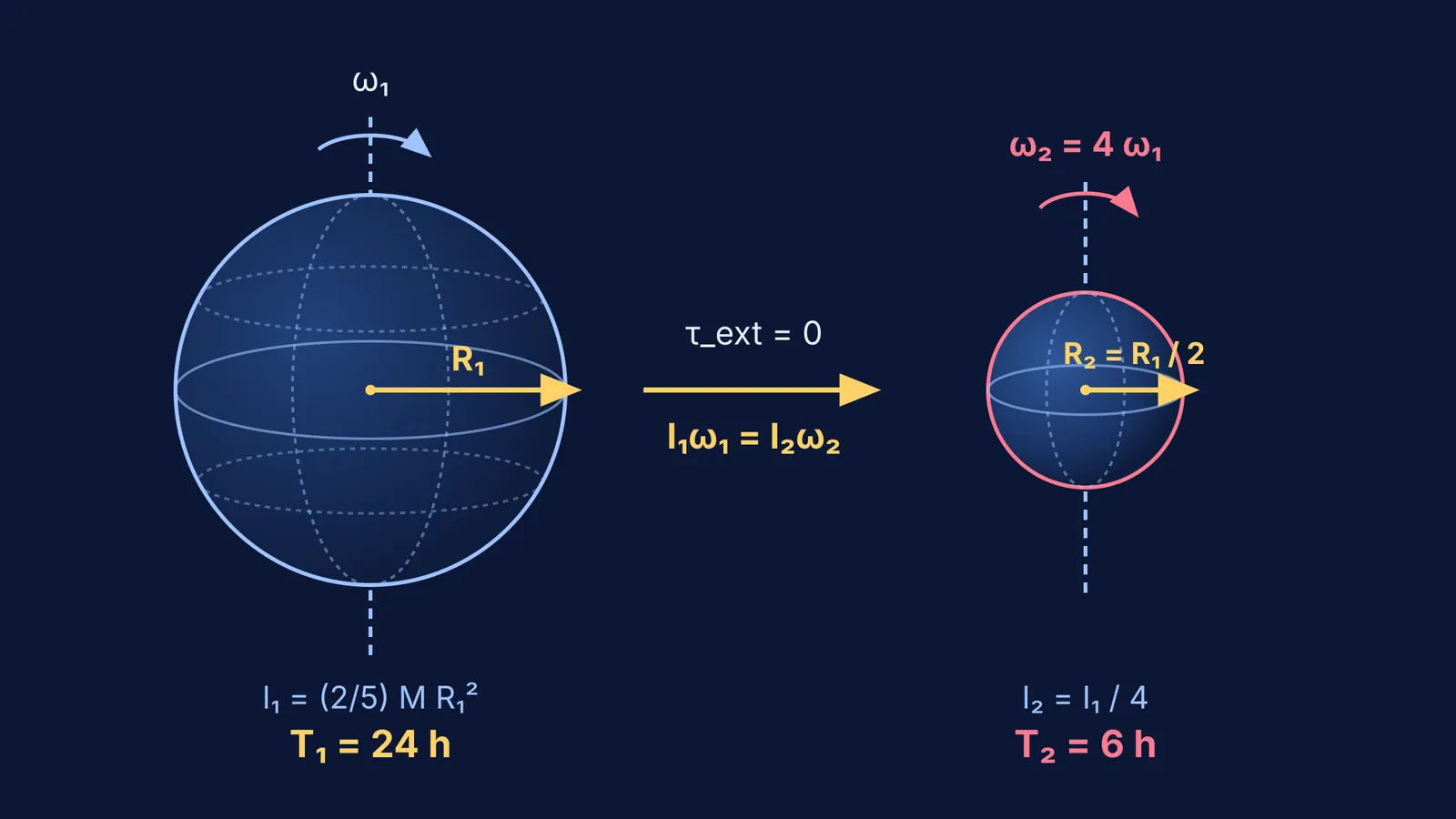
To calculate what happens when Earth contracts, we model the planet as a uniform solid sphere of mass M and radius R₁ rotating about its polar axis. The NASA Earth Fact Sheet records Earth's mean radius as approximately 6,371 km and its solar day as 24.0 hours. As derived in OpenStax University Physics, the moment of inertia for a uniform solid sphere about an axis through its centre is I = (2/5) M R².
If Earth contracts to half its current radius (R₂ = R₁ / 2) while retaining its mass M, its new moment of inertia I₂ becomes:
I₂ = (2/5) M (R₁ / 2)² = (2/5) M (R₁² / 4) = I₁ / 4
Because external torque is zero, angular momentum is conserved across the contraction:
I₁ ω₁ = I₂ ω₂ → I₁ ω₁ = (I₁ / 4) ω₂ → ω₂ = 4 ω₁
Because angular velocity relates to the rotation period T by ω = 2π / T, the new period T₂ satisfies:
2π / T₂ = 4 (2π / T₁) → T₂ = T₁ / 4
Taking our baseline day length of 24 hours, the new period becomes:
T₂ = 24 / 4 = 6 hours.
Halving the radius shrinks the day to 6 hours, shortening the calendar day by 18 hours. Similar principles apply when calculating the radius of gyration for non-uniform mass distributions.
What happens to Earth's rotational kinetic energy?
A classic follow-up in competitive exams like JEE Main and NEET-UG asks whether rotational kinetic energy is conserved. The rotational kinetic energy K of a spinning body is K = (1/2) I ω², which can be rewritten as K = L² / (2I). As explained in OpenStax University Physics, although angular momentum L is conserved, the moment of inertia I has dropped by a factor of 4.
Substituting I₂ = I₁ / 4 into the kinetic energy equation yields:
K₂ = L² / (2 I₂) = L² / [2 (I₁ / 4)] = 4 × [L² / (2 I₁)] = 4 K₁
Rotational kinetic energy quadruples. As Earth collapses under gravity, inward gravitational forces perform positive work, converting gravitational potential energy into rotational kinetic energy and compressive heat. Internal forces cannot exert an external torque because they act in collinear pairs, as seen when evaluating torque as a cross product.
How do you solve percentage contraction problems?
Exam questions often test small percentage shifts, such as Earth contracting by 1%. Because angular momentum is conserved in the absence of external torque (The Feynman Lectures on Physics), L = (2/5) M R² (2π / T) remains constant, meaning the rotation period scales with the square of the radius: T ∝ R². Differentiating both sides gives the standard fractional relationship:
ΔT / T ≈ 2 (ΔR / R)
If Earth's radius contracts by 1% (ΔR / R = −0.01), day length changes by:
ΔT / T ≈ 2 × (−0.01) = −0.02
A 1% decrease in radius shortens the day by 2%, cutting roughly 0.48 hours (28.8 minutes) from a 24-hour day. When mastering multi-step mechanics problems, the Fermi Problem Library offers worked problems with a step-by-step solver that explains the reasoning rather than printing an answer. If you want to review the underlying theory, the Fermi Concept Library covers every concept in physics with its own lesson and its place in the map, showing how rotational inertia connects to work and energy.
Does this rotational spin-up happen in real nature?
Although Earth will not suddenly contract to half its radius, this physical process drives large-scale cosmic evolution. As documented in OpenStax University Physics, our solar system formed when a vast, slowly rotating cloud of gas and dust contracted under gravity, spinning up as its radius shrank to conserve angular momentum. A similar collapse mechanism accelerates rotating stellar cores when massive stars exhaust their nuclear fuel.
On our own planet, subtle mass shifts cause measurable changes in rotation rate. According to geophysicist Richard Gross at the NASA Jet Propulsion Laboratory, the magnitude 9.0 Tohoku earthquake in 2011 shifted crustal mass inward, shortening Earth's day by approximately 1.8 microseconds. Whether measured in microseconds or theoretical hours, angular momentum conservation remains an exact law of nature.


