

On this page
When you look at a flight ticket, a railway timetable or a hospital shift schedule, you will see times written as 14:30 or 21:00. This is the 24-hour clock.
It is designed to stop mistakes. In 1876, a Canadian engineer named Sandford Fleming missed his train in Ireland because the printed timetable said 5:35 p.m. instead of 5:35 a.m. (Wikipedia). To prevent this, he began campaigning for a 24-hour system. Today, the 24-hour clock is preferred in the practice of medicine to prevent ambiguity in the documentation of care, and the Institute for Safe Medication Practices strongly recommends it because mixing up an AM and PM dose can be dangerous.
In exams and real life, you will need to convert between the 12-hour and 24-hour clock, and calculate how much time has passed between two events.
How to convert between 12-hour and 24-hour time?
The 24-hour clock does not use AM or PM. Instead, the hours run from 00 to 23.
For morning times (1:00 AM to 12:59 PM): The hour stays the same. Just ensure it has four digits. 7:15 AM becomes 07:15.
For afternoon and evening times (1:00 PM to 11:59 PM): Add 12 to the hour. 3:45 PM becomes 15:45 (because 3 + 12 = 15).
Midnight: Midnight is the start of a new day, written as 00:00.
If you need to convert back to the 12-hour clock, subtract 12 from any hour that is 13 or larger, and add "PM".
How do you calculate time difference in the same day?
If both times are in the same day, calculating the duration is a simple subtraction. It is easiest to stack the times vertically and subtract the minutes, then the hours.
Example: A train leaves at 09:15 and arrives at 14:45. How long is the journey?
Subtract the minutes: 45 − 15 = 30 minutes.
Subtract the hours: 14 − 09 = 5 hours.
The duration is 5 hours and 30 minutes.
If the starting minutes are larger than the ending minutes, you have to "borrow" an hour (60 minutes) from the hour column.
Example: An exam starts at 10:45 and finishes at 13:15. How long is it?
You cannot subtract 45 from 15. Borrow 1 hour from the 13, making it 12. Add 60 minutes to the 15, making it 75.
Subtract the minutes: 75 − 45 = 30 minutes.
Subtract the hours: 12 − 10 = 2 hours.
The exam is 2 hours and 30 minutes long.
How do you calculate time difference across midnight?
Finding the elapsed time gets tricky when an event starts late in the evening and ends the next morning. The easiest way to avoid mistakes is the "jump to midnight" method.
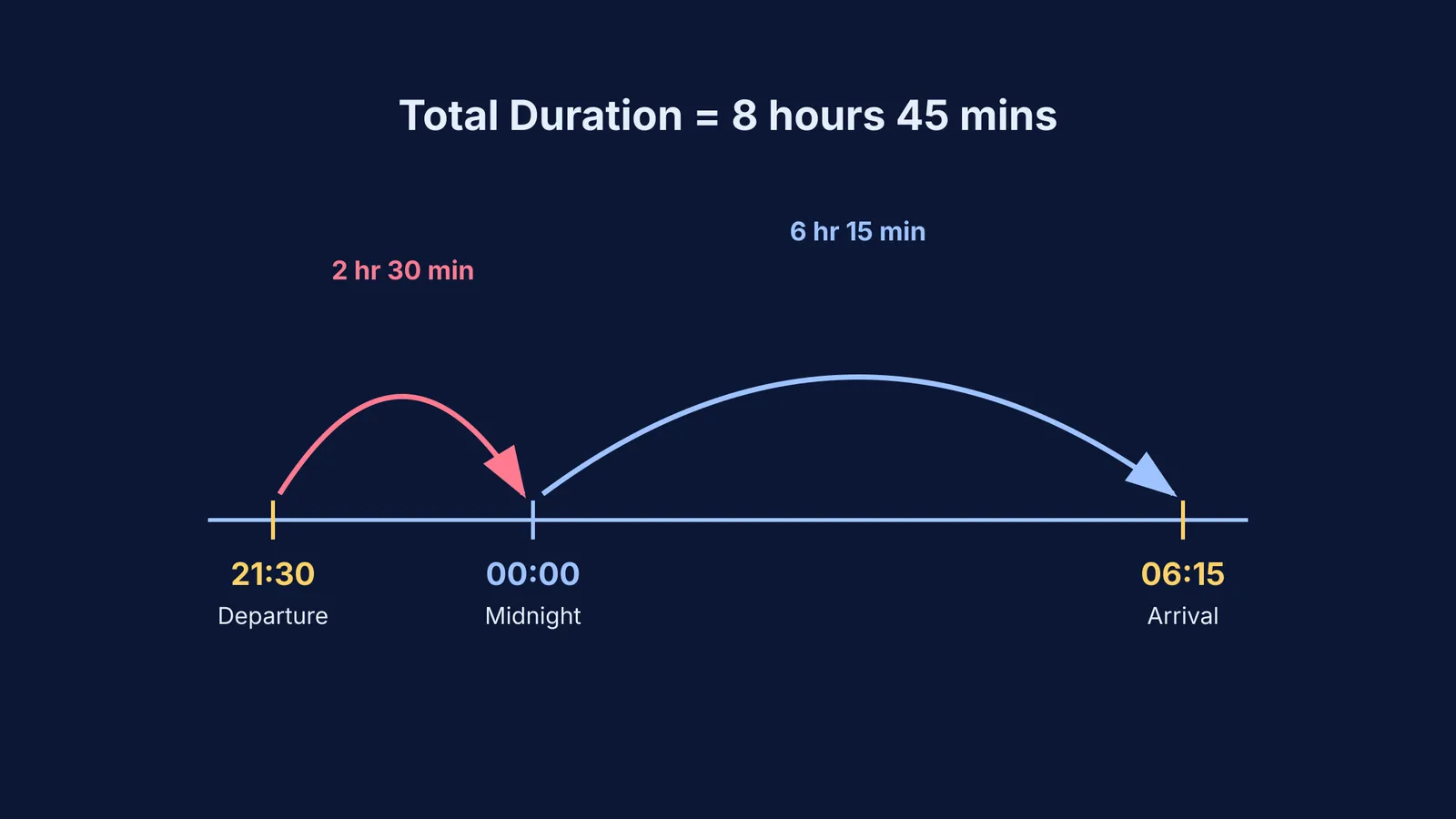
Example: A flight leaves at 21:30 and lands at 06:15 the next day. How long is the flight?
Instead of trying to subtract directly, break the calculation into two jumps.
Step 1: Jump from the start time to midnight. Midnight is 24:00. Subtract the start time (21:30) from 24:00. Borrow an hour: 24:00 becomes 23:60. Minutes: 60 − 30 = 30 minutes. Hours: 23 − 21 = 2 hours. *Time to midnight = 2 hours and 30 minutes.*
Step 2: Add the time from midnight to the end time. Because midnight is 00:00, the time from midnight to 06:15 is exactly 6 hours and 15 minutes.
Step 3: Add the two durations together. 2 hours 30 minutes + 6 hours 15 minutes = 8 hours and 45 minutes.
How do you use the "add 24 hours" method?
If you prefer a single subtraction, you can use the 24-hour method. Because the arrival is on the next day, add 24 hours to the end time before subtracting.
For the same flight landing at 06:15, add 24 hours to make it 30:15. Now subtract the start time (21:30) from 30:15.
Borrow 1 hour from 30, making it 29. Add 60 minutes to 15, making it 75.
Subtract the minutes: 75 − 30 = 45 minutes.
Subtract the hours: 29 − 21 = 8 hours.
The answer is exactly the same: 8 hours and 45 minutes.
If you are practicing for competitive exams, you might also need to solve time and work problems or work out the true time on a clock that gains 5 minutes every hour.
Checking your work with Fermi
If you are stuck on a physics or maths problem that relies on schedules or rates, an AI tutor can walk you through it. When you enter a question into the Fermi Problem Library, the step-by-step solver explains the reasoning rather than just printing an answer. Fermi's AI tutor works out what you already know and builds a plan for the session, so you sit down to a clear next step.


