

On this page
Clock-related puzzles are a staple of competitive aptitude exams, testing both your arithmetic speed and your ability to visualize time algebraically. One of the most common variants introduces a mechanical error—a clock that runs too fast or too slow—and asks you to recover the true time.
Instead of computing the exact angular speeds of the hour and minute hands, you can solve these problems quickly by establishing a ratio between the faulty clock and a true clock.
Why do we use a ratio of clock time to true time?
According to study materials from Unacademy, the minute hand of a correct clock moves at 6° per minute. Because it gains 5.5° on the hour hand each minute, the hands naturally coincide every 65 5/11 minutes. When a clock is poorly calibrated, it breaks this rhythm, traversing more or less "clock time" than the universe's true time.
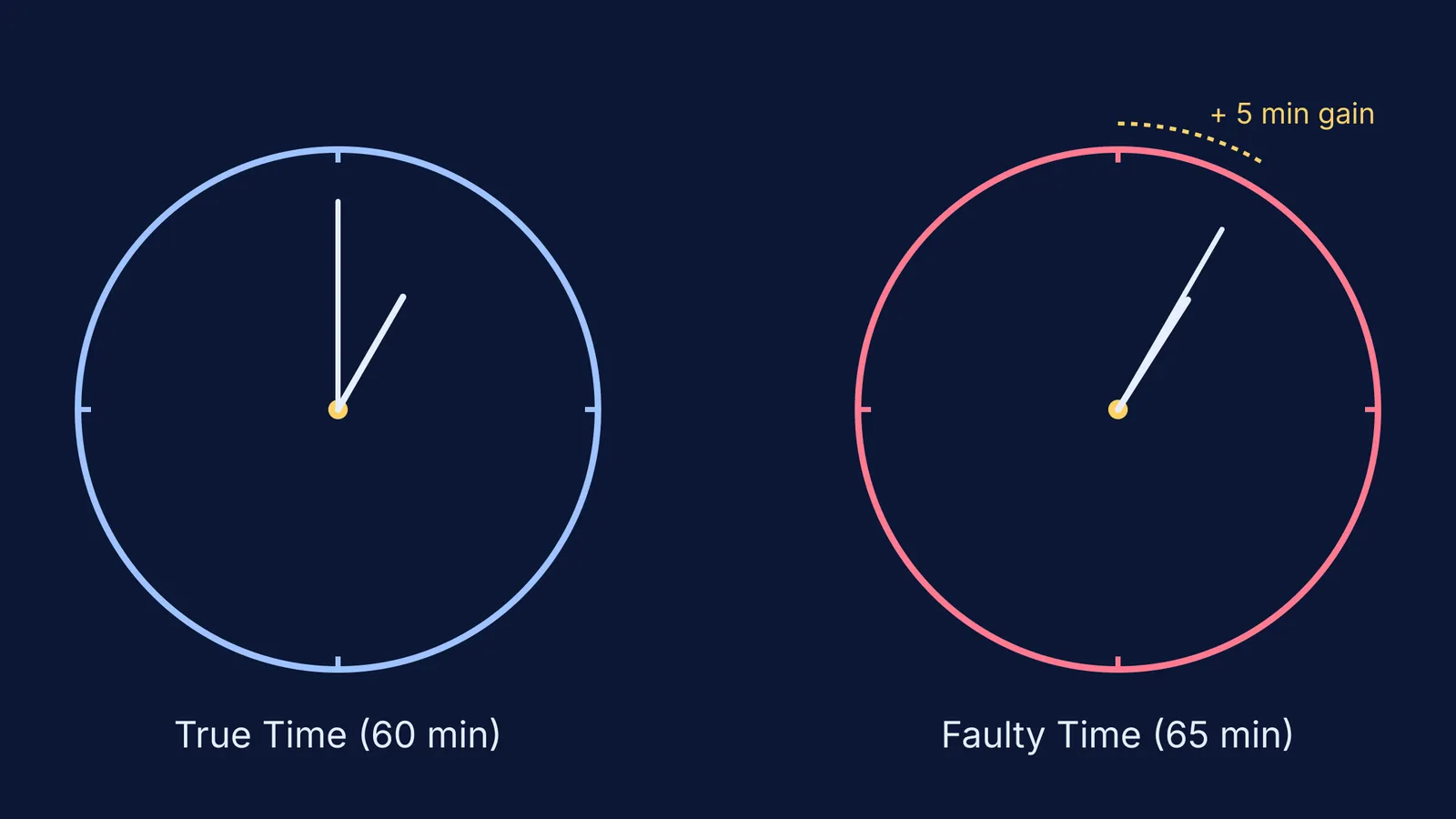
If a clock gains 5 minutes every hour, it registers 65 minutes on its face during a period when exactly 60 minutes have elapsed in reality. Because both the true clock and the faulty clock run at constant (though different) speeds, their times will always stay in a fixed ratio:
Faulty Time : True Time = 65 : 60 = 13 : 12
This means for every 13 units of time the faulty clock measures, only 12 units have actually passed.
A clock gains 5 minutes every hour find the correct time?
To find the correct time when you only have a fast-running clock, follow these three steps:
Find the total time elapsed on the faulty clock.
Multiply that elapsed time by the ratio of true time to faulty time (12/13).
Add the resulting true duration to the starting time.
Worked Example: A clock gains 5 minutes every hour. It is set to the correct time at 8:00 a.m. What is the true time when the faulty clock shows 9:00 p.m. that same day?
Step 1: The faulty clock moves from 8:00 a.m. to 9:00 p.m. This is exactly 13 hours (or 780 minutes) of faulty elapsed time.
Step 2: Scale this back to reality. True elapsed time = 780 minutes × (12 / 13) = 720 minutes.
Step 3: 720 minutes is exactly 12 hours. Adding 12 hours to the 8:00 a.m. start time brings us to 8:00 p.m.
The true time is exactly 8:00 p.m.
If you are stuck on similar competitive exam problems—whether calculating relative speeds or finding coincidence intervals—the Fermi Problem Library has worked problems with a step-by-step solver that explains the reasoning rather than simply printing an answer.
What if the clock loses 5 minutes every hour?
The logic reverses perfectly for a slow clock. If a clock loses 5 minutes every hour, it only manages to display 55 minutes of movement for every 60 minutes of true time.
Faulty Time : True Time = 55 : 60 = 11 : 12
To find the true time from this losing clock, you scale the faulty interval *forward* by multiplying by 12/11.
Worked Example: A clock loses 5 minutes every hour. It is set right at 10:00 a.m. What is the true time when the clock indicates 7:10 p.m. that evening?
Step 1: The faulty clock moves from 10:00 a.m. to 7:10 p.m. This is 9 hours and 10 minutes, or 550 minutes of faulty elapsed time.
Step 2: True elapsed time = 550 minutes × (12 / 11) = 600 minutes.
Step 3: 600 minutes is exactly 10 hours. Adding 10 hours to 10:00 a.m. gives 8:00 p.m.
Mechanical causes for these variations often relate to the physical properties of the clock itself. For instance, a pendulum clock losing time in summer does so because thermal expansion lengthens the rod, increasing its period. Ever since Christiaan Huygens and his pendulum clock brought precision to timekeeping, mathematicians have enjoyed exploring the algebra of when clocks fail.
If you struggle to set up these ratios, Fermi's AI tutor can help. A student can bring a problem set or a scanned assignment, and the tutor works out what they already know, builds a plan for the session, and teaches through it—checking understanding as it goes.


