On this page
Most paper starts as wood or plant fibre cooked in a hot alkaline solution. That solution is expensive, so a mill does not pour it away after one use. It runs two chemical loops that turn the spent liquor back into fresh alkali, and almost every step in those loops is a reaction from your Class 11 inorganic chapters: reduction with carbon, salt hydrolysis, a precipitation driven by Ksp, and the thermal decomposition of limestone.
What is the kraft process and what is white liquor?
The kraft process (kraft is German and Swedish for "strength") is the main way wood is turned into pulp. Chips are cooked in white liquor, which the Wikipedia article on the kraft process describes as an aqueous solution of sodium hydroxide and sodium sulphide. The hot alkali breaks down lignin, the glue-like polymer that holds wood fibres together, and the cellulose fibres come free. Removing lignin is also what keeps good paper from yellowing, the problem explained in why the pages of old books turn yellow.
After cooking, the liquid that drains away is dark brown and is called black liquor. It holds the dissolved lignin and other wood organics, plus almost all the sodium and sulphur that went in.
How does the recovery boiler turn black liquor back into Na₂S?
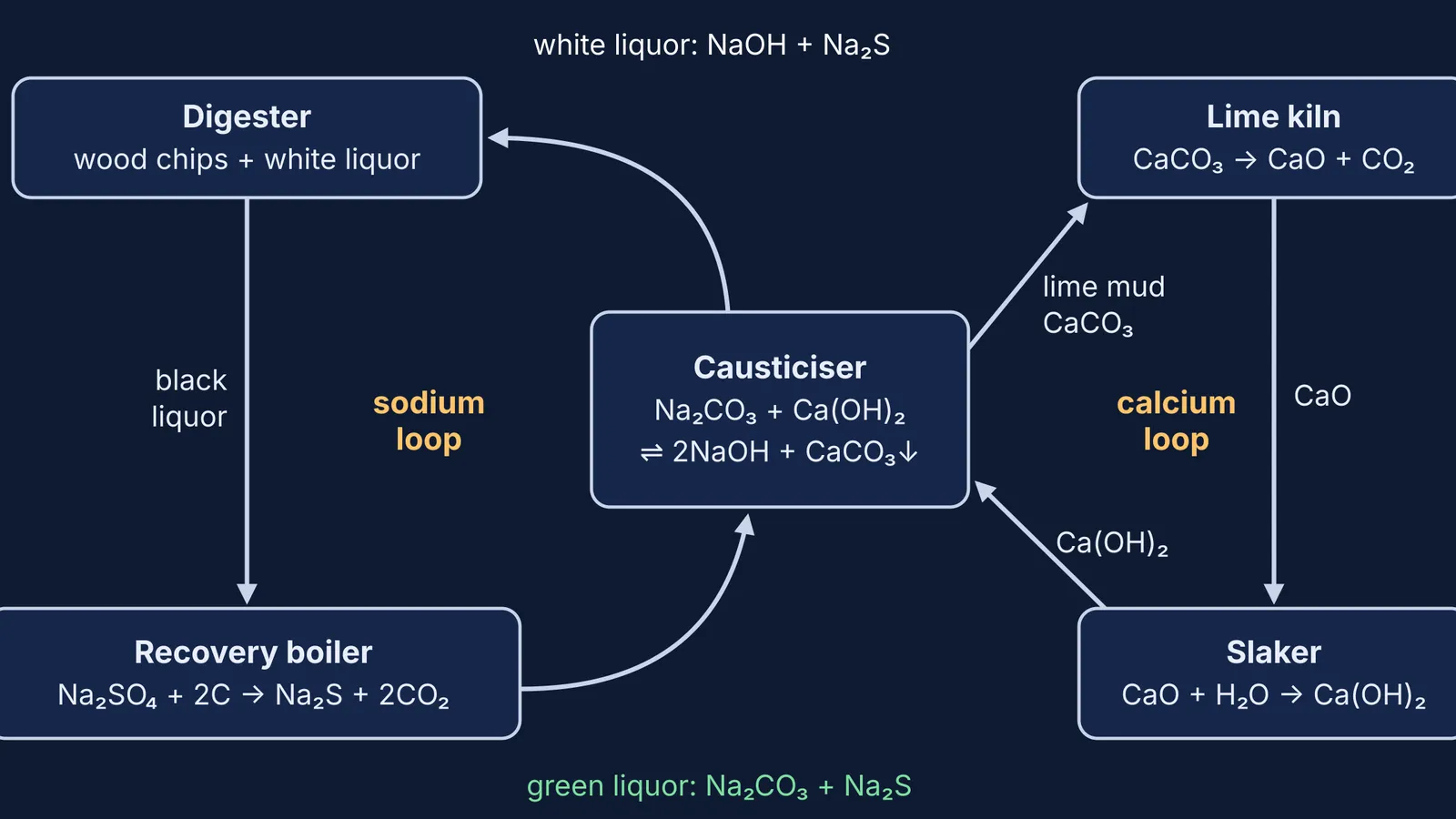
Black liquor is evaporated until it is thick enough to burn, then sprayed into a recovery boiler. Two things happen at once.
The organics burn and supply heat. The dissolved wood is the fuel.
Sulphate is reduced to sulphide. Sodium sulphate, including the make-up chemical added to replace losses, is reduced by carbon from the char: Na₂SO₄ + 2C → Na₂S + 2CO₂. The kraft process article gives this equation.
That reduction is the furnace step of the Leblanc soda process, still running today. But the whole boiler is not a reducing furnace. Reduction happens in the hot char bed at the bottom, which is kept short of air. Extra air is added higher up to burn the gases off completely.
The molten salts that run out of the bottom are called smelt, mostly Na₂CO₃ and Na₂S. Dissolved in water, the smelt gives green liquor, named for its colour (fine iron sulphide particles tint it).
How does lime turn green liquor into white liquor?
Green liquor has the right sulphide but the wrong alkali: carbonate instead of hydroxide. Slaked lime fixes that in the causticiser:
Na₂CO₃ + Ca(OH)₂ ⇌ 2NaOH + CaCO₃↓
Two sparingly soluble calcium salts compete for Ca²⁺, and CaCO₃ is far less soluble than Ca(OH)₂, so carbonate is pulled out as a solid. The equilibrium constant is a ratio of two Ksp values, the method explained in turning one precipitate into another with a ratio of Ksp values. With NCERT's Ksp(CaCO₃) = 2.8 × 10⁻⁹ and Ksp(Ca(OH)₂) of about 5 × 10⁻⁶ (tables vary):
K = [OH⁻]² / [CO₃²⁻] = Ksp(Ca(OH)₂) / Ksp(CaCO₃) ≈ 2 × 10³
K is large, but it is not infinite, and [OH⁻] enters squared. As NaOH builds up, the back reaction gets stronger, so the reaction stops short and some Na₂CO₃ stays in the white liquor. The kraft article calls causticising an equilibrium reaction for this reason. In liquor this concentrated, ideal Ksp maths is only a rough guide.
The solid CaCO₃, called lime mud, is filtered off and burnt in a lime kiln: CaCO₃ → CaO + CO₂. The quicklime is slaked, CaO + H₂O → Ca(OH)₂, and goes back to the causticiser. That is the calcium loop. It is the same lime chain the Solvay process uses, but there it recovers ammonia, and here it makes NaOH from Na₂CO₃.
Why does Na₂S count as half a NaOH?
Sulphide is the anion of a very weak acid, so it hydrolyses almost completely in water:
S²⁻ + H₂O ⇌ HS⁻ + OH⁻
Each Na₂S therefore gives one OH⁻. HS⁻ hardly hydrolyses further, so the second step adds almost nothing. That is why mills use two measures of strength. The white liquor article defines them:
Active alkali (AA) = NaOH + Na₂S
Effective alkali (EA) = NaOH + ½Na₂S, the hydroxide the cook actually sees
Sulphidity = Na₂S / (NaOH + Na₂S)
Causticity = NaOH / (NaOH + Na₂CO₃), how far causticising went
To add NaOH and Na₂S, both must be in the same unit. The common convention (TAPPI's) reports every sodium compound as the mass of Na₂O it corresponds to, the same "report as oxide" habit you see on fertiliser labels. Some mills report as NaOH instead, so always check the basis before comparing numbers.
Worked example: how strong is this white liquor?
Take teaching numbers (real liquors vary): white liquor with 80 g L⁻¹ NaOH and 30 g L⁻¹ Na₂S. Molar masses: NaOH 40.0, Na₂S 78.0, Na₂O 62.0 g mol⁻¹.
NaOH as Na₂O. Two NaOH carry the sodium of one Na₂O, so 80 × 62.0 / (2 × 40.0) = 80 × 31.0/40.0 = 62.0 g L⁻¹.
Na₂S as Na₂O. One Na₂S carries the sodium of one Na₂O, so 30 × 62.0/78.0 = 23.8 g L⁻¹.
Active alkali. 62.0 + 23.8 = 85.8 g L⁻¹ as Na₂O.
Effective alkali. 62.0 + ½ × 23.8 = 73.9 g L⁻¹ as Na₂O.
Sulphidity. 23.8/85.8 = 0.277, or about 27.7%.
Now the lime. How much CaO does it take to causticise 1.00 kg of Na₂CO₃ (106.0 g mol⁻¹)?
Moles of carbonate. 1000/106.0 = 9.43 mol.
CaO needed (1:1 through Ca(OH)₂). 9.43 × 56.1 = 529 g, so 0.529 kg.
NaOH formed (1:2). 2 × 9.43 × 40.0 = 755 g, so 0.755 kg.
Lime mud formed (1:1). 9.43 × 100.1 = 944 g, so 0.944 kg of CaCO₃ to send back to the kiln.
These are ideal figures. Suppose the causticity is only 80% (again a teaching number). With 62.0 g L⁻¹ of NaOH as Na₂O, the liquor then also holds 62.0/0.80 − 62.0 = 15.5 g L⁻¹ of Na₂CO₃ as Na₂O, which is 15.5 × 106.0/62.0 = 26.5 g L⁻¹ of Na₂CO₃. Mills call this dead load: sodium that circulates without pulping anything.
If chains of mole ratios trip you up, the Fermi Problem Library has worked problems with a step-by-step solver that explains the reasoning at each line.
Does every paper mill recover its chemicals?
No. A large kraft mill must recover its chemicals, or it would buy the sodium and sulphur again every day. Smaller mills that pulp agricultural residues such as bagasse or straw may not have a recovery boiler at all, and their black liquor is then a waste stream rather than a fuel. That is one reason black liquor discharge has been a pollution concern.
Quick checklist
White liquor = NaOH + Na₂S; black liquor = spent liquor with dissolved lignin; green liquor = Na₂CO₃ + Na₂S.
Recovery boiler: organics burn for heat, and Na₂SO₄ + 2C → Na₂S + 2CO₂ in the reducing char bed.
Causticiser: Na₂CO₃ + Ca(OH)₂ ⇌ 2NaOH + CaCO₃↓, an equilibrium that stops short.
Lime kiln and slaker close the calcium loop: CaCO₃ → CaO + CO₂, then CaO + H₂O → Ca(OH)₂.
Na₂S counts fully in active alkali and half in effective alkali, because S²⁻ + H₂O ⇌ HS⁻ + OH⁻.
Report everything as Na₂O (or everything as NaOH) before you add or divide.