

On this page
Shake white silver chloride with a solution of potassium iodide and, within a minute or two, the solid turns pale yellow. The solid simply changed into another solid. JEE Advanced likes this kind of question because one idea settles it: the equilibrium constant for turning one precipitate into another is a ratio of two solubility products.
Our post on which salt precipitates first when silver nitrate is added deals with the order in which solids appear. This post asks the next question: what happens to a solid that has already formed?
How do you write K for converting one precipitate into another?
Take the silver chloride case. The overall change is:
AgCl(s) + I⁻(aq) ⇌ AgI(s) + Cl⁻(aq)
Solids do not appear in K, so K = [Cl⁻]/[I⁻]. Now build that reaction from two dissolution equilibria you already know:
AgCl(s) ⇌ Ag⁺ + Cl⁻, with Ksp(AgCl) = [Ag⁺][Cl⁻]
Ag⁺ + I⁻ ⇌ AgI(s), the reverse of AgI dissolving, with K = 1/Ksp(AgI)
Add the two equations and Ag⁺ cancels. Multiply the two constants:
K = Ksp(AgCl)/Ksp(AgI)
You can check it directly. Divide [Ag⁺][Cl⁻] by [Ag⁺][I⁻] and the shared silver ion drops out, leaving [Cl⁻]/[I⁻]. That is the same cancelling trick used for simultaneous solubility of AgCl and AgBr, but here you use it to ask which solid survives.
The rule in words: the solid you start with goes on top, the solid you end with goes underneath. A large K means the conversion runs almost to completion.
Why does white AgCl turn yellow in iodide solution?
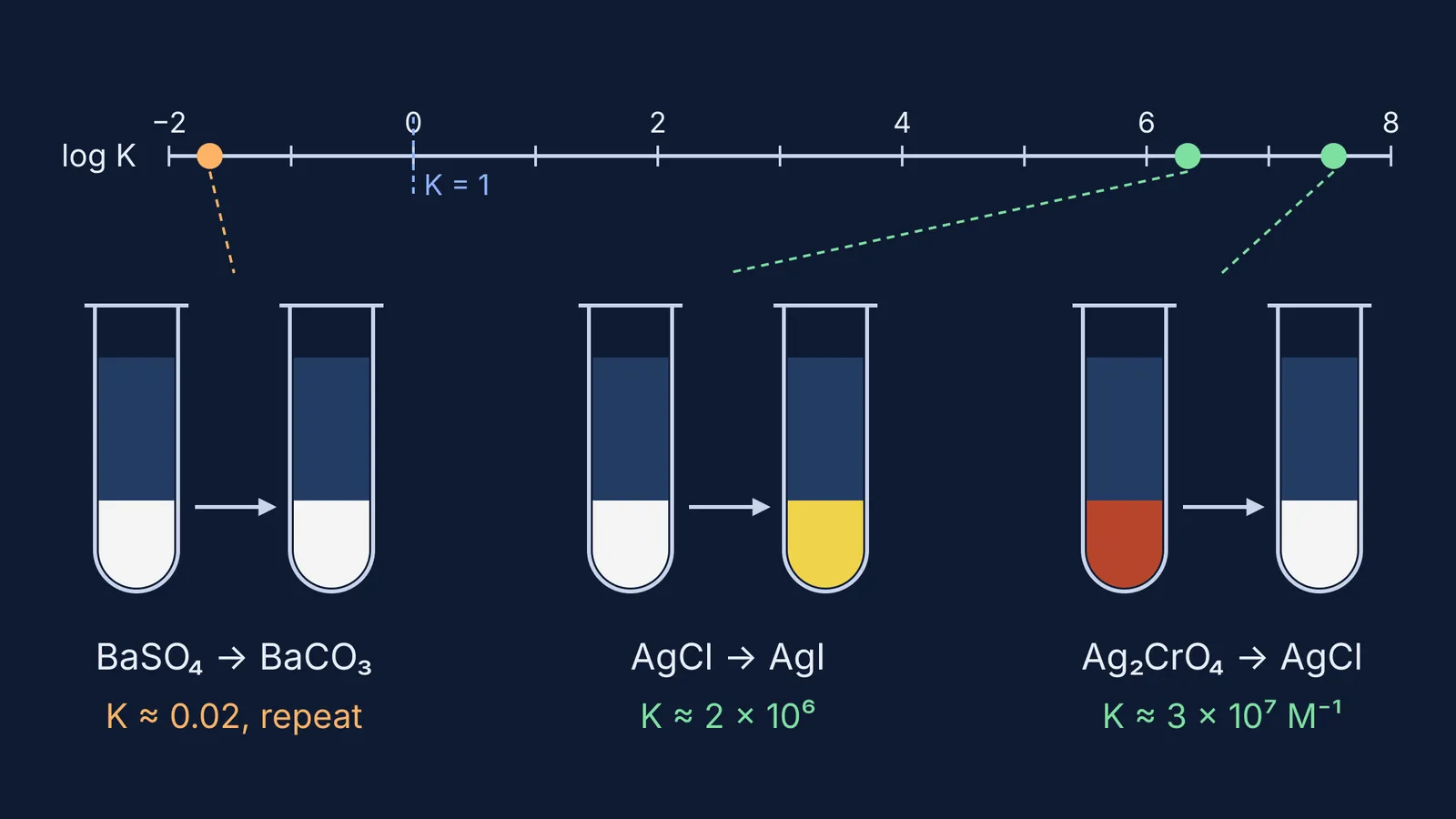
With the values in NCERT Class 11 Equilibrium, Table 6.9 (298 K), Ksp(AgCl) = 1.8 × 10⁻¹⁰ and Ksp(AgI) = 8.3 × 10⁻¹⁷. So:
K = 1.8 × 10⁻¹⁰ / 8.3 × 10⁻¹⁷ ≈ 2.2 × 10⁶
At equilibrium the chloride concentration is about two million times the iodide concentration. If you shake excess AgCl with 0.10 M KI, the iodide left in solution is only about 0.10/(1 + 2.2 × 10⁶) ≈ 5 × 10⁻⁸ M. Practically every iodide ion ends up in yellow AgI, and the same number of chloride ions are set free. The white solid turns yellow.
Both salts have the same formula type (1:1), so here the smaller Ksp really does mean the less soluble salt. That is why the conversion only runs one way: shaking AgI with chloride solution gives K ≈ 5 × 10⁻⁷, and nothing happens.
Can a precipitate convert when K is less than 1?
Yes, if you push hard enough. This is the reason the sodium carbonate extract works on barium sulphate:
BaSO₄(s) + CO₃²⁻(aq) ⇌ BaCO₃(s) + SO₄²⁻(aq)
K = Ksp(BaSO₄)/Ksp(BaCO₃) = [SO₄²⁻]/[CO₃²⁻]
NCERT gives Ksp(BaSO₄) = 1.1 × 10⁻¹⁰. Barium carbonate is not in Table 6.9, and published values vary, from about 2.6 × 10⁻⁹ to 8 × 10⁻⁹. With the commonly quoted 5.1 × 10⁻⁹:
K = 1.1 × 10⁻¹⁰ / 5.1 × 10⁻⁹ ≈ 0.022
This is uphill. At equilibrium there is only about one sulphate ion for every 46 carbonate ions. BaSO₄ does not dissolve in sodium carbonate. The solid changes identity, and the sulphate moves into the liquid, where you can test for it. Our post on the sodium carbonate extract for anion analysis describes the lab method; the numbers below show why boiling with excess soda, and repeating, matters.
Worked example: how many treatments convert 0.10 mol of BaSO₄?
You have excess solid BaSO₄ and you treat it with 1.0 L of 1.0 M Na₂CO₃. How much converts? How many fresh portions do you need to convert 0.10 mol?
Set up the mass balance. Let x mol of BaSO₄ convert. Each conversion uses one CO₃²⁻ and releases one SO₄²⁻. In 1.0 L, [SO₄²⁻] = x and [CO₃²⁻] = 1.0 − x.
Write K with both terms. x/(1.0 − x) = 0.022. Do not write K = x. The carbonate you use up and the sulphate you release both work against further conversion, and the mass balance keeps track of both.
Solve. x = 0.022/(1 + 0.022) ≈ 0.021 mol. One treatment converts about 0.021 mol of BaSO₄.
Pour off the liquid and repeat. Removing the sulphate-rich solution and adding fresh carbonate resets the system. Each portion converts about another 0.021 mol, as long as solid BaSO₄ remains.
Count portions. 0.10/0.021 ≈ 4.7, so you need about 5 fresh portions.
Activities at 1 M are far from concentrations, so treat 0.021 as approximate. And if you use Ksp(BaCO₃) = 2.6 × 10⁻⁹ instead, K ≈ 0.042 and about 3 portions do the job. The conclusion does not change: the reaction is uphill, so you win by using a large excess of carbonate and replacing the liquid, not by waiting.
Why does the red colour in a Mohr titration fade while chloride remains?
In the Mohr method you titrate chloride with silver nitrate, using a little potassium chromate as indicator. Where each drop of AgNO₃ lands, a flash of brick-red Ag₂CrO₄ appears, then fades when you swirl. The conversion explains why:
Ag₂CrO₄(s) + 2Cl⁻(aq) ⇌ 2AgCl(s) + CrO₄²⁻(aq)
Now the formula types differ. Two AgCl form for each Ag₂CrO₄, so the Ksp of AgCl is squared:
K = Ksp(Ag₂CrO₄)/[Ksp(AgCl)]² = [CrO₄²⁻]/[Cl⁻]²
With NCERT's values, Ksp(Ag₂CrO₄) = 1.1 × 10⁻¹² and Ksp(AgCl) = 1.8 × 10⁻¹⁰:
K = 1.1 × 10⁻¹² / (1.8 × 10⁻¹⁰)² = 1.1 × 10⁻¹² / 3.24 × 10⁻²⁰ ≈ 3.4 × 10⁷ M⁻¹
The units are M⁻¹, because K = [CrO₄²⁻]/[Cl⁻]². With 0.005 M chromate, red Ag₂CrO₄ stays only when [Cl⁻]² is below 0.005/3.4 × 10⁷, which means [Cl⁻] below about 1.2 × 10⁻⁵ M. While more chloride than that is left, every red speck turns back into white AgCl. The red colour stays only when nearly all the chloride is gone, which is what makes chromate a working end-point indicator.
This case also shows why you cannot compare a 1:1 salt and a 2:1 salt by Ksp alone. Ag₂CrO₄ has the smaller Ksp, yet it is the one that converts to AgCl.
Where else does this K show up?
Boiler scale and gypsum chemistry run on the same idea. Calcium sulphate meeting carbonate:
CaSO₄(s) + CO₃²⁻ ⇌ CaCO₃(s) + SO₄²⁻, with K = 9.1 × 10⁻⁶ / 2.8 × 10⁻⁹ ≈ 3.3 × 10³
This one runs strongly forward. It is why washing soda turns hard sulphate scale into calcium carbonate, and why gypsum spread on alkaline, sodium-rich soil locks up carbonate as CaCO₃.
If you want to practise building these ratios for new pairs of salts, the Fermi Problem Library has worked problems with a step-by-step solver that explains the reasoning rather than printing an answer.
Quick checklist
Write the conversion with solids on both sides; K contains only the two anions.
K = Ksp(starting solid)/Ksp(product solid), with powers that match the equation.
Different formula types give K with units, here M⁻¹; square Ksp(AgCl) in the Mohr case.
K far above 1: one treatment converts almost everything (AgCl to AgI).
K below 1: use x/(c − x), a large excess and repeated fresh portions (BaSO₄ to BaCO₃).
Say the solid changes identity; do not say it dissolves.
Ksp tables differ, so state your source and call the answer approximate.


