

On this page
When you add silver nitrate (AgNO₃) to a solution containing multiple anions—like chloride, iodide, and chromate—they do not all precipitate at once. Instead, they form solid salts in a strict sequence.
This is a classic question in competitive exams like JEE and NEET, and a fundamental principle in analytical chemistry. To find out which salt precipitates first, you cannot simply look at which solubility product constant (Ksp) is the numerically smallest. You must calculate the exact silver ion concentration, [Ag⁺], required to trigger precipitation for each specific salt.
If you struggle with how stoichiometries affect solubility, the Fermi Concept Library holds every concept in physics, chemistry, biology, mathematics and computing, each with its own lesson and its place in the map.
Which salt precipitates first when silver nitrate is added?
Precipitation begins the moment the ionic product of the solution exceeds the Ksp of the salt.
For a generic silver salt, you set up the equilibrium expression and solve for [Ag⁺]. The salt that requires the lowest concentration of Ag⁺ to reach its Ksp will be the first to crash out of the solution as a solid.
To compare them fairly, we assume the anions are present in the mixture at equal concentrations. For this example, let us assume our mixture contains 0.1 M each of iodide (I⁻), chloride (Cl⁻), and chromate (CrO₄²⁻).
Calculating required [Ag⁺] for silver halides
Silver halides share a simple 1:1 stoichiometry. The equilibrium is AgX(s) ⇌ Ag⁺(aq) + X⁻(aq), making the calculation straightforward: [Ag⁺] = Ksp / [X⁻].
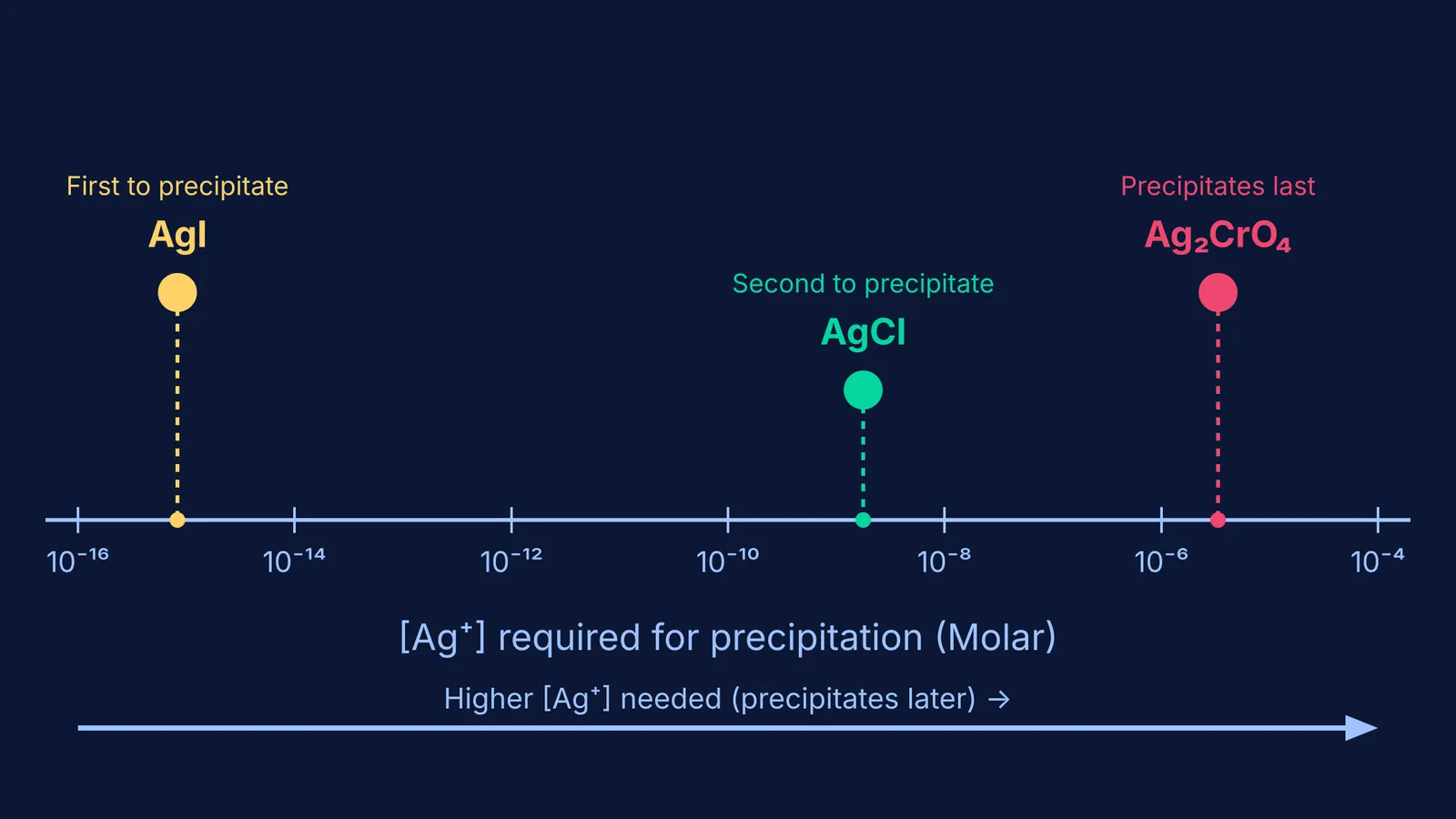
According to standard chemical data, the Ksp of silver iodide (AgI) is 8.3 × 10⁻¹⁷ at room temperature (Source). For our 0.1 M iodide solution, the required silver concentration is: [Ag⁺] = (8.3 × 10⁻¹⁷) / 0.1 = 8.3 × 10⁻¹⁶ M
The Ksp of silver chloride (AgCl) is 1.77 × 10⁻¹⁰ (Source). For the 0.1 M chloride solution, the required silver concentration is: [Ag⁺] = (1.77 × 10⁻¹⁰) / 0.1 = 1.77 × 10⁻⁹ M
Because 8.3 × 10⁻¹⁶ M is much smaller than 1.77 × 10⁻⁹ M, silver iodide will precipitate as a yellow solid long before the white silver chloride begins to form.
Why does silver chromate precipitate last?
Silver chromate (Ag₂CrO₄) introduces a 2:1 stoichiometry. Its dissociation equation is Ag₂CrO₄(s) ⇌ 2Ag⁺(aq) + CrO₄²⁻(aq), which means its solubility product expression squares the silver concentration: Ksp = [Ag⁺]² × [CrO₄²⁻].
The Ksp of silver chromate is 1.12 × 10⁻¹² (Source). To find the required silver concentration for a 0.1 M chromate solution, we rearrange the formula and take the square root: [Ag⁺] = √((1.12 × 10⁻¹²) / 0.1) = √(1.12 × 10⁻¹¹) ≈ 3.35 × 10⁻⁶ M
Even though silver chromate has a Ksp (10⁻¹²) that looks numerically smaller than silver chloride's Ksp (10⁻¹⁰), the squared term changes everything. It requires a significantly higher concentration of silver ions (~3.35 × 10⁻⁶ M) to precipitate.
A checklist for precipitation problems
When you face a "which precipitates first" question, do not guess based on Ksp alone. Follow this routine:
Write the expressions: Write out the balanced dissociation equation and the Ksp expression for each salt.
Plug in the anions: Substitute the given concentration of the anion into each expression.
Solve for the cation: Calculate the exact [Ag⁺] (or whichever cation is being added) needed to reach saturation. Remember to take square or cube roots if the stoichiometry requires it.
Rank the results: Order the salts from the lowest required cation concentration (precipitates first) to the highest (precipitates last).
If you are preparing for exams and frequently get caught out by stoichiometry traps, Fermi's AI tutor works out what you already know, builds a plan for the session, and teaches through it—checking your understanding as it goes.
You can read our guide on heterogeneous equilibria to review why solids are omitted from Ksp expressions. You can also explore how shifts in concentration trigger precipitation using reaction quotient Q vs K, or see how similar competitive principles apply in back titration calculations.


