

On this page
In short
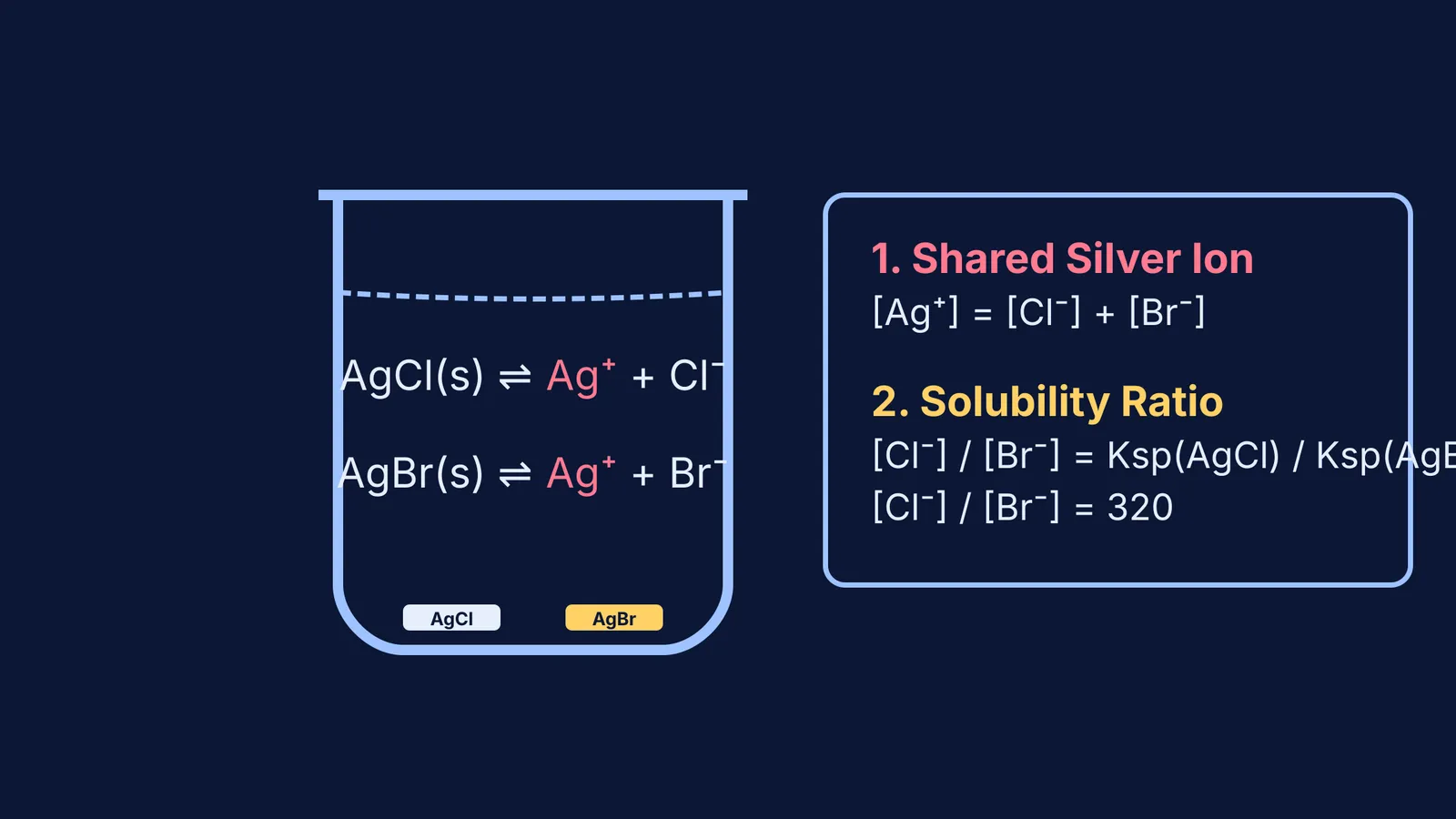
When silver chloride and silver bromide dissolve together, they share a single silver ion concentration in the beaker. Because AgCl is more soluble, it dominates this common ion, suppressing the solubility of AgBr by a factor of 18 compared to pure water.
When two sparingly soluble salts that share an ion are placed in water, they do not dissolve independently. They compete to satisfy their equilibrium constants, and one often shuts the other down. A classic scenario asks for the simultaneous solubility of silver chloride (AgCl) and silver bromide (AgBr) in the same beaker.
What happens when AgCl and AgBr dissolve together?
Normally, if you put solid AgBr in pure water, it dissolves until the product of [Ag⁺] and [Br⁻] reaches its solubility product constant (Ksp). According to the OpenStax Chemistry textbook, the Ksp of AgBr at 25 °C is 5.0 × 10⁻¹³ [https://openstax.org/books/chemistry-2e/pages/j-solubility-products]. This gives a molar solubility of 7.07 × 10⁻⁷ M in pure water.
AgCl is significantly more soluble. Its Ksp is 1.6 × 10⁻¹⁰ [https://openstax.org/books/chemistry-2e/pages/j-solubility-products]. In pure water, its solubility is 1.26 × 10⁻⁵ M.
But when both solids are present in the same beaker, they must share the silver ion. This is an extreme version of the common ion effect. The more soluble salt (AgCl) floods the water with Ag⁺ ions. Because the Ksp of AgBr is fixed, this massive excess of Ag⁺ forces the AgBr equilibrium backwards, drastically reducing how much bromide can dissolve.
How do you set up the Ksp expressions with a shared [Ag⁺]?
To find the exact concentrations, we set up the expressions simultaneously. Let x be the concentration of chloride ions, [Cl⁻], and let y be the concentration of bromide ions, [Br⁻].
Every chloride ion in solution leaves behind one silver ion, and every bromide ion leaves behind one silver ion. Therefore, the total silver ion concentration is the sum of both: [Ag⁺] = x + y
Now we write the two equilibrium equations, making sure to use the total [Ag⁺] in both:
Ksp for AgCl = (x + y)x = 1.6 × 10⁻¹⁰
Ksp for AgBr = (x + y)y = 5.0 × 10⁻¹³
This looks like a messy quadratic system, but there is a straightforward trick to solve it, and working through the steps in the Fermi Problem Library will show you the exact reasoning for any pair of salts.
How do you calculate simultaneous solubility?
Using the Ksp values from OpenStax, if we divide the first equation by the second, the messy (x + y) term cancels out entirely:
[(x + y)x] / [(x + y)y] = (1.6 × 10⁻¹⁰) / (5.0 × 10⁻¹³) x / y = 320
This tells us that the chloride concentration will be exactly 320 times higher than the bromide concentration. We can substitute x = 320y back into the AgBr equation: (320y + y)y = 5.0 × 10⁻¹³ 321y² = 5.0 × 10⁻¹³ y² = 1.56 × 10⁻¹⁵ y = 3.95 × 10⁻⁸ M
So, the solubility of AgBr in the mixture is 3.95 × 10⁻⁸ M. The solubility of AgCl is x = 320y = 1.26 × 10⁻⁵ M. The total [Ag⁺] is 321y = 1.27 × 10⁻⁵ M.
What happens if you add solid silver nitrate?
To fully test your grasp of the common ion effect, examination questions often throw a third chemical into the beaker, such as solid silver nitrate (AgNO₃).
Because silver nitrate is completely soluble, it introduces a large, independent source of silver ions. Let us say you add enough AgNO₃ to make the solution 0.1 M in Ag⁺ (a standard example akin to scenarios in OpenStax).
Now, the total silver ion concentration is no longer just x + y. It becomes 0.1 + x + y. Because the solubility of AgCl and AgBr is so tiny compared to 0.1 M, we can approximate the total [Ag⁺] simply as 0.1 M. The external silver ion completely takes over.
When we plug 0.1 M back into the Ksp expressions: [Cl⁻] = Ksp(AgCl) / 0.1 = (1.6 × 10⁻¹⁰) / 0.1 = 1.6 × 10⁻⁹ M [Br⁻] = Ksp(AgBr) / 0.1 = (5.0 × 10⁻¹³) / 0.1 = 5.0 × 10⁻¹² M
The ratio of their solubilities remains exactly the same—the chloride concentration is still 320 times the bromide concentration. However, their absolute solubilities have been crushed even further by the massive presence of the external silver ion.
Why does AgCl suppress AgBr so much?
Look at the final numbers from the simultaneous dissolution without the nitrate, drawing on the OpenStax constants. By itself, AgCl dissolves to 1.26 × 10⁻⁵ M. In the mixture, it dissolves to 1.26 × 10⁻⁵ M. Its solubility is almost completely unaffected.
AgBr, however, drops from 7.07 × 10⁻⁷ M down to 3.95 × 10⁻⁸ M. Its solubility is suppressed by a factor of 18 compared to pure water.
Because AgCl is roughly 320 times more soluble than AgBr, it dictates the silver ion concentration in the beaker. The AgCl behaves as if the AgBr is not even there. The AgBr, on the other hand, finds itself swimming in a solution flooded with Ag⁺, and its equilibrium shifts hard to the left to compensate.
Whenever you see two salts with drastically different Ksp values, the more soluble one will govern the common ion, a principle often tested alongside heterogeneous equilibria and reaction quotients. You can explore the mechanics behind these interacting systems in the Fermi Concept Library.


