On this page
In 1791 Nicolas Leblanc, a French surgeon and chemist, patented a way to make soda ash, sodium carbonate, from ordinary salt. It ran at factory scale, and its waste became an industrial pollution problem that Britain's government stepped in to control.
Who was Nicolas Leblanc?
According to his Wikipedia biography, he was born in Ivoy-le-Pré, France, in 1742, trained in surgery and in 1780 became physician to the household of the Duke of Orléans. The Wikipedia article on the Leblanc process says that in 1783 King Louis XVI and the French Academy of Sciences offered a prize of 2,400 livres for a method to make alkali from sea salt.
Sodium carbonate is still used in the glass, soap and paper industries, as your NCERT Class 10 Science chapter on acids, bases and salts lists. The same chapter explains that washing soda, Na2CO3·10H2O, is made by recrystallising sodium carbonate.
How did the Leblanc process make soda ash from salt?
The process ran in two stages, the second made of two reactions in one furnace, as the Leblanc process article summarises:
Salt is heated with sulphuric acid: 2NaCl + H2SO4 → Na2SO4 + 2HCl. The solid sodium sulphate was called salt cake; the hydrogen chloride left as a gas.
Salt cake is roasted with coal: Na2SO4 + 2C → Na2S + 2CO2.
The sodium sulphide reacts with limestone in the same furnace: Na2S + CaCO3 → Na2CO3 + CaS.
The furnace product, a mix of sodium carbonate and calcium sulphide, was called black ash; the soda was extracted from it with water.
The same article records that Leblanc patented the process in 1791 and that year built the first plant for the Duke at Saint-Denis, which began to produce 320 tons of soda a year.
What happened to Leblanc and his factory?
In 1794, during the French Revolution, the plant was seized with the rest of the Duke's estate and Leblanc's trade secrets were made public, the Leblanc process article says. Napoleon returned the plant in 1801, but Leblanc lacked the money to repair it and compete, and he died by suicide in 1806. (If you are going through a hard time yourself, Tele MANAS on 14416 offers free, confidential support in India.)
Why did the Leblanc process cause pollution?
The Leblanc process article puts it in numbers: for every 8 tons of soda ash, the process produced 5.5 tons of hydrogen chloride and 7 tons of calcium sulphide waste.
That solid waste, known as galligu, had no economic value. It was piled in heaps near the works, where it weathered to release hydrogen sulphide, the gas that smells of rotten eggs.
In 1863 the British Parliament passed the Alkali Act, which, the same article says, allowed no more than 5% of the hydrochloric acid made by alkali plants to be vented to the air. The Alkali Act 1863 received royal assent on 28 July 1863 and appointed an inspector and four sub-inspectors. Captured acid then became a raw material, the story behind the Deacon process for making chlorine from hydrogen chloride.
The Leblanc method was eventually replaced by the process the Belgian chemist Ernest Solvay developed in 1861; by 1900, 90% of the world's soda was made by the Solvay method, according to the Leblanc process article. Compare the reaction your NCERT chapter gives for baking soda, NaCl + H2O + CO2 + NH3 → NH4Cl + NaHCO3: it also starts from salt, but uses no sulphuric acid and gives off no hydrogen chloride.
Can you check the 5.5 tonnes of acid gas yourself?
Yes, with the mole concept; the historical figures come from the Leblanc process article. Use Na = 23, Cl = 35.5, H = 1, C = 12, O = 16, Ca = 40, S = 32.
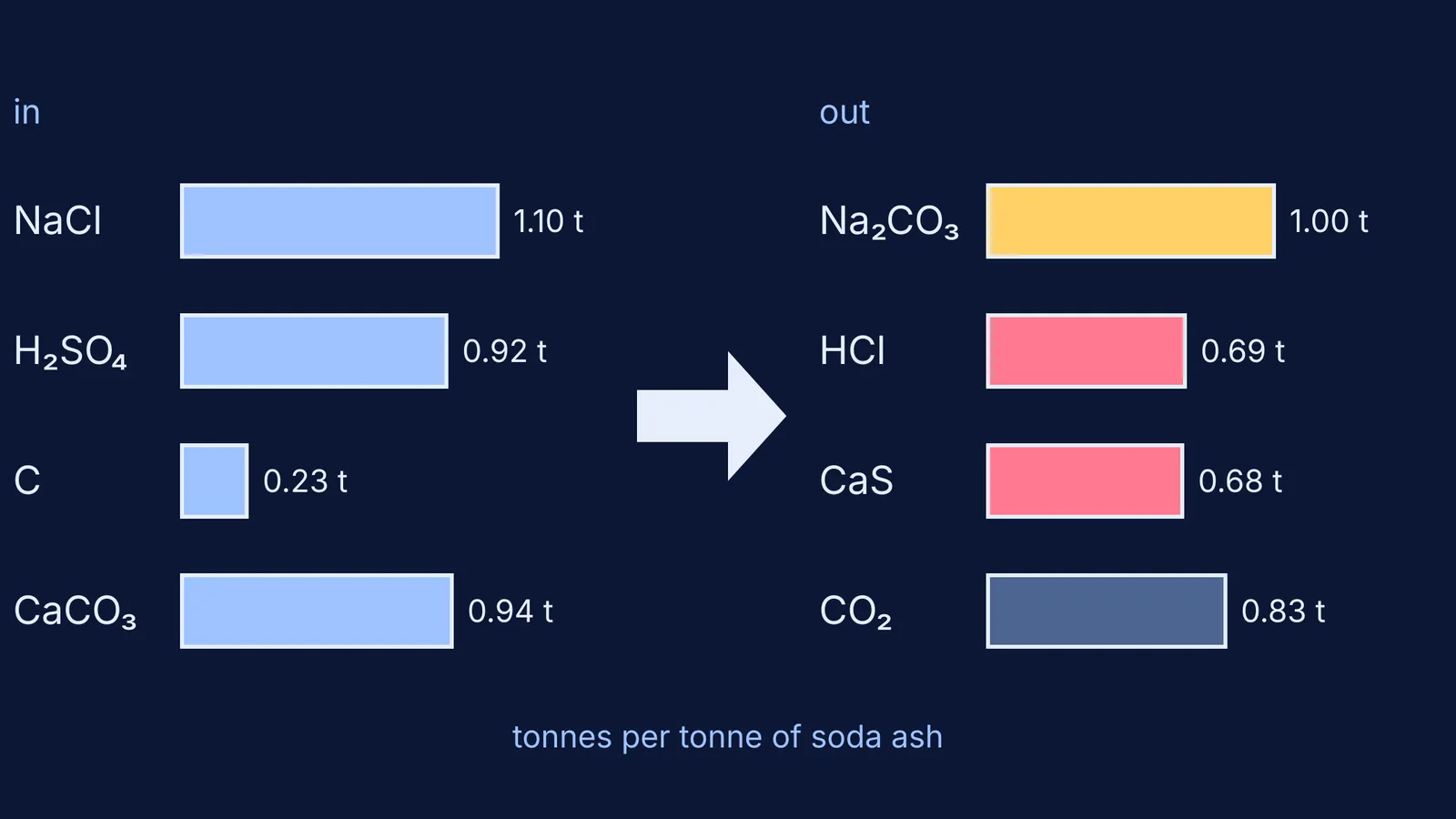
Add the three steps. Overall: 2NaCl + H2SO4 + 2C + CaCO3 → Na2CO3 + 2HCl + 2CO2 + CaS.
Molar masses: Na2CO3 = 106 g/mol, 2HCl = 73 g, CaS = 72 g/mol.
So 106 g of soda comes with 73 g of hydrogen chloride and 72 g of calcium sulphide.
Scale to 8 tonnes of soda: HCl = 8 × 73 ÷ 106 = 5.5 tonnes. The ideal equation matches the reported figure.
CaS = 8 × 72 ÷ 106 = 5.4 tonnes. The reported 7 tonnes of waste is larger, which suggests the real heap was not pure calcium sulphide.
An ideal equation gives a minimum; real factories do worse. Percentage-purity questions work the same way, as in our guide to solving stoichiometry problems with impure samples.
If you lose track in a chain of reactions like this one, the Fermi Problem Library has worked problems with a step-by-step solver that explains the reasoning rather than printing an answer, so you can see which ratio you used wrongly.
Next, compare Leblanc's route with the modern route from salt in the products of the chlor-alkali process at the anode and cathode.