

On this page
In short In the chlor-alkali process, electrolysing brine yields chlorine gas at the anode, hydrogen gas at the cathode, and sodium hydroxide near the cathode, as detailed in NCERT Class 10 Science. These three products are industrially vital, with chlorine used for water treatment, hydrogen for fuel and ammonia, and sodium hydroxide for soaps.
The chlor-alkali process is the industrial method used to produce sodium hydroxide, chlorine and hydrogen from an aqueous solution of sodium chloride. Because a concentrated sodium chloride solution is commonly known as brine, the process is often described simply as the electrolysis of brine.
The name "chlor-alkali" comes from its two main products: "chlor" stands for chlorine, and "alkali" stands for sodium hydroxide. The overall chemical reaction is:
2NaCl(aq) + 2H₂O(l) → 2NaOH(aq) + Cl₂(g) + H₂(g)
To see how ions migrate and form these products step by step, you can use the Fermi Concept Library, which covers every concept in physics, chemistry, biology, mathematics and computing, each with its own lesson and its place in the map.
What forms at the anode?
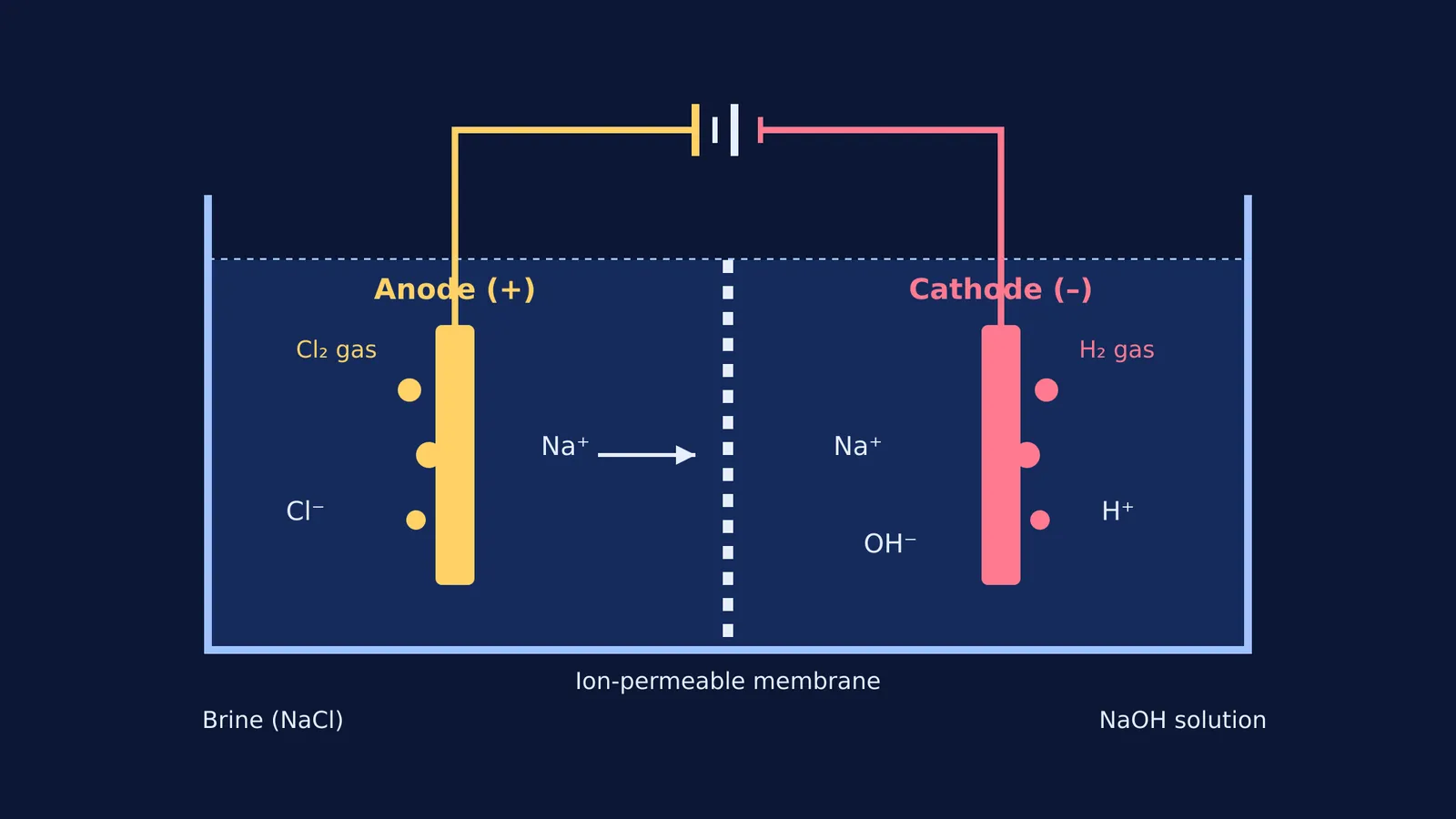
During electrolysis, the anode is the positive electrode. It attracts negatively charged chloride ions (Cl⁻) from the sodium chloride in the brine. At the anode, these chloride ions lose electrons (oxidation) to form chlorine gas (Cl₂).
The oxidation of chloride ions is represented by the half-equation:
2Cl⁻(aq) → Cl₂(g) + 2e⁻
The released electrons then travel through the external electrical circuit towards the cathode.
In modern industrial setups, a semi-permeable membrane is used to separate the anode and cathode compartments. This membrane allows only the positive sodium ions (Na⁺) to pass through it, moving from the anode side to the cathode side. It blocks the negative chloride and hydroxide ions from crossing back. This innovation ensures that the sodium hydroxide produced is of very high purity and prevents the hazardous mixing of chlorine gas with hydrogen gas, which can be highly explosive if they combine in the presence of light.
What forms at the cathode?
The cathode is the negative electrode. It attracts positive ions. Water in the brine slightly dissociates into hydrogen ions (H⁺) and hydroxide ions (OH⁻). The hydrogen ions gain the incoming electrons (reduction) at the cathode to form hydrogen gas (H₂).
The reduction of water is represented by the half-equation:
2H₂O(l) + 2e⁻ → H₂(g) + 2OH⁻(aq)
This shows exactly where the hydroxide ions come from. They do not come from the sodium chloride salt itself, but rather from the splitting of water molecules in the aqueous solution.
As hydrogen gas bubbles away, the hydroxide ions are left behind in the solution. They pair with the sodium ions (Na⁺) from the salt to form sodium hydroxide (NaOH). Thus, sodium hydroxide is formed in the solution near the cathode.
Using a highly concentrated solution of sodium chloride is essential. If a very dilute solution were used instead, the products at the electrodes would change: oxygen gas would be produced at the anode instead of chlorine because hydroxide ions would be oxidised preferentially. The high concentration of chloride ions in brine ensures that chlorine is preferentially discharged at the anode. If you are practising electrochemistry numericals and get stuck on which ion is discharged first, the Fermi Problem Library provides a step-by-step solver that explains the reasoning rather than printing an answer.
What are the uses of the chlor-alkali products?
The chlor-alkali process is crucial because all three of its products have massive industrial demand.
Chlorine (Cl₂): Used extensively in water treatment to disinfect drinking water and swimming pools. It is also a key raw material for manufacturing polyvinyl chloride (PVC), CFCs, pesticides and various disinfectants.
Hydrogen (H₂): Used as a clean fuel and in the hydrogenation of vegetable oils to make margarine. Its largest industrial use is in the manufacture of ammonia for fertilisers.
Sodium hydroxide (NaOH): A strong base used for de-greasing metals, manufacturing soaps and detergents, making paper, and producing artificial fibres such as rayon.
How can you remember the products for exams?
It is easy to mix up which gas goes to which electrode. Use this simple framework based on electrostatic attraction:
Identify the electrode charge: Anode is positive, Cathode is negative.
Match opposites: The positive anode attracts the negative chloride ion (Cl⁻) to make chlorine gas. The negative cathode attracts the positive hydrogen ion (H⁺) from water to make hydrogen gas.
What is left? You have used Cl and H. You are left with Na and OH. These stay in the solution near the cathode as sodium hydroxide (NaOH).
This logic saves you from memorising the products by rote and ensures you always get the locations right in an exam, helping you to confidently tackle multiple-choice and long-answer questions alike.
Read more about similar topics:


