

On this page
What is the Deacon process for the manufacture of chlorine from HCl?
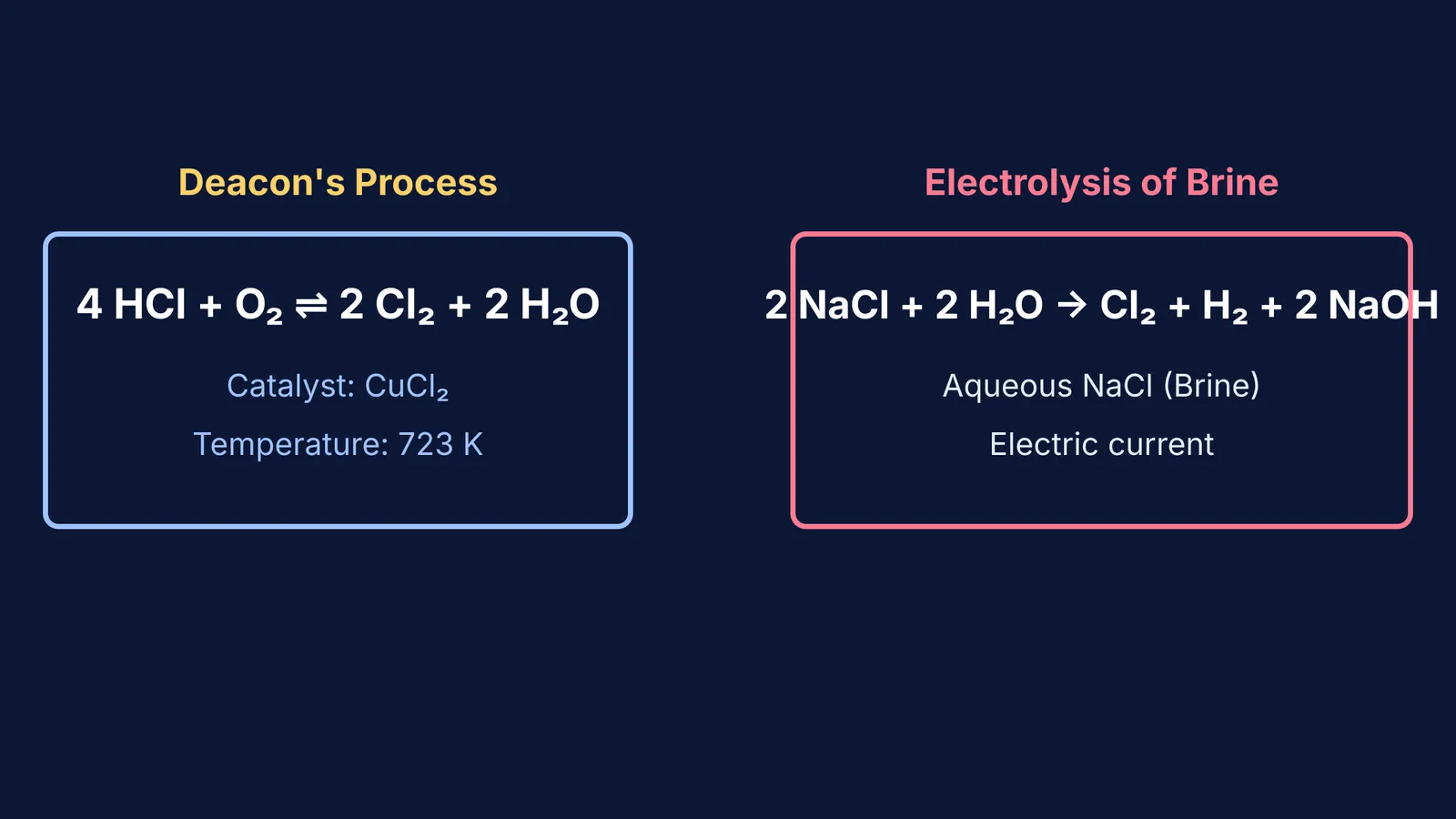
The Deacon process is a chemical method to produce chlorine gas by oxidising hydrogen chloride (HCl) with atmospheric oxygen (Zhang et al., 2022). The reaction is an exothermic equilibrium:
4 HCl + O₂ ⇌ 2 Cl₂ + 2 H₂O
To make the reaction proceed at a useful rate, it requires a catalyst. Historically, this is copper(II) chloride (CuCl₂), and the reaction chamber is kept at a temperature of about 723 K (450 °C).
While it was invented in 1868 by Henry Deacon to clean up waste HCl from the old Leblanc soda ash process, it remains relevant today. Modern variations of the process (often using highly active ruthenium oxide catalysts instead of CuCl₂) are used by chemical plants to recover chlorine from the waste HCl generated during the manufacture of polyurethanes and polycarbonates.
The reaction is notably exothermic, meaning it releases heat as the products form. From a thermodynamic perspective, this means that the equilibrium shifts backwards—towards the reactants—if the temperature is raised too high. However, if the temperature is too low, the reaction kinetics become incredibly slow, and very little chlorine is produced in a practical timeframe. The use of a catalyst like copper(II) chloride lowers the activation energy of the reaction, allowing it to reach equilibrium much faster at a moderate temperature of 723 K. This represents a carefully chosen compromise between achieving a fast enough reaction rate and maintaining a high enough yield of chlorine at equilibrium.
How does the Deacon process compare with the electrolysis of brine?
Although the Deacon process is a clever way to recycle HCl, it is not how we get most of our fresh chlorine. Today, the primary industrial method for manufacturing chlorine is the chlor-alkali process, which uses the electrolysis of brine, a concentrated aqueous solution of sodium chloride (Wikipedia).
When an electric current passes through the brine, the NaCl and water decompose:
2 NaCl + 2 H₂O → 2 NaOH + Cl₂ + H₂
This method produces three valuable chemicals at once: chlorine gas at the anode, hydrogen gas at the cathode, and sodium hydroxide (caustic soda) in the solution.
To understand the electrolysis of brine, it helps to look at the two half-reactions taking place at the electrodes. At the anode, chloride ions lose electrons (oxidation) to become chlorine gas:
2 Cl⁻ → Cl₂ + 2 e⁻
At the cathode, water molecules gain electrons (reduction) to produce hydrogen gas and hydroxide ions:
2 H₂O + 2 e⁻ → H₂ + 2 OH⁻
The remaining sodium ions (Na⁺) in the brine combine with these newly formed hydroxide ions to create aqueous sodium hydroxide. Because chlorine gas and sodium hydroxide react violently if they mix, modern chemical plants use an ion-exchange membrane to separate the anode and cathode compartments. This membrane allows only the sodium ions to pass through, keeping the dangerous products apart and ensuring the sodium hydroxide remains extremely pure.
The main difference between the two is their starting material and energy source. The chlor-alkali process uses electricity to split common salt (NaCl), while the Deacon process uses thermal energy and a catalyst to oxidise a waste acid (HCl).
How to remember the conditions for JEE and NEET?
In the context of the p-block elements for Class 12 and entrance exams, questions often test your memory of the specific catalysts and temperatures for named processes.
For the Deacon process, remember these three facts:
The reactants are hydrogen chloride gas and atmospheric oxygen.
The catalyst is CuCl₂ (cupric chloride).
The temperature is 723 K (Zhang et al., 2022).
When you study the p-block elements, it is easy to mix up the different large-scale manufacturing processes. A great study habit is to build a summary table that lists the starting materials, catalysts, and optimal conditions for each process. For example, compare the Deacon process with the Haber process for ammonia or the Ostwald process for nitric acid. Each of these relies on an exothermic equilibrium that requires a catalyst to achieve an acceptable rate at a moderate temperature.
If you get stuck on how temperature and pressure affect equilibrium yields, the Fermi Problem Library has worked problems with a step-by-step solver that explains the reasoning rather than printing an answer. If you have forgotten the wider context of group 17 elements, you can trace the entire topic map in the Fermi Concept Library.
To see how electricity splits compounds in a related process, you can read about the electrolytic refining of copper, which relies on similar principles to the electrolysis of brine.


