On this page
Kinetic Theory is Chapter 12 of the NCERT Class 11 Physics Part II textbook (reprint 2026-27), and the CBSE 2026-27 Physics syllabus lists it under Unit IX. The syllabus names specific heats of gases only, so specific heat of solids (NCERT section 12.6.4) is left out. For the whole chapter, read our Kinetic theory Class 11 chapter guide.
What do the gas law terms mean?
Values are from NCERT section 12.3.
Atomic hypothesis: all matter is built from atoms that never stop moving; they pull on each other at small separations and push apart when pressed together.
Ideal gas: a model gas that obeys PV = µRT exactly at every pressure and temperature. Don't confuse with: a real gas, which only comes close at low pressure and high temperature.
Perfect gas equation (equation of state): PV = µRT, linking pressure P (Pa), volume V (m³), absolute temperature T (K) and amount µ (mol). Per molecule: PV = kBNT.
Mole and Avogadro number: one mole holds NA = 6.02 × 10²³ particles. Example: at STP (273 K, 1 atm) a mole of any ideal gas fills 22.4 litres.
Avogadro's hypothesis: at one temperature and pressure, equal volumes of any gases hold equal numbers of molecules.
Boltzmann constant (kB): the gas constant for one molecule, 1.38 × 10⁻²³ J K⁻¹. Don't confuse with: the universal gas constant R = 8.314 J mol⁻¹ K⁻¹, the same idea for one mole; R = NA kB.
Number density (n): molecules per unit volume, in m⁻³. Don't confuse with: mass density ρ, in kg m⁻³.
Boyle's law: at fixed temperature, the pressure of a fixed amount of gas varies inversely with its volume.
Charles' law: at fixed pressure, volume is proportional to absolute temperature.
Partial pressure: the pressure one gas in a mixture would exert if it alone filled the vessel at the same volume and temperature.
Dalton's law of partial pressures: in a mixture of non-reacting ideal gases, the partial pressures add up to the total pressure.
How does kinetic theory explain pressure and temperature?
Values are from NCERT section 12.4.
Kinetic theory of gases: pictures a gas as many far-apart molecules in random straight-line motion between brief collisions.
Elastic collision: total kinetic energy is unchanged; assumed for every collision, with molecules or walls.
Pressure (kinetic view): momentum delivered to the wall per second per unit area, P = (1/3) n m⟨v²⟩, in pascal.
Isotropic: having no preferred direction, so ⟨vx²⟩ = ⟨vy²⟩ = ⟨vz²⟩ = ⟨v²⟩/3.
Mean square speed ⟨v²⟩: the average of squared speeds, in m² s⁻². Don't confuse with: ⟨v⟩², the square of the average speed; the two are generally not equal.
Root mean square (rms) speed: vrms = √(3kBT/m), in m s⁻¹. Example: nitrogen at 300 K has vrms of about 516 m s⁻¹.
Kinetic interpretation of temperature: the average translational kinetic energy of a molecule is (3/2)kBT, whatever the gas, pressure or volume. At one temperature, lighter molecules move faster.
Internal energy of an ideal gas: the total energy of its molecules, which depends only on temperature.
What are degrees of freedom and equipartition?
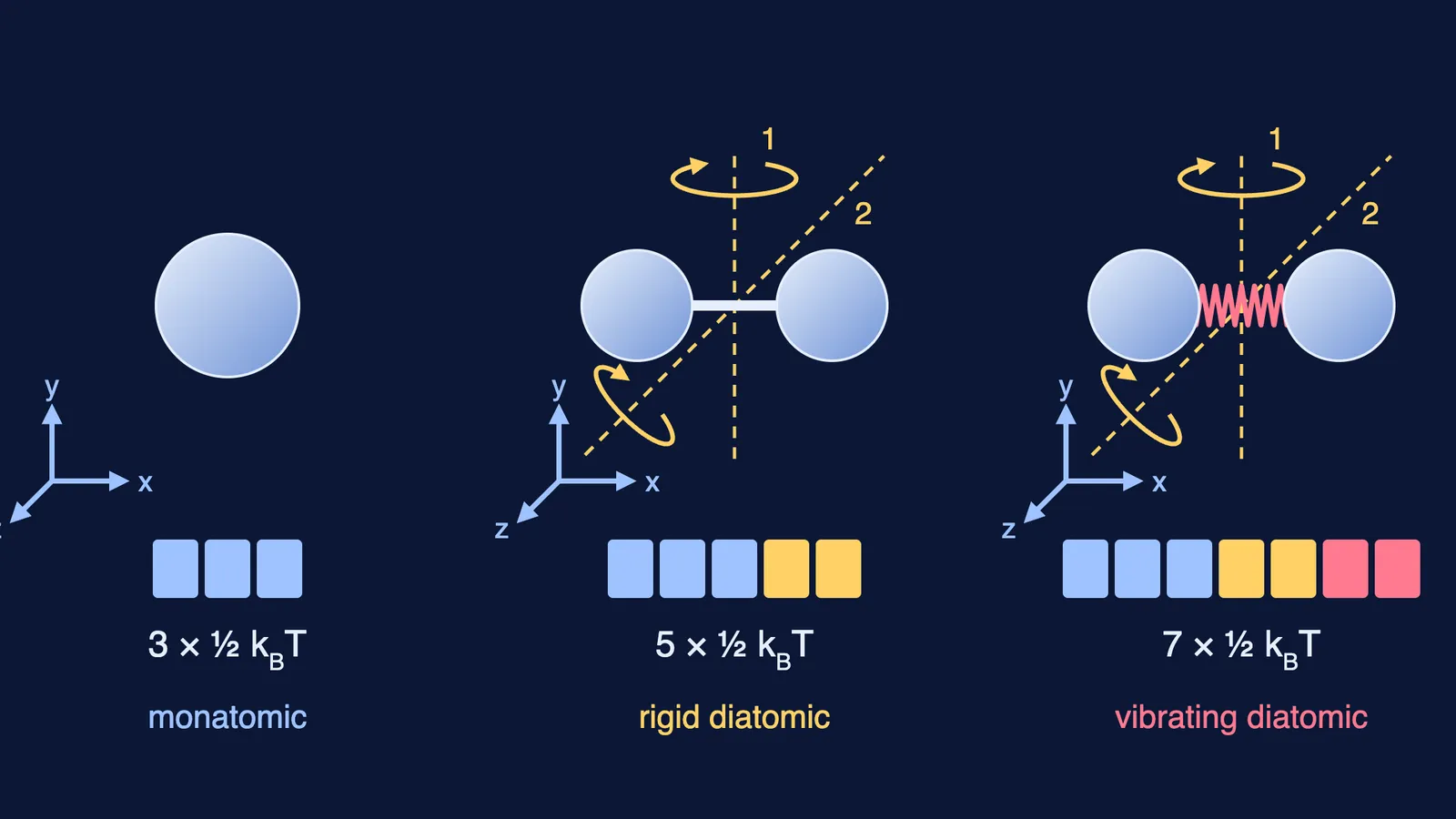
Degree of freedom: an independent way a molecule can move or store energy. Each squared term in a molecule's energy counts as one, so a vibrational mode counts as two.
Translational degrees of freedom: motion of the whole molecule along x, y and z. Example: argon, a monatomic gas, has only these 3.
Rotational degrees of freedom: spinning about axes through the centre of mass. Example: O2 has 2, about the two axes perpendicular to its bond.
Rigid rotator: a diatomic molecule treated as a dumbbell that does not vibrate, with 3 translational + 2 rotational = 5 degrees of freedom.
Vibrational mode: the atoms oscillate along the bond, as in CO. It has a kinetic and a potential energy term, so it contributes kBT, not ½kBT.
Law of equipartition of energy: in thermal equilibrium at temperature T, each energy mode of a molecule gets an average energy of ½kBT. The syllabus asks for the statement only.
How are specific heats of gases predicted?
Values are from NCERT section 12.6.
Molar specific heat at constant volume (Cv): heat to warm 1 mol by 1 K at fixed volume, in J mol⁻¹ K⁻¹; Cv = dU/dT. Example: (3/2)R for a monatomic gas.
Molar specific heat at constant pressure (Cp): the same at fixed pressure. Don't confuse with: Cv; for any ideal gas, Cp − Cv = R.
Ratio of specific heats (γ): Cp/Cv, with no unit. Example: 5/3 for a monatomic gas, 7/5 for a rigid diatomic gas and 9/7 for a diatomic gas with one vibrational mode.
Polyatomic gas: molecules of three or more atoms, with 3 translational, 3 rotational and f vibrational modes, giving Cv = (3 + f)R.
What is mean free path?
Values are from NCERT section 12.7.
Mean free path (l): the average distance a molecule travels between two successive collisions, in metres; l = 1/(√2 nπd²). Example: for air at STP it is of the order of 10⁻⁷ m, about a thousand times a molecule's size.
Molecular diameter (d): a molecule's size treated as a sphere; two molecules collide when their centres come within d.
Collision time (τ): the average time between successive collisions, in seconds. Don't confuse with: collision frequency, the number of collisions per second (s⁻¹), which is 1/τ.
How to learn these terms
Learn the mix-ups as pairs: kB and R, n and ρ, ⟨v²⟩ and ⟨v⟩², Cv and Cp.
Run the ladder for O2 as a rigid rotator: 5 degrees of freedom, so U = (5/2)RT per mole, Cv = (5/2)R ≈ 20.8 J mol⁻¹ K⁻¹, Cp = Cv + R ≈ 29.1 J mol⁻¹ K⁻¹, γ = 1.40. These match Table 12.1 of the NCERT chapter.
Sketch a dumbbell with its two rotation axes and a vibration spring, then test yourself with our kinetic theory JEE Main practice questions with solutions and see where Cv and Cp return in our Thermodynamics Class 11 physics guide.
If a term still feels abstract, the Fermi Concept Library covers every concept in physics, each with its own lesson and its place in the map.