On this page
Preparing for JEE Main and NEET-UG together? Kinematics looks like the same chapter twice, and mostly is. The differences sit in three places: vectors, question format, and how many steps a question chains.
Is the Kinematics syllabus the same for JEE Main and NEET?
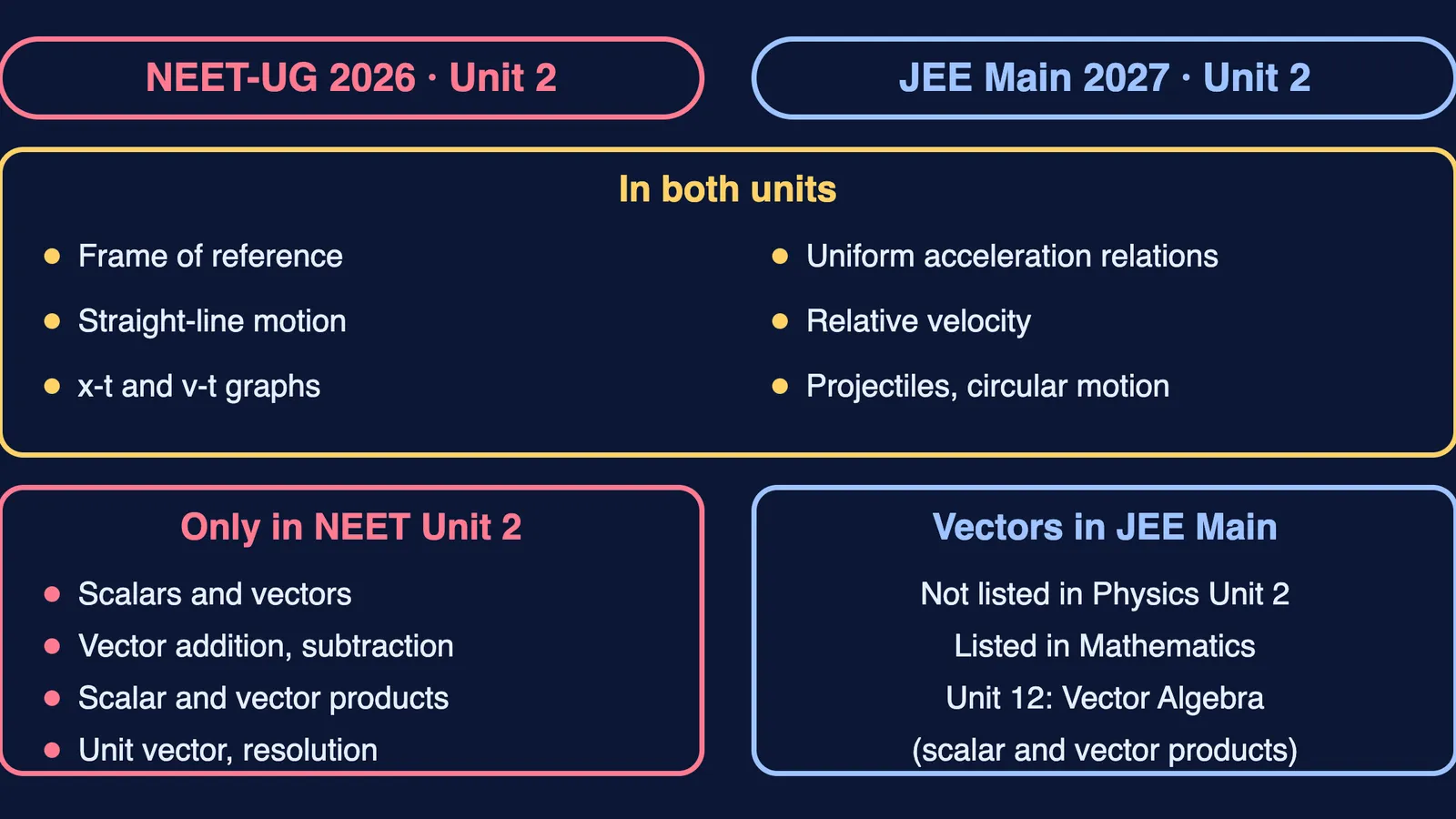
Almost. In the NTA Syllabus for JEE (Main) - 2027, Kinematics is Physics Unit 2. In the National Medical Commission's syllabus for NEET (UG)-2026, dated 22 December 2025, it is also Physics Unit 2.
Read side by side, these phrases appear in both units:
"The frame of reference, motion in a straight line"
"average speed and instantaneous velocity, uniformly accelerated motion"
"velocity-time, position-time graph"
"relations for uniformly accelerated motion" and "relative velocity"
"Motion in a plane", "projectile motion" and "uniform circular motion"
One block appears only in the NEET unit: "Scalars and Vectors, Vector. Addition and subtraction", then "scalar and vector products, Unit Vector, Resolution of a Vector." The JEE Main Kinematics unit has no vector line at all.
That does not mean JEE Main skips vectors. The same JEE Main document lists them under Mathematics, Unit 12, Vector Algebra: "Vectors and scalars, the addition of vectors", components, and "scalar and vector products." Both exams expect vector skills; only the syllabus heading differs.
How are Kinematics questions asked in JEE Main and NEET?
The JEE (Main) 2027 Information Bulletin sets Paper 1 Physics at 20 questions in Section A and 5 in Section B, for 100 marks, in a computer-based test. Section A is multiple choice. In Section B you type a numerical answer, and the bulletin says it "should be rounded off to the nearest integer." Both sections carry +4 for a correct answer and -1 for a wrong one.
The NEET (UG)-2026 Information Bulletin sets 180 compulsory questions in 180 minutes, with 45 Physics questions worth 180 marks. Every question is a multiple-choice item "with four options and single correct answer/best option", marked +4, -1 or 0 if unanswered, on pen and paper.
So a Kinematics question in NEET always gives you four options to check against. In JEE Main it may give you none.
How does the question style differ?
Neither syllabus document gives a chapter weightage, so treat any quoted figure with caution. What you will notice in official past papers is a difference in tendency, not in topics.
NEET leans on clean, single-idea questions. Many read like an NCERT statement turned into a calculation: a definition, one formula, a sign check. Statement-type items reward precise reading.
JEE Main leans on chaining. A question often joins two ideas, such as a vector condition and projectile motion, or a velocity function and a turning point. Calculus on x(t) and v(t) also tends to appear.
Numerical-value questions change your checking. With no options, you cannot back-solve or eliminate. Your own sanity check is the only one.
What does the same idea look like in each exam?
Here is one idea, the moment a projectile's velocity becomes perpendicular to its launch velocity, written both ways. Both are original. Take g = 10 m/s² and ignore air resistance.
NEET style. A ball is projected from level ground with velocity u = (9î + 12ĵ) m/s, where ĵ points up. After how long is its velocity perpendicular to its initial velocity?
(A) 1.2 s (B) 1.5 s (C) 1.875 s (D) 2.4 s
Answer: (C). At time t, v = 9î + (12 − 10t)ĵ. Perpendicular means u·v = 0: 81 + 12(12 − 10t) = 0, so 225 = 120t and t = 1.875 s. The flight lasts 2 × 12/10 = 2.4 s, so this happens in the air. Trap: (A) is the top of the flight, where velocity is horizontal, not perpendicular to u. (B) is just |u|/g, and (D) is the landing time.
One scalar product, one line of algebra: typical NEET territory.
JEE Main style (numerical value). A stone is thrown from level ground at 30 m/s, 60° above the horizontal. At the instant its velocity is perpendicular to its initial velocity, how high is it above the ground, in metres?
Answer: 30. Write u·v = 0 in general: u² − g t u sin θ = 0, so t = u/(g sin θ) = 30/(10 × sin 60°) = 2√3 ≈ 3.46 s. Check it is still flying: time of flight is 2u sin θ/g = 3√3 ≈ 5.20 s, so yes. Height y = u sin θ × t − ½gt² = 15√3 × 2√3 − 5 × 12 = 90 − 60 = 30 m.
The extra steps are the point: derive the condition, check it happens before landing, then compute. Push θ down to 45° and the perpendicular moment arrives exactly at landing; below 45° it never comes. A JEE Main question can hide that check, and there are no options to warn you.
How to prepare for both
Learn the shared core once. Equations of motion, x-t and v-t graphs, relative velocity, projectiles and uniform circular motion are the same syllabus lines in both exams.
Do vectors as physics, whichever exam you sit. NEET lists them in this unit; JEE Main lists them under Mathematics, and 2D motion uses them anyway. Practise resolution and the scalar product until they are automatic.
Add calculus drills for JEE Main. Turn x(t) into v(t) and a(t), find turning points, and separate distance from displacement.
Practise without options. For JEE Main, solve some multiple-choice questions with the options covered, then round your answer to the nearest integer as the bulletin asks.
Train speed and precise reading for NEET. 45 Physics questions sit alongside 135 others in one 180-minute paper, per the bulletin, so timed sets of short single-idea items help.
Keep one mistake log for both. Tag each miss as scope, method, sign or arithmetic.
Struggling to picture why the velocity turns perpendicular only above 45°? The Fermi Simulation Lab has interactive simulations for the ideas that are easier to see than to read.
For the full exam-specific plans, read how to prepare Kinematics for NEET and how to prepare Kinematics for JEE Main. Then check the common traps in projectile motion mistakes in JEE and NEET.