On this page
Chapter 2 of the NCERT Class 12 Mathematics Part I textbook is short, but almost every line in it leans on a precise word: branch, principal value, domain, range. The CBSE 2026-27 Mathematics syllabus lists the chapter's content as definition, range, domain, principal value branch and graphs of inverse trigonometric functions. Below are the key terms from the rationalised NCERT chapter (reprint 2026-27), grouped by topic, each in plain words with an example. For answer-writing and common traps, read our chapter guide, Inverse trigonometric functions Class 12: board answers and traps.
Which ideas from functions does this chapter need?
The chapter opens by recalling Chapter 1. If these feel shaky, revise relations and functions for the Class 12 board exam first.
Domain: the set of inputs a function accepts. Example: sin x accepts every real number, so its domain is R.
Range: the set of outputs the function actually produces. Example: the range of sin x is [−1, 1].
One-one function: different inputs always give different outputs. Counter-example: sin 0 = sin π = 0, so sine on R is not one-one.
Onto function: every value in the target set is reached by some input. Example: sin : R → [−1, 1] is onto, but sin : R → R is not, because 2 is never reached.
Bijective function: a function that is both one-one and onto. Only a bijection has an inverse.
Inverse function (f⁻¹): the function that undoes f. If f(x) = y, then f⁻¹(y) = x, and the domain of f⁻¹ is the range of f. Don't confuse with: 1/f(x), which is a reciprocal, not an inverse.
What is a principal value branch?
Restricting the domain: cutting a trigonometric function down to an interval where it becomes one-one and onto. Example: sine restricted to [−π/2, π/2] is a bijection onto [−1, 1].
Branch: one inverse function obtained from one such interval. Example: sine restricted to [π/2, 3π/2] gives another branch of sin⁻¹, with outputs in that interval.
Principal value branch: the one branch NCERT agrees to use by default. Whenever no branch is named, sin⁻¹ means the branch with range [−π/2, π/2].
Principal value: the one answer you accept from an inverse trigonometric function, chosen so it falls inside the principal range. Example: sin⁻¹(1/2) = π/6, not 5π/6, even though sin(5π/6) is also 1/2.
sin⁻¹x (arc sine): the angle in [−π/2, π/2] whose sine is x. Don't confuse with: (sin x)⁻¹, which means 1/sin x. The same warning holds for cos⁻¹, tan⁻¹ and the rest.
What are the domains and ranges of the six inverse functions?
The first six lines follow the chapter's summary table; learn each domain and range as a pair.
sin⁻¹x: domain [−1, 1], principal range [−π/2, π/2]. Example: sin⁻¹(−1) = −π/2.
cos⁻¹x: domain [−1, 1], principal range [0, π]. Example: cos⁻¹(−1/2) = 2π/3, not −2π/3. Don't confuse with: sin⁻¹, whose range allows negative angles; cos⁻¹ never gives one.
tan⁻¹x: domain R, principal range (−π/2, π/2), open at both ends. Example: tan⁻¹(−1) = −π/4.
cot⁻¹x: domain R, principal range (0, π). Example: cot⁻¹(−1/√3) = 2π/3. Don't confuse with: tan⁻¹, whose range is centred on 0 instead.
sec⁻¹x: domain R − (−1, 1), meaning x ≤ −1 or x ≥ 1; principal range [0, π] − {π/2}. Example: sec⁻¹(2) = π/3.
cosec⁻¹x: domain R − (−1, 1); principal range [−π/2, π/2] − {0}. Example: cosec⁻¹(2) = π/6.
Closed and open interval: square brackets include the end point, round brackets leave it out. Example: tan⁻¹ never reaches π/2, so its range uses round brackets.
R − (−1, 1): all real numbers except those strictly between −1 and 1. Counter-example: sec⁻¹(1/2) is not defined.
How are the graphs of inverse trigonometric functions drawn?
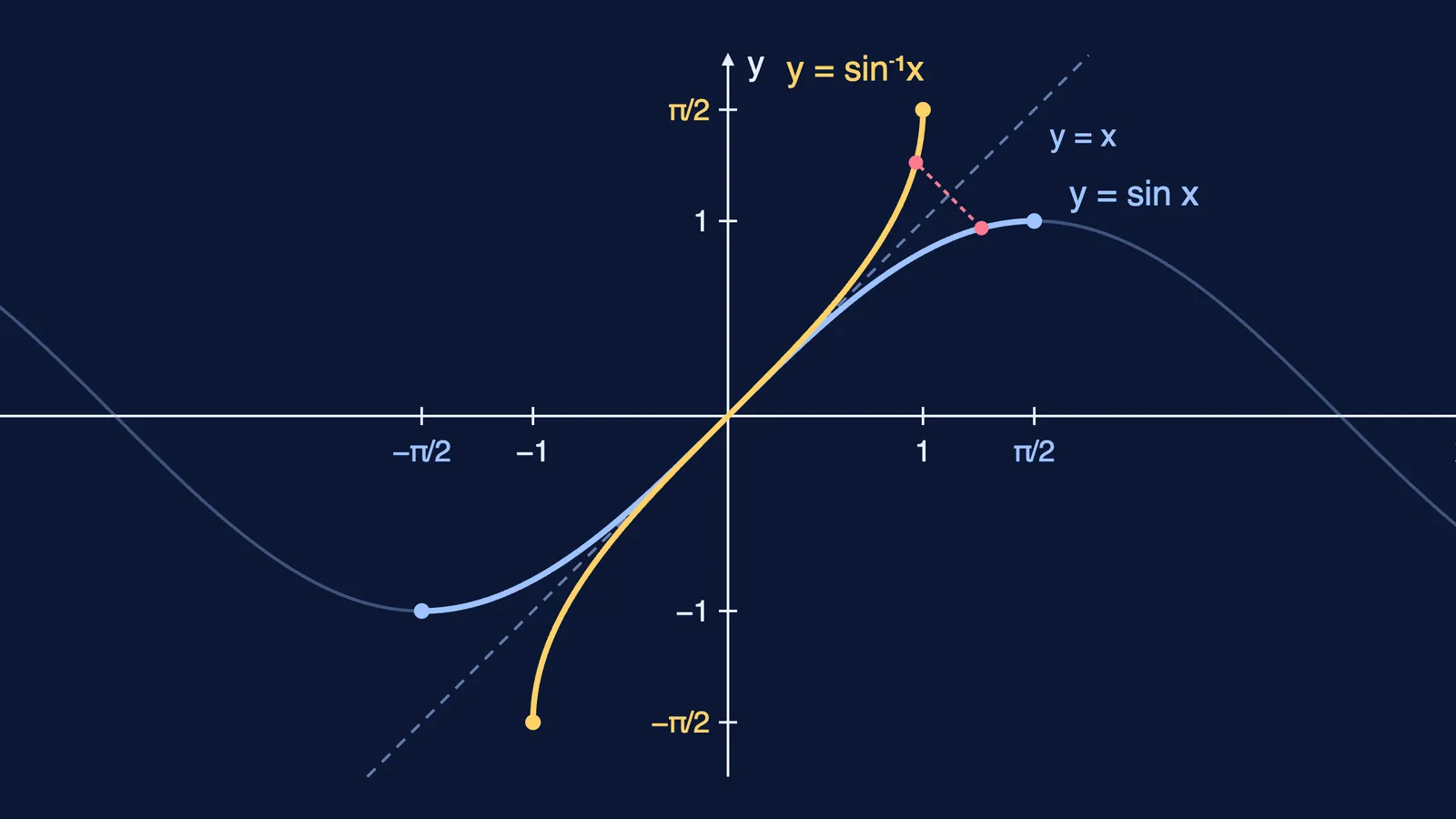
Interchanging the axes: if (a, b) lies on y = sin x, then (b, a) lies on y = sin⁻¹x. Example: (π/6, 1/2) on the sine graph becomes (1/2, π/6).
Mirror image in the line y = x: flip the original graph over the line y = x and you get the graph of its inverse. The diagram at the top of this post shows this for sine.
Principal value branch on a graph: NCERT draws it as the dark part of the sin⁻¹ graph; the rest of the curve belongs to other branches.
Which properties and forms does the chapter use?
sin(sin⁻¹x) = x: true for every x in [−1, 1].
sin⁻¹(sin x) = x: true only when x lies in [−π/2, π/2]. Example: sin⁻¹(sin 3π/5) is 2π/5, not 3π/5, because 3π/5 is outside the principal branch. Don't confuse with: the first property, which has no such catch.
Simplest form: rewriting a messy inverse expression as a short one. Example: for x > 1, cot⁻¹(1/√(x² − 1)) becomes sec⁻¹x.
Trigonometric substitution: putting x = sin θ, cos θ, tan θ or sec θ to simplify a root. Example: with x = sec θ, √(x² − 1) becomes tan θ.
The 2026-27 chapter does not state identities such as sin⁻¹x + cos⁻¹x = π/2 or the tan⁻¹x + tan⁻¹y formula; its short properties section gives only the two results above and then works through examples.
How to learn these terms
Learn domain and range as one card per function, and say both out loud: "sin inverse, minus one to one, minus pi by two to pi by two."
Sketch sine and its restricted piece, then reflect it in y = x by hand. Repeat for cos and tan; the ranges stop feeling arbitrary once you have drawn them.
Before writing any answer, check it lies in the principal range. An answer can be a true angle and still be wrong if it sits on the wrong branch.
Keep a do-not-confuse list: sin⁻¹x versus 1/sin x, sin(sin⁻¹x) versus sin⁻¹(sin x), and the open range of tan⁻¹ versus the closed range of sin⁻¹.
If a term like "bijective" still feels vague, the Fermi Concept Library covers every concept in mathematics, each with its own lesson and its place in the map. For tougher drills on the same ideas, see how to prepare inverse trigonometric functions for JEE Main.