On this page
Chapter 1 of NCERT's Introductory Macroeconomics is short, but it sets up the whole of Part A of your Class 12 paper. We read the current NCERT chapter (Reprint 2026-27) and the CBSE 2026-27 Economics curriculum to build this guide.
What does macroeconomics study?
Macroeconomics studies the economy as a whole: total output, the general price level and overall employment. Microeconomics, which you did in Class 11, looks at single consumers, firms and markets, and takes things like inflation and unemployment as given.
The NCERT chapter makes three points:
Aggregates move together. When grain output grows, industrial output usually grows too, and prices tend to rise or fall together. So economists can study one imaginary "representative good".
Sometimes we split it up. Agriculture, industry and services, or households, firms and government, can behave differently, so macroeconomics also studies how sectors depend on one another.
The decision makers are different. Macro policy is run by the State and statutory bodies such as the RBI and SEBI, which pursue public goals set by law or the Constitution, not private profit.
Why did macroeconomics begin with the Great Depression and Keynes?
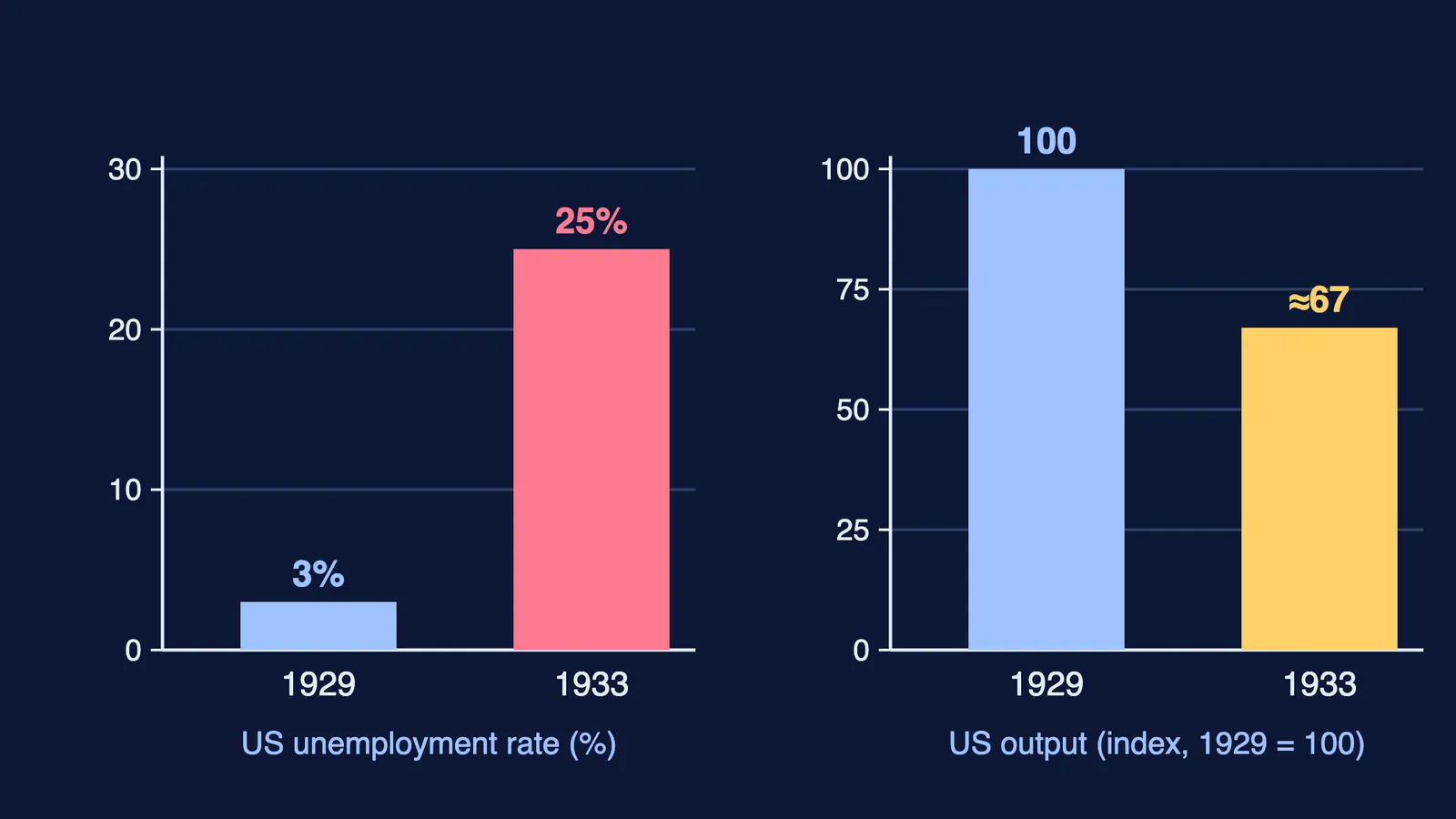
Before Keynes, the classical tradition held that anyone ready to work would get a job and factories would run at full capacity. The Great Depression that began in 1929 broke that assumption. According to the NCERT chapter, US unemployment went from 3 per cent in 1929 to 25 per cent in 1933, and total US output fell by about 33 per cent in those four years.
The British economist John Maynard Keynes set out to explain long-lasting unemployment. His book The General Theory of Employment, Interest and Money (1936) looked at the economy in its entirety and at how its sectors depend on each other. NCERT dates macroeconomics as a separate branch from that book.
What are the four sectors of a macro economy?
The book studies a capitalist economy, which NCERT describes by private ownership of the means of production, production for sale in the market, and labour bought and sold at a wage rate. Within it, the chapter names four sectors:
Households: consume, save and pay taxes; supply labour, land and capital and earn wages, rent, interest and profit.
Firms: entrepreneurs hire labour, land and capital, produce output and sell it for profit; profit spent on new machines or factories, which raises capacity, is investment expenditure.
Government: makes and enforces laws, taxes, spends on infrastructure, schools and health, and sometimes produces goods itself.
External sector: exports, imports, and capital flowing in or out.
NCERT adds that where peasant families produce mainly for their own use, or land belongs to a whole tribe, the book's analysis does not apply.
Worked example: an unemployment rate, step by step
These are our own numbers. A town has 4,600 people working, 400 not working but looking for jobs, and 1,000 who are not looking (students and retired people).
Labour force = 4,600 + 400 = 5,000.
Unemployment rate = 400 / 5,000 = 0.08, or 8%.
Trap: dividing by all 6,000 people gives 6.67%, which is wrong because people not looking for work are not counted.
Next year, demand falls and 1,000 workers lose their jobs but keep looking. Now 3,600 work and 1,400 look: 1,400 / 5,000 = 28%. If the town's output also falls from ₹1,500 crore to ₹1,050 crore, the fall is 450 / 1,500 = 30%.
How is this chapter tested in CBSE 2026-27?
The CBSE 2026-27 curriculum lists "What is Macroeconomics?" as the first topic of Unit 1, National Income and Related Aggregates. That unit carries 10 marks in total, shared with circular flow and national income; this chapter has no separate figure.
The 2026-27 sample paper uses 1-mark MCQs (including assertion-reason and two-statement items), 3-mark answers of 60-80 words, 4-mark answers of 80-100 words and 6-mark answers of 100-150 words. Practise in those shapes:
(1 mark) Which of these is a macroeconomic decision maker? (a) a shopkeeper (b) the RBI (c) a household (d) a single firm.
(1 mark, assertion-reason) A: Microeconomics treats inflation as given. R: No single buyer or seller can change the general price level.
(3 marks) Explain why the RBI counts as a macroeconomic decision maker while even a very large company does not.
(4 marks) A district has 9,000 people working and 1,000 looking for work. Find its unemployment rate and explain who is left out of the calculation.
(6 marks) Output and jobs in a country fall sharply and stay low for years. Why could the classical tradition not explain this, and how did Keynes's approach differ?
(Answers: 1 is (b); 2 is both true, and R explains A; 4 is 10%.)
Stuck on a step? Fermi's AI tutor works out what you already know and builds a plan for the session. Next, the national income chapter puts these sectors into numbers: try our guide to solving national income numericals, then credit creation by commercial banks. For Part B, start with the Indian economy on the eve of independence.