

On this page
The first chapter of Class 12 Indian Economic Development asks one question: what state was India's economy in when British rule ended in 1947, and why? The chapter covers agriculture, industry, foreign trade, population, the workforce and infrastructure, and good answers tie each part to a colonial policy. Every number below comes from the NCERT chapter Indian Economy on the Eve of Independence.
Why was the Indian economy stagnant at independence?
NCERT's answer is that colonial policy aimed to turn India into a supplier of raw materials for Britain's industries and a buyer of Britain's finished goods (NCERT, Chapter 1). The colonial government never made a sincere attempt to measure national income, so the figures come from individual estimators such as Dadabhai Naoroji and V.K.R.V. Rao.
Most studies found that India's aggregate real output grew by less than 2% a year in the first half of the twentieth century (NCERT). Per capita output grew by only about 0.5% a year.
What happened to agriculture under British rule?
About 85% of India's population lived mostly in villages and depended on agriculture for a living (NCERT). Productivity stayed low; the sector grew a little mainly because more land came under cultivation. NCERT gives four causes:
Land settlement systems, especially zamindari in the Bengal Presidency, where the profit from farming went to zamindars, not cultivators.
Fixed revenue deadlines: a zamindar who missed one lost his rights, so rent was collected whatever the cultivators' condition.
Low technology, a lack of irrigation facilities and negligible use of fertilisers.
Commercialisation: some farmers switched to cash crops, but these were ultimately used by British industry.
Why did India's industries decline before 1947?
Handicrafts famous for cotton and silk textiles, metal and precious-stone work declined, which caused massive unemployment, and cheap British imports filled the gap (NCERT). Modern industry began in the second half of the nineteenth century with cotton mills, mainly Indian-owned in Maharashtra and Gujarat, and jute mills, mainly foreign-owned in Bengal. The Tata Iron and Steel Company (TISCO) was incorporated in 1907.
Two weaknesses are worth naming: there was hardly any capital goods industry (factories that make machine tools), and the public sector was confined to railways, power, communications, ports and a few departmental undertakings.
What were India's trade and demographic indicators in 1947?
India exported primary products such as raw silk, cotton, wool, sugar, indigo and jute, and imported finished consumer goods and light machinery (NCERT). More than half of India's foreign trade was restricted to Britain. The Suez Canal, opened in 1869, tightened British control. The railways, introduced in 1850, expanded exports, but the benefits rarely reached Indian people. India ran a large export surplus, but it paid for the colonial government's office in Britain, its wars and invisible imports; NCERT calls this the drain of Indian wealth.
The first census of British India was taken in 1881, and India moved from the first to the second stage of demographic transition after 1921 (NCERT).
Overall literacy was below 16%, and female literacy about 7%.
The infant mortality rate was about 218 per thousand.
Life expectancy was about 32 years.
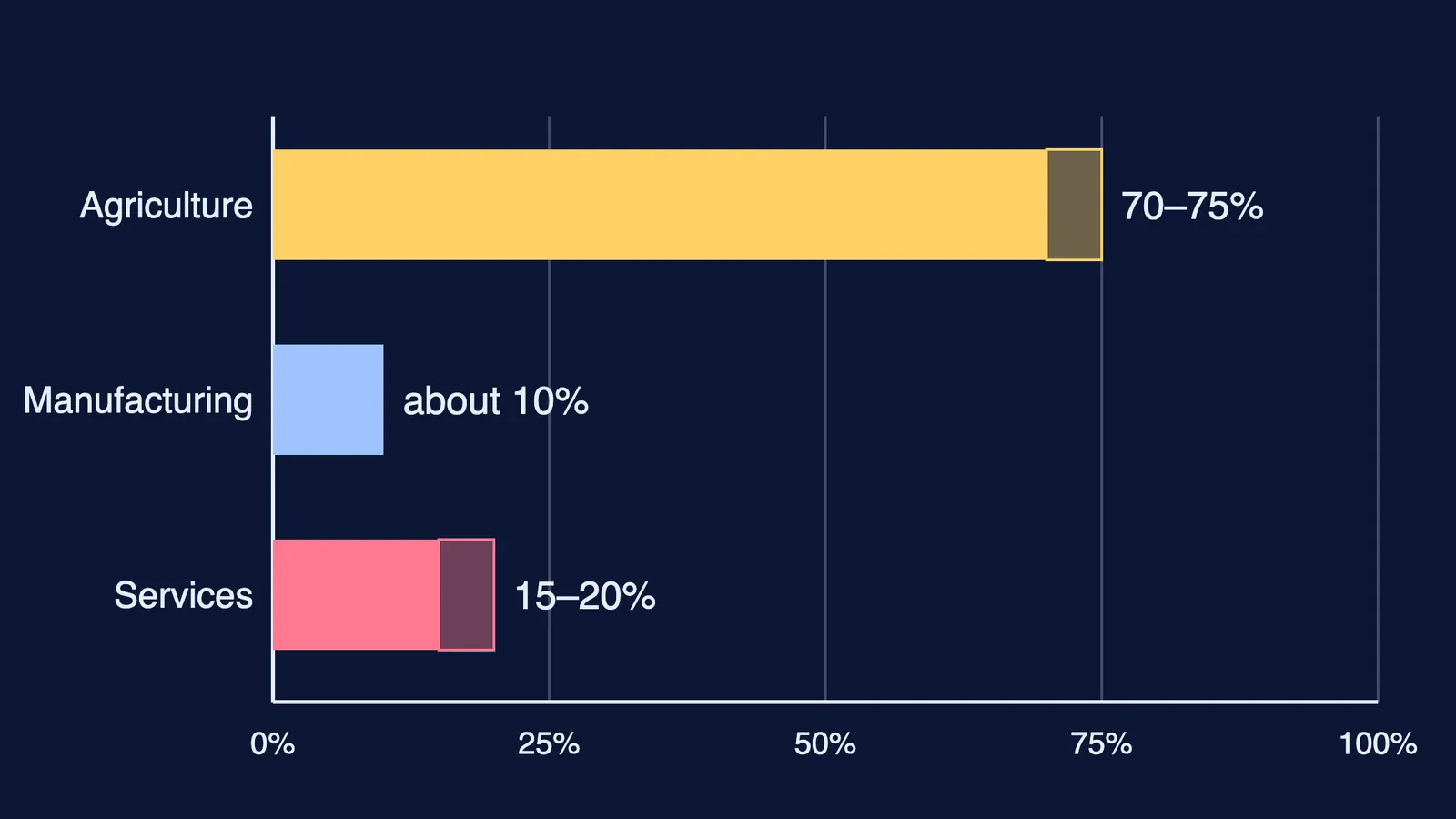
Agriculture employed 70-75% of the workforce, manufacturing about 10% and services 15-20% (NCERT). If you studied the three sectors of the Indian economy in Class 10, this is the same primary, secondary and tertiary lens applied to 1947.
How do you write a long answer on this chapter?
Use a policy, effect, evidence chain built from the NCERT chapter. Here is a worked example for: why was agricultural productivity low on the eve of independence?
Policy: the zamindari system, with fixed dates for paying revenue.
Effect: zamindars collected rent regardless of the cultivators' condition, and many of them, like the colonial government, did nothing to improve agriculture.
Evidence: low technology, poor irrigation, negligible fertiliser, and growth coming mainly from more cultivated area.
Link back: so productivity stayed low even though about 85% of people depended on farming.
The same four lines work for industry (policy: make India a raw-material exporter and a market for British goods) and trade (policy: British monopoly control over exports and imports). To lay these out on one page, see how to make a cause-and-effect chart for a history chapter. The trade story continues in globalisation and the Indian economy.
Before the exam, write this recall card from memory, then check it against the NCERT chapter and drill only what you missed:
Growth: under 2% total, about 0.5% per head.
Farming: about 85% of people; workforce 70-75 / 10 / 15-20.
Dates: 1850 railways, 1869 Suez, 1881 census, 1907 TISCO, 1921 transition.
Health and literacy: literacy under 16% (women about 7%), infant mortality 218, life expectancy 32.
If you are not sure where to start revising, Fermi's AI tutor works out what you already know and builds a plan for the session, so you begin with a clear next step.


