On this page
Introduction to Linear Polynomials is Chapter 2 of Ganita Manjari, the new NCERT Class 9 mathematics textbook and part of the Algebra unit in the CBSE Class IX Mathematics curriculum for 2026-27. Here are 31 of its key terms in five groups. For worked solutions, see our Introduction to linear polynomials Class 9 chapter guide.
What are the parts of an algebraic expression?
Source: NCERT section 2.1.
Algebraic expression: numbers and variables joined by operations. Example: 4x + 5y + 3 (pens and pencils in x red and y blue boxes, plus 3 free pens).
Term: one of the pieces that are added to make an expression. Example: 4x, 5y and 3 are the terms of 4x + 5y + 3.
Variable: the book's new word for a letter-number, a letter standing for a number. Example: x and y above.
Coefficient: the number multiplying a variable or a power of it. Example: in 5y³ + y² + 2y − 1, the coefficient of y² is 1.
Constant term: the term with no variable in it. Example: −1 in 5y³ + y² + 2y − 1. Don't confuse with: a coefficient, which is attached to a variable.
What is a polynomial, and what is its degree?
Source: NCERT section 2.1.
Univariate polynomial (polynomial): an expression in one variable and its powers. Example: x² + 5x + 1. Counter-example: 4x + 5y + 3 has two variables.
Degree: the highest power of the variable in the polynomial. Example: 5y³ + y² − 8 has degree 3. Don't confuse with: the number of terms.
Constant polynomial: a constant on its own, of degree 0 because 8 = 8x⁰. Example: 8 or −9.
Linear polynomial: a polynomial of degree 1. Example: 3z + 7, or 5 − 4y.
Quadratic polynomial: degree 2. Example: 10x − x², a rectangle's area from a 20 cm wire.
Cubic polynomial: degree 3. Example: 5y³ + y² + 2y − 1.
Value of a polynomial: the number you get by substituting a value for the variable. Example: 5x − 3 at x = 2 is 7.
How are linear polynomials, equations and functions linked?
Source: NCERT section 2.2.
Linear equation: a linear polynomial set equal to a constant. Example: 2x + 10 = 64 gives x = 27. Don't confuse with: the polynomial 2x + 10, which has no equals sign.
Input-output process: a value of x goes in, the expression's value comes out. Example: 2x + 3 turns 4 into 11 and −6 into −9.
Function: another name for such a process.
Linear function: a function given by a linear polynomial. Example: C(d) = 100 + 60d. Don't confuse with: a quadratic function such as 10x − x².
What is a linear pattern?
Source: NCERT sections 2.3 to 2.5. Next: our Predicting What Comes Next guide to sequences and progressions.
Linear pattern: a sequence of numbers in which consecutive terms always differ by the same amount. Example: tiles 1, 3, 5, 7, 9 go up by 2 each stage.
Constant difference: that fixed gap between consecutive terms. Example: a chess club fee of Rs (200 + 50m) rises Rs 50 per match.
nth term: the term at position n, here a linear expression in n. Example: stage n has 2n − 1 tiles, so stage 15 has 29.
Linear growth: a quantity rising by a fixed amount over equal intervals. Example: C(d) = 100 + 60d grows by Rs 60 per km.
Linear decay: a quantity falling by the same amount over equal intervals. Example: tank water h(t) = 3 − 0.5t. Don't confuse with: any decrease; each fall must be equal.
Linear relationship: a link between two variables that can be written y = ax + b. Example: a phone bill of y = 20x + 150 for x GB.
How do you graph y = ax + b?
Source: NCERT section 2.6. Next: our Two Variables, One Line guide to linear equations in two variables.
Coordinates: the pair (x, y) fixing a point: x-coordinate first, then y-coordinate. Example: B (3, 7).
Plotting a line: mark two points that fit the equation and draw a straight line through them. Example: (0, 1) and (3, 7) for y = 2x + 1.
Point on a line: a point lies on the line only if its coordinates satisfy the equation. Example: (7, 15) fits y = 2x + 1, since 2 × 7 + 1 = 15.
Origin: the point (0, 0). Every line y = ax passes through it.
Slope: the number a in y = ax + b; it sets the steepness. y = ax is steeper than y = x when a > 1, less steep when 0 < a < 1.
Positive and negative slope: linear growth gives a rising line (positive slope); linear decay gives a falling line (negative slope). Example: y = 3x + 1 versus y = −3x + 1.
Slope as constant difference: for a linear pattern, the slope equals the step between terms. Example: the tile rule y = 2x − 1 has slope 2.
y-intercept: the number b; the line cuts the y-axis at (0, b). Example: y = 3x − 2 cuts it at (0, −2). Don't confuse with: the slope a.
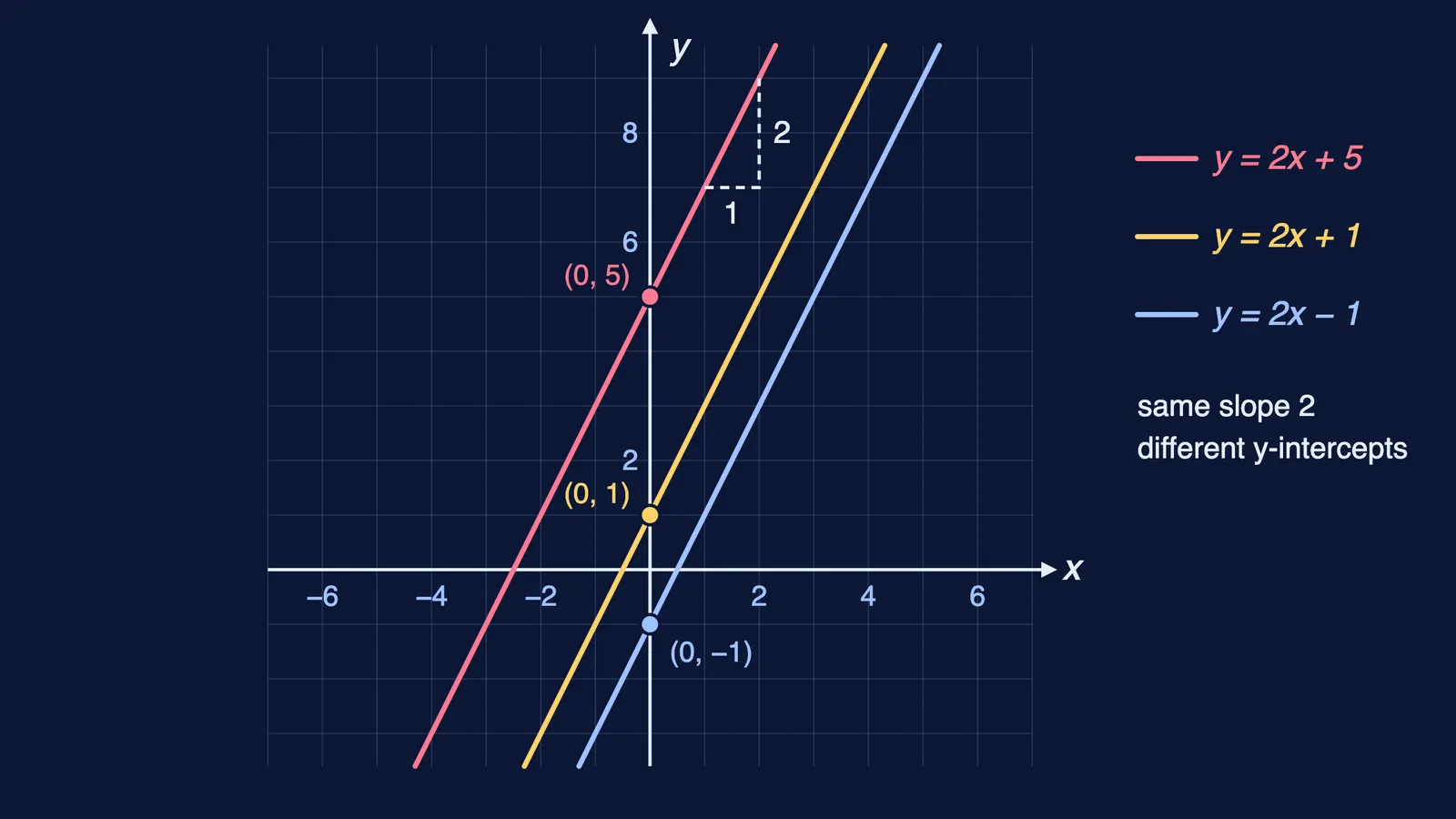
Parallel lines: lines with the same slope and different y-intercepts. Example: y = 2x − 1, y = 2x + 1 and y = 2x + 5.
The book says slope returns in the chapter on linear equations.
How to learn these terms
Learn them in pairs: polynomial and equation, slope and y-intercept, linear growth and linear decay.
For any rule, tabulate x = 0, 1, 2, 3 and check for a constant difference.
Draw y = 2x − 1, y = 2x + 1 and y = 2x + 5 on one graph, then y = x, y = 2x and y = ½x, and say what a and b each change.
Write a real bill or fare as y = ax + b and say what a and b mean.
If a term still feels abstract, the Fermi Concept Library gives every mathematics concept its own lesson and its place in the map.