On this page
Chapter 18 is the first numbered chapter of Unit 5, Sports, in *Khel Praveen*, NCERT's new Class 9 Physical Education and Well-being textbook (First Edition, April 2026) (NCERT prelims). It runs across pages 139 to 142 of the Unit 5 PDF and has two parts: three indigenous martial arts (Thang-Ta, Gatka and Kalaripayattu) and one indigenous sport, Mallakhamb.
A note on spelling: the book prints the title as "Indigenious Martial Arts and Sport". This guide uses the standard spelling, "Indigenous".
How is this chapter marked in 2026-27?
The CBSE Grade 9 curriculum for Physical Education and Well-being sets 100 marks: 20 for theory and 80 for practical work. Its assessment table says every unit carries 2 theory marks (MCQs, objective or short answer), giving 2 × 8 units = 16 marks, plus a 4-mark viva.
The 2 marks belong to the whole unit, never to this chapter alone. The curriculum also numbers units differently from the book: it lists Kalaripayattu, Thang Ta, Gatka and Malkambh (its spelling) under Unit 8, Sports, with 40 practical hours. Assessment is continuous and run by your school, not a board paper.
What are Thang-Ta, Gatka and Kalaripayattu?
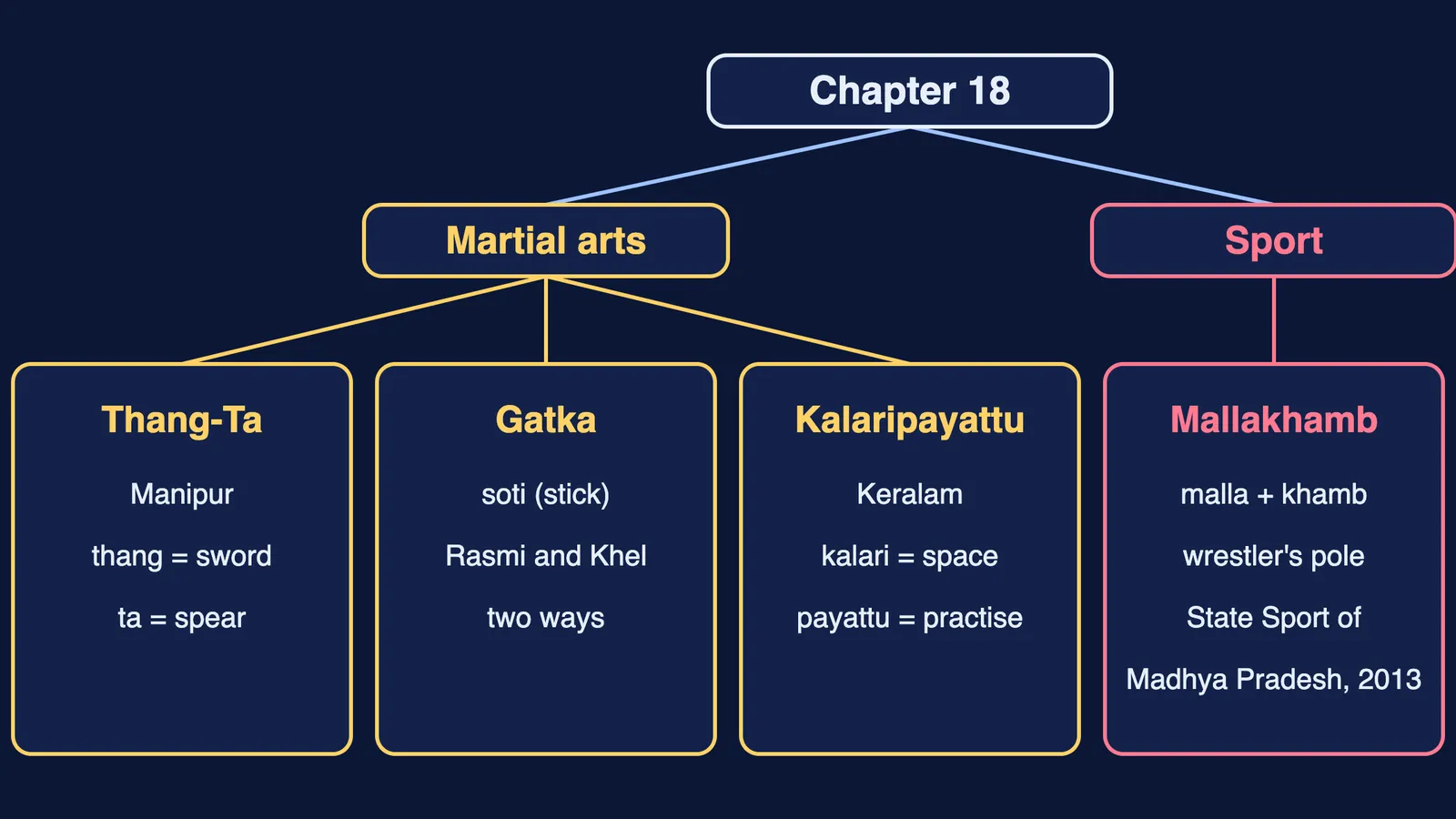
Thang-Ta comes from Manipur in Northeast India. In its name, thang means sword and ta means spear. The book presents it as a system linking movement, breathing, meditation and weapons, and gives a second name, Huyen Lallong.
The book describes two skills. The basic stance keeps the feet about shoulder-width apart. The footwork turns the body left on the balls of both feet, with the feet at roughly 45 degrees and the body in one straight line from head to right heel; this is the Singh Mudrā, or Lion's Posture. Sarik Sarat is the empty-hand form, using hands and feet, and is taught once a learner has become competent with weapons.
Gatka, as the book explains it, refers to a wooden stick, traditionally called the soti, used to stand in for a sword. The book links it to Sikh history: it credits the Sixth Guru, Guru Hargobind Sahib Ji (1595–1644), with starting it, and Guru Gobind Singh Ji with developing it further. Gatka is practised in two ways, Rasmi (symbolic and traditional) and Khel (competitive), and the World Gatka Federation frames its international rules.
Kalaripayattu is linked to Keralam in the book. Kalari is the place where training happens; payattu means practising. Citing references in the Vedas, the book says it has existed for 3,000 years, and that its movements and stances draw on animals such as the boar, lion and elephant. It records that the practice was banned under British rule, kept alive by a few masters in secret, and revived after independence. Advanced learners study marma-sthānam, the body's vital points.
What is Mallakhamb, and why does the book call it a sport?
Mallakhamb joins malla (wrestler) and khamb (pole), so the name means "wrestler's pole". The book places it in Gurukul and Akhara training and names two historical texts that mention it, *Manasollasa* (12th century AD) and *Vyayam Dipika*.
Key names and dates from the book:
Balambhat Dada Deodhar, court gymnast to Bajirao Peshwa II (1796–1818), revived it for training soldiers.
Popularised in the early 20th century by Pt. Babasaheb Natu, R. V. Bhogle and K. B. Boksekar.
Declared the State Sport of Madhya Pradesh in 2013, and part of the Khelo India Games and the 36th National Games (2022).
Performed today by both men and women on a wooden pole, a rope or hanging apparatus. The book calls the modern form a competitive and artistic sport.
How can you revise all four in 15 minutes?
Draw a grid with one row per tradition and four columns: origin, name meaning, one person or date, one skill or form. Fill it from memory, then check the book.
A filled row looks like this. Thang-Ta: Manipur; thang = sword, ta = spear; also called Huyen Lallong; Sarik Sarat is its unarmed form.
Watch for three easy slips:
Mixing up which word means sword (thang) and which means spear (ta).
Swapping Rasmi (traditional) and Khel (competitive) in Gatka.
Calling Mallakhamb a martial art; the book files it as the chapter's indigenous sport.
Practice questions for Chapter 18
Marks shown are our suggestion.
(1 mark) Which is the unarmed form of Thang-Ta? (a) Huyen Lallong (b) Sarik Sarat (c) Rasmi (d) Khel. Answer: (b).
(1 mark) Mallakhamb was declared the State Sport of which state, and in which year? Answer: Madhya Pradesh, 2013.
(2 marks) Name the two ways Gatka is practised and say how they differ. Answer: Rasmi is symbolic and traditional; Khel is the competitive form.
(2 marks) Split "Kalaripayattu" into its two parts and give the meaning of each. Answer: kalari, the training place; payattu, practising.
Taking PE further? See our Class 11 guides to Olympism, Olympic values and symbols, yoga for Class 11 physical education and psychology and sports.
Not sure where to begin your revision? Fermi's AI tutor works out what you already know and builds a plan for the session.