On this page
India's Long Road to Independence is Chapter 2 of Exploring Society: India and Beyond, Part 2, NCERT's new Social Science textbook for Grade 8 (book code 0882, First Edition June 2026, per the book's prelims). It runs from page 35 to page 84 and is the only chapter in Theme B, Tapestry of the Past.
CBSE publishes no separate 2026-27 curriculum for Classes 6 to 8; its 2026-27 curriculum page lists Classes 9 to 12 only. Class 8 follows the NCERT book and is assessed by the school, so this guide gives no marks or exam pattern.
What is Chapter 2 of Exploring Society Part 2 about?
The chapter asks three big questions: how a land of many languages, regions and faiths came together to end almost two centuries of British rule, which events and people shaped the struggle, and what the freedom fighters agreed or disagreed about. It admits it can name only a few of the many who took part; an ICHR dictionary lists some 14,000 martyrs (NCERT, Chapter 2).
A study tip from the prelims: anything in the book may be assessed except chapter-opening quotations, text marked "You need not remember this", diacritic marks and the glossary. So the jail figures near the end are for discussion, not memorising.
What are the main events from 1858 to 1947?
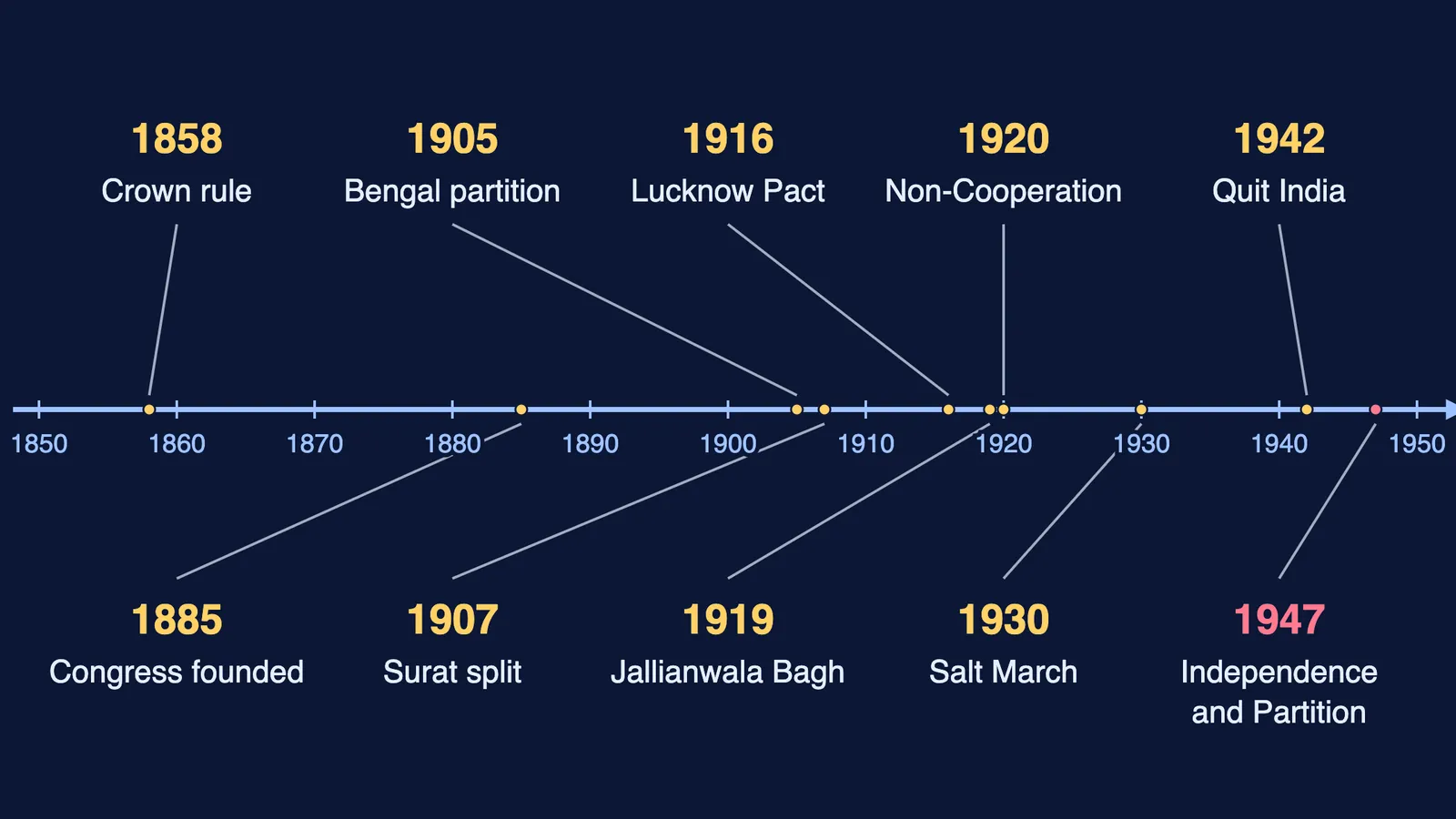
All dates below are from the NCERT chapter.
1858: the British Crown takes direct control from the East India Company; a royal proclamation says some 560 princes will keep their states under British "paramountcy".
1885: the Indian National Congress holds its first session in Bombay.
1905: Viceroy Curzon partitions Bengal. Swadeshi and boycott protests spread.
1907: the Congress splits at Surat between Moderates and Nationalists.
1916: the Lucknow Pact joins the Congress and the Muslim League; Tilak and Annie Besant start Home Rule.
1919 to 1922: the Rowlatt Act, the Jallianwala Bagh massacre and Non-Cooperation, called off after Chauri Chaura.
1929 and 1930: the Lahore session demands Purna Swaraj (complete independence); Gandhi's 380-km Salt March to Dandi starts Civil Disobedience.
1942: the Cripps offer is rejected; Quit India begins with "Do or Die".
1946 and 1947: naval and air force mutinies, the Cabinet Mission and Direct Action Day, then independence on 15 August 1947 together with Partition.
Also in the chapter: social reformers, Swami Vivekananda, Vande Mataram, Birsa Munda's Ulgulaan, the North-East, Subhas Chandra Bose's INA and Sardar Patel's integration of the princely states.
How did freedom fighters differ on methods?
The chapter's summary groups the approaches; in our words:
Moderates: hoped for a degree of autonomy within the British Empire, through resolutions calling for dialogue and gradual reform.
Nationalists: wanted Swaraj and used Swadeshi, boycott and national education to awaken the public. Tilak, Lala Lajpat Rai, Bipin Chandra Pal and Aurobindo Ghose are the book's examples.
Revolutionaries: believed armed action would shake British rule, from Khudiram Bose to the Ghadar Party and Bhagat Singh.
Gandhi's satyagraha: non-violent mass action by ordinary people, as in the Salt March.
The book adds that historians have debated why Britain left: older views credited mainly Gandhi and the Congress, newer ones add popular uprisings, revolutionaries' attempts, the air force and navy mutinies, Britain's weakened position after World War II and worldwide decolonisation.
Worked example: a five-mark answer
Question (our suggestion, 5 marks): How did the Moderates and Nationalists differ, and what happened at Surat in 1907?
Model answer:
Goal: Moderates sought gradual self-government within the Empire; Nationalists worked towards independence.
Methods: Moderates relied on resolutions and dialogue; Nationalists used Swadeshi, boycott and national education to involve the public.
Trigger: alarmed by the 1906 Calcutta session's call for Swaraj, the British pressed some moderate leaders, who then tried to step back from those resolutions.
Event: at Surat, Tilak was stopped from speaking, the session broke down, and the Nationalists held a separate meeting.
Result: the Congress stayed divided until the 1916 Lucknow session reunited it.
The pattern (goal, method, trigger, event, result) fits most "compare" questions here.
Practice questions (our suggestion)
Who was Birsa Munda, and what was the Ulgulaan? (2 marks)
Explain two ways the Swadeshi idea existed before 1905, using examples from the chapter. (3 marks)
What did the Home Rule Movement ask for, and how did it differ from the earlier Nationalist demand? (3 marks)
Compare the Cripps Mission's offer with the demand made at Lahore in 1929. (4 marks)
Give three reasons the book lists for Britain leaving India in 1947. (3 marks)
Not sure where to start? Fermi's AI tutor works out what you already know and builds a plan for the session.
How does the chapter connect to the rest of the book?
It continues from Part 1's colonial era and 1857 chapters; our 1857 revolt guide is a quick refresher. It ends by asking what sort of nation free India would build; later in Part 2, Theme D covers the judiciary and citizenship.
Using the older book? See our making of the national movement guide, or test yourself with the freedom struggle timeline for Class 8.