

On this page
This is a revision guide to NCERT's Class 8 history chapter “The Making of the National Movement: 1870s–1947”, Chapter 8 of Our Pasts III. For 2025-26 NCERT has also brought out a new Class 8 social science book, Exploring Society: India and Beyond, so check which book your school follows.
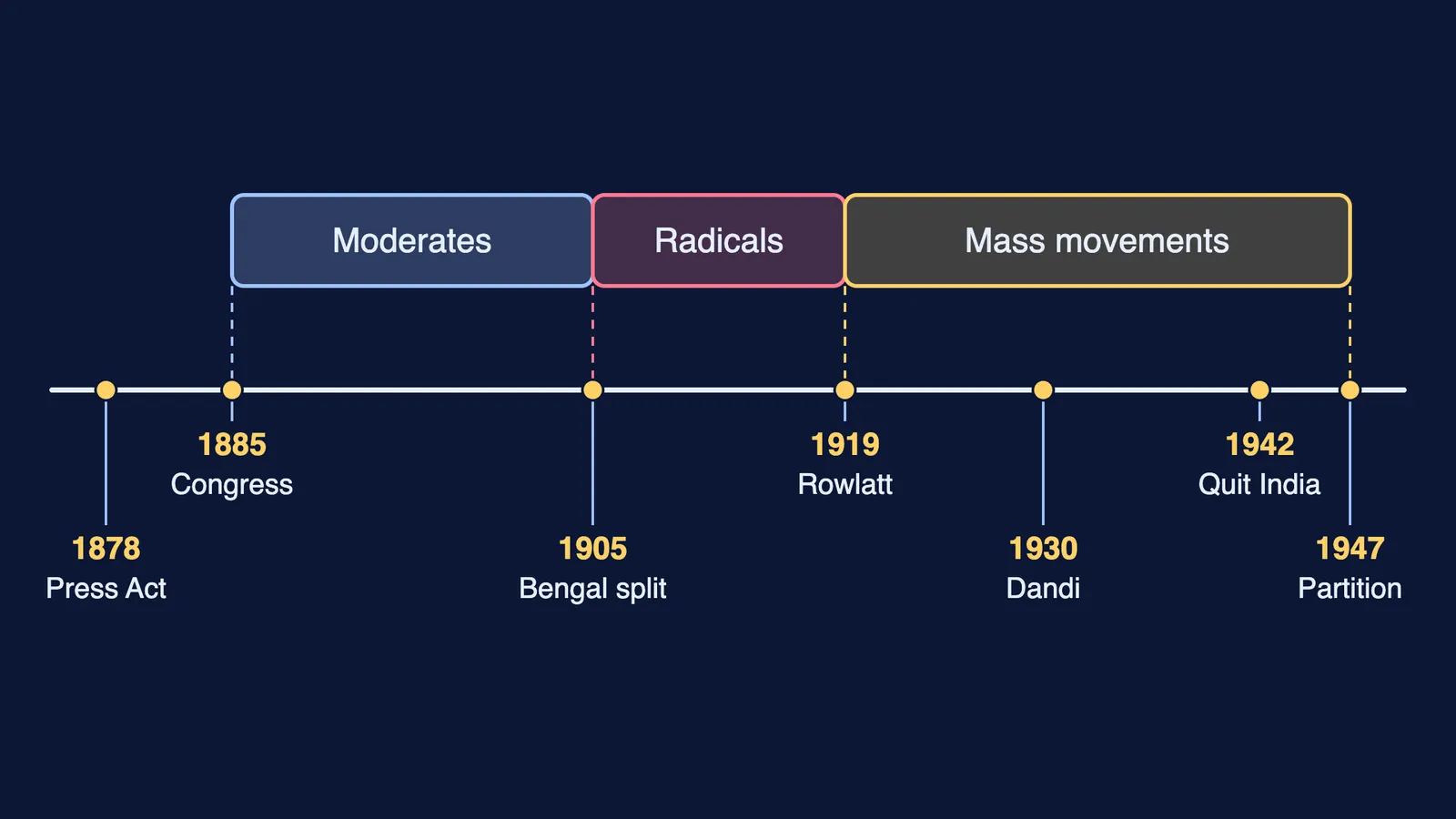
The chapter is long, but it has a simple spine. Learn it as four phases, each with its own leaders, methods and results, and the dates stop feeling random.
What does the making of the national movement chapter cover?
It opens with a question: what is India, and who is it for? The NCERT chapter answers that India meant all its people, whatever their class, caste, creed, language or gender, and that India could not be for Indians while the British controlled its resources.
Anger grew in the 1870s and 1880s. The Arms Act of 1878 barred Indians from keeping arms, the Vernacular Press Act of the same year let the government seize newspapers that printed anything “objectionable”, and in 1883 the Ilbert Bill row exposed British racial attitudes. The Indian National Congress was founded when 72 delegates met in Bombay in December 1885, according to the textbook.
Who were the Moderates and the Radicals?
Two exercise questions turn on this contrast. All details are from the NCERT chapter.
Moderates (roughly the first twenty years of the Congress): Dadabhai Naoroji, Pherozeshah Mehta, Badruddin Tyabji, Surendranath Banerji and others. They wanted more Indians in government, civil service exams in India as well as London, and lower land revenue. Their method was petitions, speeches and newspapers, because they believed the British respected justice.
Radicals (from the 1890s): Bal Gangadhar Tilak, Bipin Chandra Pal and Lala Lajpat Rai. They criticised the “politics of prayers”, asked people to rely on their own strength and fight for swaraj, and backed boycott. Tilak's slogan was “Freedom is my birthright and I shall have it!”
The turning point was Curzon's partition of Bengal in 1905, which set off the Swadeshi movement. The two groups split in 1907 over boycott and reunited in December 1915. In 1916 the Congress and the Muslim League signed the Lucknow Pact.
What were Gandhi's movements, in order?
Gandhi came back from South Africa in 1915, aged 46. After local struggles in Champaran, Kheda and Ahmedabad, he led national campaigns, in this order according to the chapter:
Rowlatt Satyagraha, 1919: a hartal on 6 April against a law that curbed basic freedoms; the Jallianwala Bagh massacre followed on 13 April.
Khilafat and Non-Cooperation, 1920–22: students left government schools, lawyers gave up their practices and foreign cloth was burnt. Gandhi called it off after the violence at Chauri Chaura in February 1922.
Civil Disobedience: the Congress resolved on Purna Swaraj in 1929, and in 1930 Gandhi marched over 240 miles from Sabarmati to Dandi to break the salt law.
Quit India, 1942: “do or die”, but non-violently. By the end of 1943 over 90,000 people had been arrested and around 1,000 killed in police firing.
Why did partition happen?
Learn it as a chain of causes, all from the NCERT text:
1937: the Congress formed governments in 7 out of 11 provinces, which, the chapter says, seemed to convince the League that Muslims were a minority who would always play second fiddle.
1940: the League demanded “Independent States” for Muslims in the north-west and east, without naming Pakistan.
1946: the League's success in the seats reserved for Muslims was spectacular, and the Cabinet Mission's plan for a united India as a loose confederation could not get the Congress and the League to agree.
16 August 1946: the League's “Direct Action Day” set off riots in Calcutta, and violence spread across northern India by March 1947.
Independence, the chapter ends, came mixed with the pain and violence of partition, as millions were forced to flee their homes.
How should you revise this chapter?
Make one grid with four columns: phase, leaders, methods, result. Fill one row each for the Moderates, the Radicals, Gandhi's mass movements and 1937–47. That single page covers several of the exercise questions, including 5, 6, 8 and 9. For the dates in order, use our freedom struggle timeline for Class 8.
A worked answer for question 6 (how the Radicals differed from the Moderates):
Aim: Moderates wanted reforms and more Indians in high posts; Radicals demanded swaraj.
Method: Moderates petitioned; Radicals called for boycott and mass mobilisation.
Belief: Moderates trusted British justice; Radicals said people must rely on their own strength.
Example: Tilak's “Freedom is my birthright” slogan.
To link causes and effects across phases, try a cause-and-effect chart for a history chapter. You will meet Non-Cooperation and Civil Disobedience again in our Class 10 notes on nationalism in India.
When you switch back to science, Fermi's AI tutor can work out what you already know and build a plan for the session, so you start with a clear next step.


