On this page
Chapter 5 of the new Class 6 Social Science book asks: how do we define India, and what were its ancient names? The book is *Exploring Society: India and Beyond* (NCERT code fees1, First Edition June 2024), and this chapter sits in Theme B, "Tapestry of the Past", between "Timeline and Sources of History" and "The Beginnings of Indian Civilisation" (NCERT textbook contents).
CBSE publishes no separate 2026-27 curriculum for Classes 6 to 8; these classes follow the NCERT book, and the chapter is assessed by the school.
What is the chapter India, That Is Bharat about?
The chapter's starting point is that today's India is a modern nation with defined borders, states and population, but the region we call the Indian Subcontinent has carried many names and changing boundaries over thousands of years (NCERT Chapter 5). Those names reach us through three kinds of sources: ancient texts, accounts left by travellers and pilgrims, and inscriptions.
What were the ancient names for India?
These come from Indian texts and inscriptions (NCERT Chapter 5):
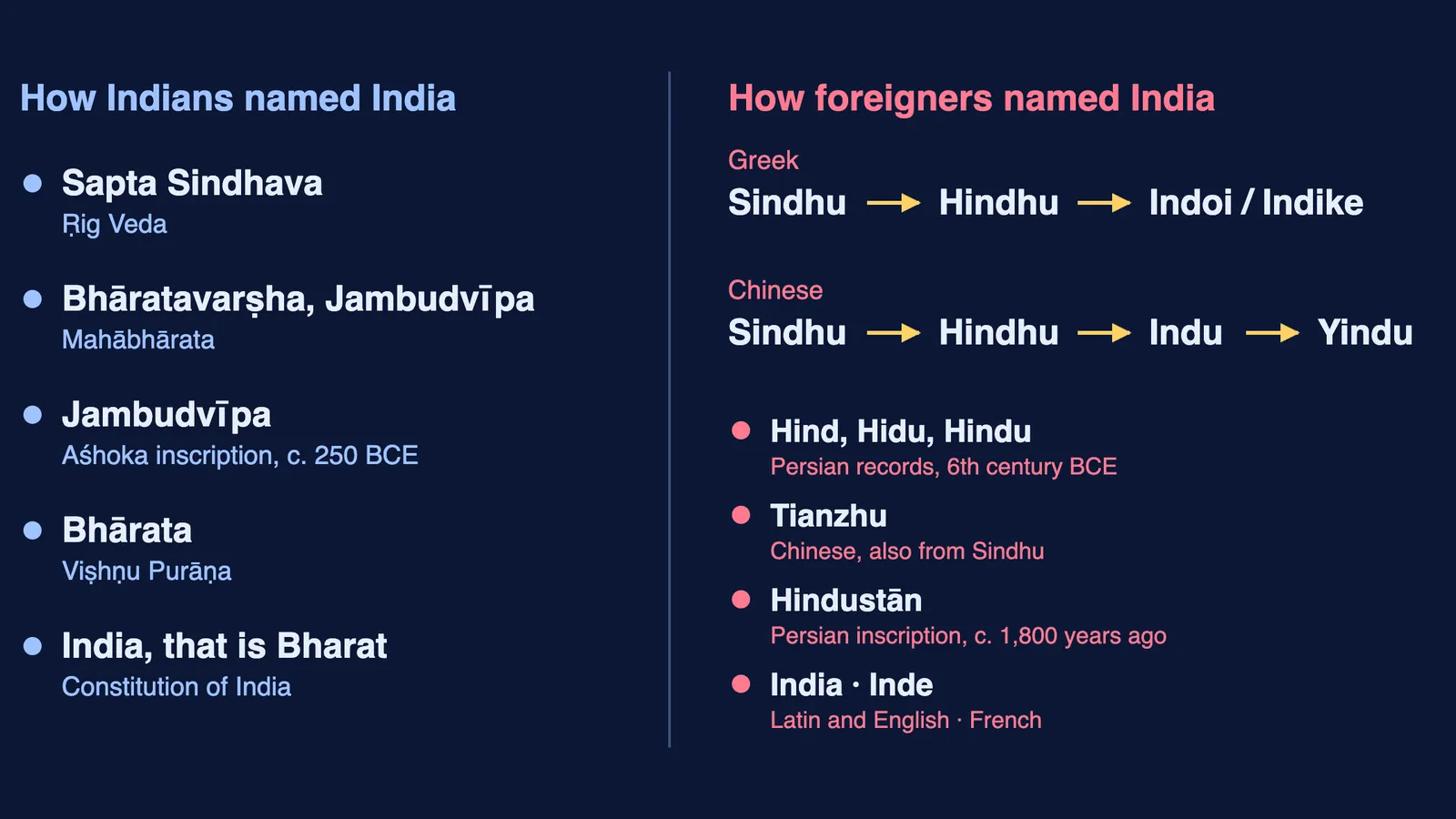
Sapta Sindhava, "land of the seven rivers", is what the Ṛig Veda calls the northwest of the Subcontinent. "Sindhava" comes from Sindhu, the Indus River (or sometimes any river).
The Mahābhārata names many regions, such as Kāshmīra, Vanga, Kaccha and Kerala.
For a name covering the whole Subcontinent, the book turns to two Mahābhārata terms: Bhāratavarṣha, "the country of the Bharatas", and Jambudvīpa, "the island of the jamun tree's fruit". Ancient texts are hard to date, the book notes, but scholars generally place this long poem from a few centuries BCE onward.
Emperor Aśhoka, whom the book dates to about 250 BCE, used Jambudvīpa in one of his inscriptions for all of India, which at that time also took in today's Bangladesh, Pakistan and parts of Afghanistan.
A few centuries later, Bhārata became the usual name. The Viṣhṇu Purāṇa describes it as the land between the ocean to the south and the snowy mountains to the north.
An ancient Tamil poem from about 2,000 years ago describes a similar span. Today the name is generally written Bharat in north India and often Bharatam in south India. The phrase "India, that is Bharat" appears at the very start of the Constitution, which came into force in 1950; its Hindi version reads "Bhārat arthāth India".
Where does the name India come from?
Almost every outside name traces back to one river, the Sindhu (NCERT Chapter 5).
A Persian emperor took control of the Indus region in the 6th century BCE. Persian records called India Hind, Hidu or Hindu, their adaptations of Sindhu. The book stresses that in ancient Persian, "Hindu" was purely a place name, not a reference to the religion.
The ancient Greeks, working from Persian sources, said Indoi or Indike, dropping the "h" because Greek had no such letter.
The ancient Chinese used Yintu or Yindu, also from Sindhu. Another Chinese name from Sindhu, Tianzhu, could also be read as "heavenly master"; the book links this to ancient Chinese respect for India as the Buddha's land.
Hindustān first appears in a Persian inscription about 1,800 years ago. The book says "most invaders" of India later used this term.
Latin and English say India; French says Inde.
Worked example: trace one name back to its source
The book draws two arrow chains. Copy them exactly, then rebuild them from memory:
Greek: Sindhu → Hindhu → Indoi / Indike. The Greeks worked from Persian sources and dropped the opening "h".
Chinese: Sindhu → Hindhu → Indu → Yindu.
A note on spelling: the arrows print the middle step as "Hindhu", while the chapter's text gives the Persian forms as Hind, Hidu or Hindu. We follow the arrows as printed.
Then cover both chains and write them out. The book's summary adds that names like Hindu and Indoi eventually led to "India".
How does this chapter connect to the rest of the book?
The book says the Ṛig Veda returns in Chapter 7, India's Cultural Roots; the Mahābhārata is read in Theme C, "Our Cultural Heritage and Knowledge Traditions"; we will meet Aśhoka again later; and the Constitution is studied in Grade 7 (NCERT Chapter 5). For a head start, see our guides to the Rigveda and what early books tell us, Ashoka and his inscriptions and the key features of the Indian Constitution.
Practice questions (marks are our suggestion)
What does "Sapta Sindhava" mean, and which text uses it? (1 mark)
Give the meanings of Bhāratavarṣha and Jambudvīpa. (2 marks)
Why did the Greeks say Indoi and not Hindoi? (2 marks)
Name three kinds of sources the chapter uses to learn India's old names, with one example of each. (3 marks)
Write the book's chain from Sindhu to Yindu and say which people used Yindu. (3 marks)
Stuck on where to begin revising? Fermi's AI tutor works out what you already know and builds a plan for the session.