On this page
A JEE Advanced-style hydrocarbons question often tests more than one reaction: you follow a radical, count ring positions or identify an unknown. Here are 8 original questions, easy to hard.
Hydrocarbons in the JEE (Advanced) 2026 syllabus covers alkanes, alkenes and alkynes, and benzene, and names allylic halogenation, metal acetylides and the cyclic polymerisation of alkynes. The facts below follow NCERT Class 11 Chemistry, Unit 9 Hydrocarbons (Reprint 2026-27), and every answer was checked with a Python script (RDKit). For the chapter plan, see Hydrocarbons for JEE Advanced: how to prepare.
How should you use this JEE Advanced hydrocarbons set?
Give yourself 25 minutes for all eight, with the solutions covered.
"One or more options correct" means judging each option on its own.
Write the intermediate (cation or radical) before choosing.
Read the trap line even when you were right.
For how multi-correct answers are scored, see our guide to partial marking in JEE Advanced.
Easy: are the core rules automatic?
Q1 (easy, single correct). A mixture of bromoethane and 2-bromopropane is treated with sodium in dry ether. Which alkanes form?
(A) butane, 2-methylbutane and 2,3-dimethylbutane (B) 2-methylbutane only (C) butane, pentane and hexane (D) butane and 2,3-dimethylbutane only
Answer: (A). Wurtz coupling joins any two alkyl groups: ethyl–ethyl gives butane, ethyl–isopropyl 2-methylbutane, isopropyl–isopropyl 2,3-dimethylbutane. Trap: (B) assumes only the two different halides couple.
Q2 (easy, one or more options correct). Which statements are correct?
(A) cis-But-2-ene has a dipole moment of about 0.33 D, while that of trans-but-2-ene is almost zero. (B) In the solid state, trans-but-2-ene has a higher melting point than cis-but-2-ene. (C) 2,2-Dimethylpropane boils above pentane because its molecules are more compact. (D) The cis and trans forms of but-2-ene are structural isomers.
Answer: (A), (B). NCERT gives both: in the trans form the two C–CH₃ bond dipoles cancel, and trans isomers melt higher. Trap: (C) gets the effect backwards. A compact molecule has less surface contact and weaker van der Waals forces, so it boils lower; NCERT gives pentane the highest boiling point of the three pentanes, 309.1 K. (D): same connectivity makes them stereoisomers.
Q3 (easy, single correct). Hex-3-yne is reduced with H₂ over Lindlar's catalyst to give X, and with sodium in liquid ammonia to give Y. Then
(A) X is cis-hex-3-ene, Y is trans-hex-3-ene (B) X is trans-hex-3-ene, Y is cis-hex-3-ene (C) X and Y are both hexane (D) X is cis-hex-3-ene, Y is hexane
Answer: (A). Lindlar's catalyst gives the cis alkene; sodium in liquid ammonia gives the trans alkene. Trap: (B) swaps them; both reductions stop at the alkene.
Medium: can you follow a cut or a radical?
Q4 (medium, one or more options correct). Which alkenes give exactly one organic compound on ozonolysis (O₃, then Zn–H₂O)?
(A) oct-4-ene (B) 1,2-dimethylcyclopentene (C) methylenecyclohexane (D) 2,5-dimethylhex-3-ene
Answer: (A), (B), (D). (A) gives two molecules of butanal and (D) two of 2-methylpropanal. In (B), cutting the ring double bond keeps both carbonyl ends in one molecule: heptane-2,6-dione, CH₃CO(CH₂)₃COCH₃. Trap: (C). Its double bond is outside the ring: cyclohexanone and methanal.
Q5 (medium, numerical). Pent-2-ene, CH₃CH=CHCH₂CH₃, is brominated only at allylic positions (Br₂ at very low concentration, in light). Counting structural isomers only, how many monobromo products are possible?
Answer: 3. There are two allylic carbons, C1 and C4. The radical at C1 is shared with C3, giving 1-bromopent-2-ene and 3-bromopent-1-ene. The radical at C4 is shared with C2, but both ends give the same compound, 4-bromopent-2-ene. Trap: 2, which forgets the allylic shift.
Q6 (medium, list match). Match each reagent acting on 1-methylcyclohexene with its major product.
List I: (P) HBr (Q) HBr with benzoyl peroxide (R) H₂O with a few drops of concentrated H₂SO₄ (S) O₃, then Zn–H₂O
List II: (1) 1-bromo-1-methylcyclohexane (2) 1-bromo-2-methylcyclohexane (3) 1-methylcyclohexan-1-ol (4) 2-methylcyclohexan-1-ol (5) 6-oxoheptanal
(A) P-1, Q-2, R-3, S-5 (B) P-2, Q-1, R-3, S-5 (C) P-1, Q-2, R-4, S-5 (D) P-2, Q-1, R-4, S-5
Answer: (A). HBr and acid-catalysed water both add through the tertiary carbocation at C1 (Markovnikov). With peroxide, a bromine radical adds to C2, leaving the tertiary radical on C1. Ozonolysis opens the ring to CH₃CO(CH₂)₄CHO. Trap: (C) carries the peroxide reversal over to hydration; NCERT notes the peroxide effect is seen only with HBr.
Hard: can you count and identify?
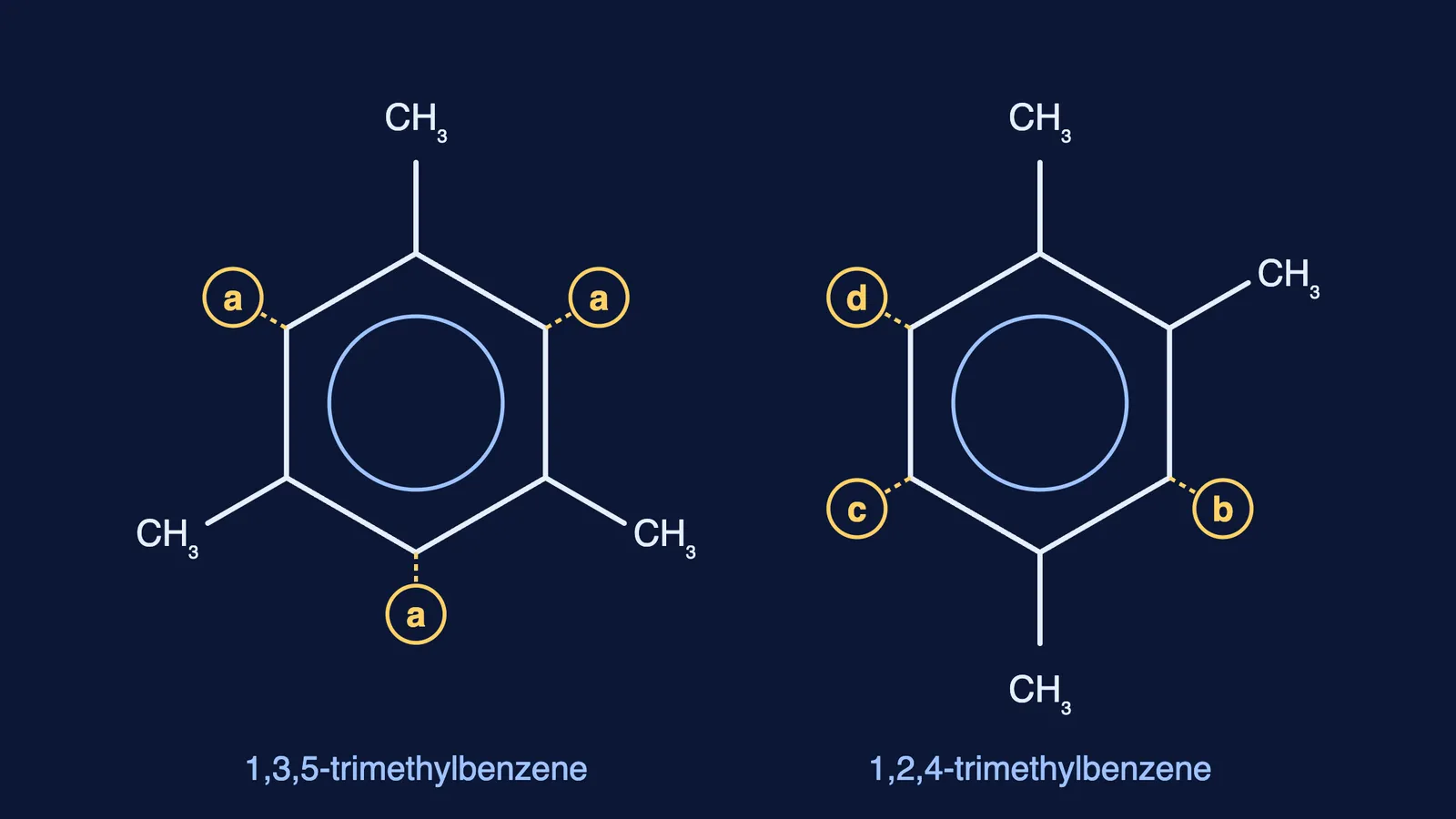
Q7 (hard, numerical). Propyne is passed through a red-hot iron tube at 873 K (as ethyne gives benzene). Assume only cyclic trimers form. Each trimer is then nitrated once on the ring. How many different mononitro products are possible in total?
Answer: 4. Each propyne unit gives the ring one C–CH₃ next to one C–H, so every arrangement is 1,3,5- or 1,2,4-trimethylbenzene; 1,2,3 would need two methyls from one unit. The 1,3,5 isomer has three equivalent free positions (1 product); the 1,2,4 isomer has three different ones (3 products), lettered in the diagram at the top. Trap: 6, which wrongly includes 1,2,3-trimethylbenzene.
Q8 (hard, one or more options correct). 0.52 g of hydrocarbon X (molar mass 104 g mol⁻¹) burns completely to give 1.76 g CO₂ and 0.36 g H₂O. X contains a benzene ring and decolourises bromine in CCl₄. Which statements are correct?
(A) With HBr (no peroxide), X gives (1-bromoethyl)benzene as the major product. (B) With HBr and benzoyl peroxide, X gives (2-bromoethyl)benzene as the major product. (C) X gives a precipitate with ammoniacal silver nitrate. (D) Acid-catalysed hydration of X gives 2-phenylethanol as the major product.
Answer: (A), (B). CO₂: 1.76/44 = 0.040 mol C. H₂O: 0.36/18 = 0.020 mol, so 0.040 mol H. C : H = 1 : 1, and (CH)ₙ with 13n = 104 gives C₈H₈. A benzene ring plus one C=C makes X styrene, C₆H₅CH=CH₂. H⁺ adds to the CH₂ end, giving a cation next to the ring, so Br and OH land on that carbon: (A) right, (D) wrong. A bromine radical also adds to CH₂, leaving a radical next to the ring: (B) right. Trap: (C) fits phenylethyne, C₈H₆, with its acidic ≡C–H.
What should you revise after this set?
Missed Q1 or Q3: reread NCERT sections 9.2.2 and 9.3.4 on preparation.
Missed Q4, Q5 or Q7: redo each with every carbon drawn.
Missed Q6 or Q8: revise cation and radical stability with our guide to GOC for JEE Advanced.
For more reaction problems, the Fermi Problem Library has worked problems with a step-by-step solver that explains the reasoning rather than printing an answer.