On this page
At Advanced level, hydrocarbons come back inside other questions: a product count that needs stereochemistry, an unknown identified from three reactions, a synthesis where the order of steps decides the answer. Below: the official syllabus, what it adds to JEE Main, three solved problems and a plan.
What is in the JEE Advanced hydrocarbons syllabus?
The official JEE (Advanced) 2026 syllabus splits the unit into three parts:
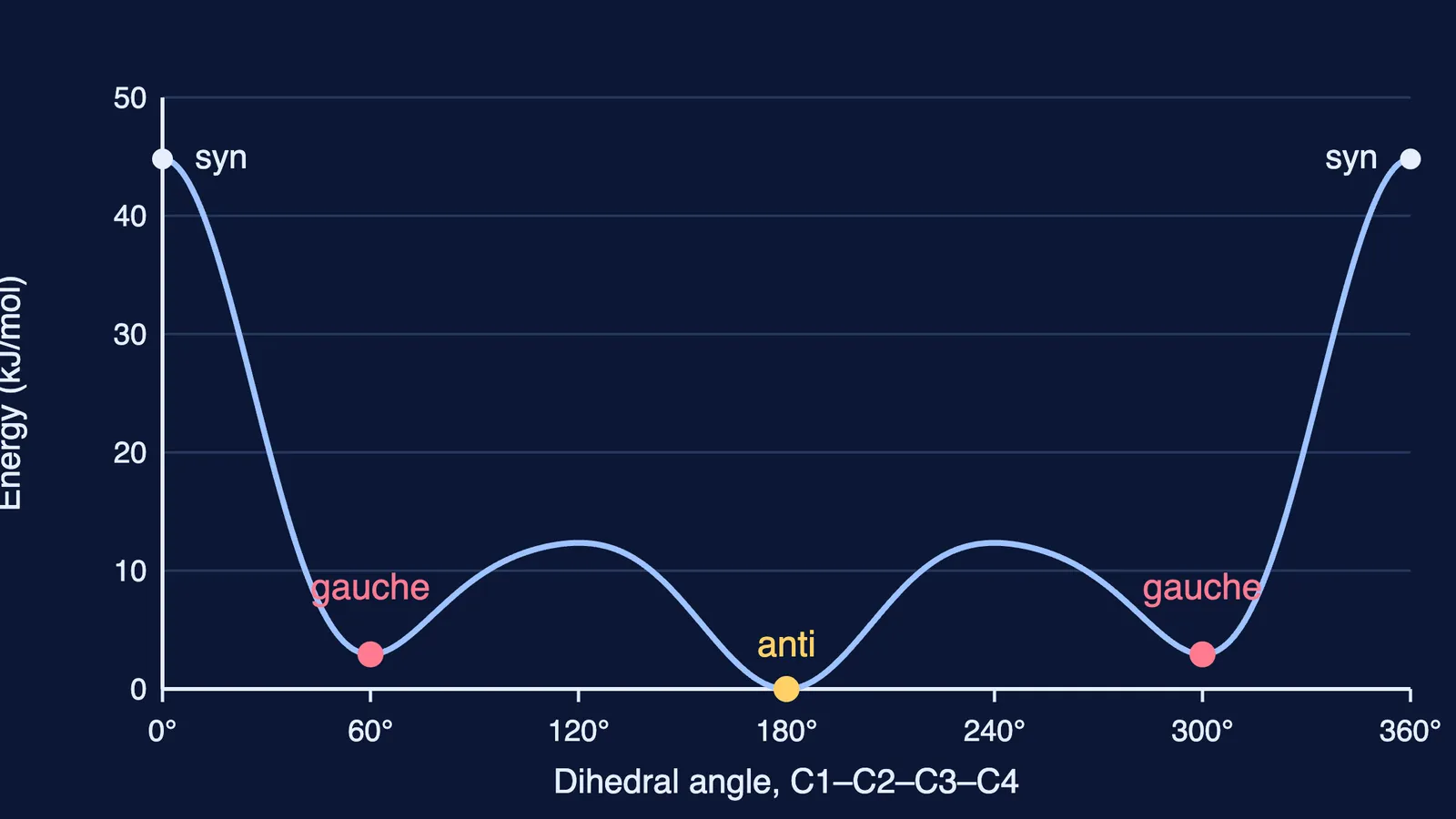
Alkanes: "Homologous series; Physical properties (melting points, boiling points and density) and effect of branching on them; Conformations of ethane and butane (Newman projections only); Preparation from alkyl halides and aliphatic carboxylic acids; Reactions: combustion, halogenation (including allylic and benzylic halogenation) and oxidation."
Alkenes and alkynes: "Physical properties (boiling points, density and dipole moments); Preparation by elimination reactions; Acid catalysed hydration (excluding the stereochemistry of addition and elimination); Metal acetylides; Reactions of alkenes with KMnO4 and ozone; Reduction of alkenes and alkynes; Electrophilic addition reactions of alkenes with X2, HX, HOX, (X=halogen); Effect of peroxide on addition reactions; cyclic polymerization reaction of alkynes."
Benzene: "Structure; Electrophilic substitution reactions: halogenation, nitration, sulphonation, Friedel-Crafts alkylation and acylation; Effect of directing groups (monosubstituted benzene) in these reactions."
The same document notes that the 2026 syllabus is unchanged from 2025. The 2027 syllabus has not been published yet (as of 19 November 2026). What is announced: JEE (Advanced) 2027 will be held on 23 May 2027 (Sunday), organised by IIT Delhi, and you must be among the top 2,50,000 successful candidates in the B.E./B.Tech. paper of JEE (Main) 2027, plus other criteria.
How is JEE Advanced hydrocarbons different from JEE Main?
The hydrocarbons unit of the JEE (Main) 2027 syllabus names conformations of ethane only; Advanced adds butane. Advanced also names allylic and benzylic halogenation, metal acetylides, the reaction of alkenes with KMnO4, the effect of branching on melting point and density, and the dipole moments of alkenes and alkynes, none of which appear by name in the Main unit. If you have finished our hydrocarbons plan for JEE Main, those are the gaps to close.
The JEE (Advanced) 2026 Information Brochure shows that JEE (Advanced) 2026 had two compulsory papers of three hours each. Question types and marking were announced in the paper itself, so practise all formats. Our post on how partial marking works in multiple-correct questions walks through how wrong options have cost marks under past schemes.
Three habits matter more than reagent lists:
Count hydrogen types first. Equivalent hydrogens decide how many halogenation products form.
Ask what each reagent proves. A precipitate with ammoniacal silver nitrate proves a terminal C≡C–H; ozonolysis fragments tell you where the double bond was.
Check the order of steps. On benzene, the first group decides where the second goes.
Worked examples at Advanced level
These problems and numbers are our own.
1. Halogenation, numerical answer. 2,4-Dimethylpentane, (CH₃)₂CH–CH₂–CH(CH₃)₂, is monochlorinated in light. Take the relative reactivity per hydrogen as 1 : 4 : 6 for primary : secondary : tertiary. What percentage of the product is 3-chloro-2,4-dimethylpentane, and how many monochloro isomers form, counting stereoisomers? There are three hydrogen types: 12 primary, 2 tertiary and 2 secondary. Weighted shares: 12 × 1 = 12, 2 × 6 = 12 and 2 × 4 = 8, total 32. The C3 product is 8/32 = 25%. Of three structural isomers, only 1-chloro-2,4-dimethylpentane has a stereocentre (C2 carries H, CH₃, CH₂Cl and an isobutyl group), so it forms as two enantiomers. Total: 4.
2. Identify the alkyne, multi-concept. Hydrocarbon P, C₆H₁₀, gives a precipitate with ammoniacal silver nitrate, so it is a terminal alkyne: hex-1-yne, 3-methylpent-1-yne, 4-methylpent-1-yne or 3,3-dimethylbut-1-yne. Partial hydrogenation, then ozonolysis, gives methanal and 3-methylbutanal. Only 4-methylpent-1-yne, HC≡C–CH₂–CH(CH₃)₂, fits; the others give pentanal, 2-methylbutanal and 2,2-dimethylpropanal. Its acid-catalysed hydration (Hg²⁺) gives the methyl ketone 4-methylpentan-2-one, C₆H₁₂O.
3. Order of steps, multiple-correct. Which routes from benzene give 1-(3-bromophenyl)propan-1-one? (A) Friedel-Crafts acylation with CH₃CH₂COCl/AlCl₃, then Br₂/FeBr₃. (B) Br₂/FeBr₃, then the same acylation. (C) Nitration, then acylation, then bromination. Only A works. The acyl group directs meta. In B, bromine directs ortho and para. In C, Friedel-Crafts reactions fail on strongly deactivated nitrobenzene.
Stuck on why a step works rather than what the answer is? The Fermi Problem Library has worked problems with a step-by-step solver that explains the reasoning rather than printing an answer.
How should you practise hydrocarbons for JEE Advanced?
Revise preparation and reactions with our Class 11 hydrocarbons guide.
Week one: alkanes. Draw Newman projections of butane at every 60°, rank their energies, and count halogenation products for five branched alkanes.
Week two: alkenes and alkynes. For each reagent in the syllabus list, write one product and the one fact it proves.
Week three: benzene. Plan two-step syntheses both ways round and say which order works.
Check every product's molecular formula before you mark it.
Practice:
How many structural monochloro isomers does 2,3,4-trimethylpentane give?
How many C₅H₈ alkynes give a precipitate with ammoniacal silver nitrate?
An alkene C₆H₁₂ gives butanone and ethanal on ozonolysis. Name it.
Answers: 4; 2 (pent-1-yne and 3-methylbut-1-yne); 3-methylpent-2-ene.