On this page
Growth, Development, and Maturation is Chapter 7 of *Khel Praveen*, the new NCERT Class 9 Physical Education and Well-being book (First Edition, April 2026). It sits in the book's Unit 2, Science and Sports, and the full unit is free as a PDF on the NCERT site. It explains why two classmates of the same age can look and perform so differently.
What does Chapter 7 cover, and how many marks is it?
The chapter defines growth, development and maturation, compares them in a table, lists the factors that shape them, and ends with age terms, growth plates and a bone-density graph.
In the CBSE Physical Education and Well-being curriculum for 2026-27, growth and development is a topic in Unit 3, Sciences and Sports, which gets 10 hours (6 theory, 4 practical). The curriculum numbers units differently from the book. The subject is out of 100: theory 20 and practical 80. Theory is 2 marks for each of 8 units, plus a 4-mark viva. Those 2 marks cover the whole unit, not this chapter alone, and the assessment is done by your school.
What is the difference between growth, development and maturation?
In our own words, from the comparison table in the NCERT chapter:
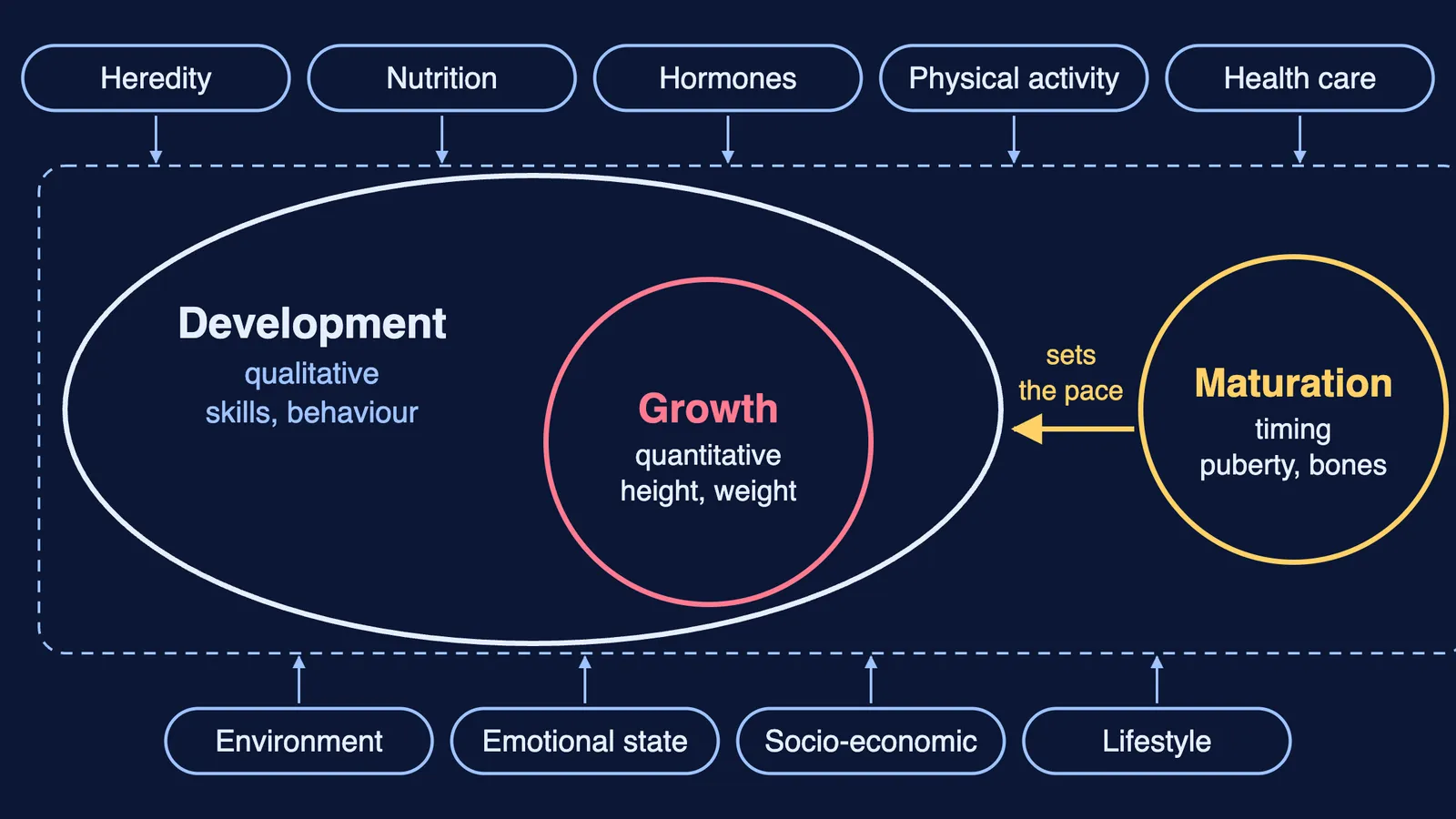
Growth is change you can measure: height, weight, the size of a body part. It is quantitative, happens through cells multiplying, and stops once maturity is reached.
Development is the bigger idea. It covers growth plus qualitative change in function, skills and behaviour, such as learning a sport or keeping calm under pressure. It carries on through life and can happen without any growth.
Maturation is the body's progress towards adulthood. It decides when body systems are ready, so it sets the pace for the other two. Signs include puberty and the closing of growth plates in bones.
The book adds that systems mature at different times: the skeleton finishes later than the reproductive system.
Which factors affect growth, development and maturation?
The chapter's second table lists nine factors, each touching all three processes:
Genetics or heredity
Nutrition
Hormones, including growth and thyroid hormones, and estrogen and testosterone for maturity
Physical activity and exercise
Health and medical care
Environment
Psychological and emotional domain; the book notes stress can lower growth hormone output
Socio-economic domain
Culture and lifestyle, including sleep, rest and activity
For more on how adolescence affects behaviour in sport, see our Class 11 guide to psychology and sports.
What are growth plates and the TW3 method?
The book gives four everyday labels: children are under 12, adolescence begins with puberty and has no fixed starting age, youth is a broad term for anyone under 19, and young athletes are the same age band seen through sport.
Growth plates (physes) are cartilage zones near the ends of long bones where new bone is added, letting bones grow in length and width. After puberty they turn into solid bone, and bone growth then stops. The book notes that the Tanner–Whitehouse 3 (TW3) method judges skeletal maturity for sport from an X-ray of the wrist and hand on the left side. Its Fig. 7.3 plots bone density against age from 0 to 70 years. (The figure's label prints "aggeing"; the correct spelling is ageing.)
This is a study summary, not medical advice. For any injury or growth concern, speak to a doctor.
How do you apply this to two classmates?
Take two fictional 14-year-olds in the same class. The names and numbers are invented for this example.
Arjun grows from 152.0 cm to 159.5 cm in a year: 159.5 − 152.0 = 7.5 cm.
Kabir grows from 160.0 cm to 162.0 cm: 162.0 − 160.0 = 2.0 cm.
Arjun grew 7.5 ÷ 2.0 = 3.75 times as much, yet is still 2.5 cm shorter.
Growth (the centimetres) is measurable; maturation explains the timing, since Arjun may be in his growth spurt while Kabir had his earlier. The book makes the same point for sport: a sudden jump in speed or strength may come from training or from a natural growth spurt. To compare body measures properly, read our Class 11 guide to tests and measurements.
What practice questions can you try?
Marks are our suggestion, in the curriculum's MCQ and short-answer style.
(1 mark) Which is an example of growth? (a) learning to dribble (b) a 3 cm rise in height (c) staying calm in a match (d) better teamwork
(1 mark) Name the sports age method based on a hand-and-wrist X-ray.
(2 marks) Give one example of development that happens with no growth at all, and say why it still counts as development.
(2 marks) A sprinter's time improves after a summer in which she grew 5 cm. Give two possible reasons.
Answers: 1 (b); 2 TW3. For 3 and 4, use Table 7.1 and the factors above.
Not sure where to begin revising a unit like this? Fermi's AI tutor works out what you already know and builds a plan for the session. In Class 11, the anatomy and physiology guide builds on this chapter.