On this page
Gravitation questions in JEE Main and NEET-UG rarely need new physics. Marks go on a short list of slips: the wrong distance, a shortcut used outside its range, a sign dropped, a ratio applied to the wrong system. Below are nine of them, each with the wrong working, the physics behind the fix, an original example and a habit.
The unit is the same for both exams. Unit 6 of the NTA Syllabus for JEE (Main) 2027 and Unit 6 of the NMC NEET (UG) 2026 syllabus both list the universal law, variation of g with altitude and depth, Kepler's laws, potential energy and potential, escape velocity and satellite motion. All examples use g = 9.8 m/s² and R = 6400 km, the values in Chapter 7 of NCERT Class 11 Physics Part I.
Which distance goes into a gravitation formula?
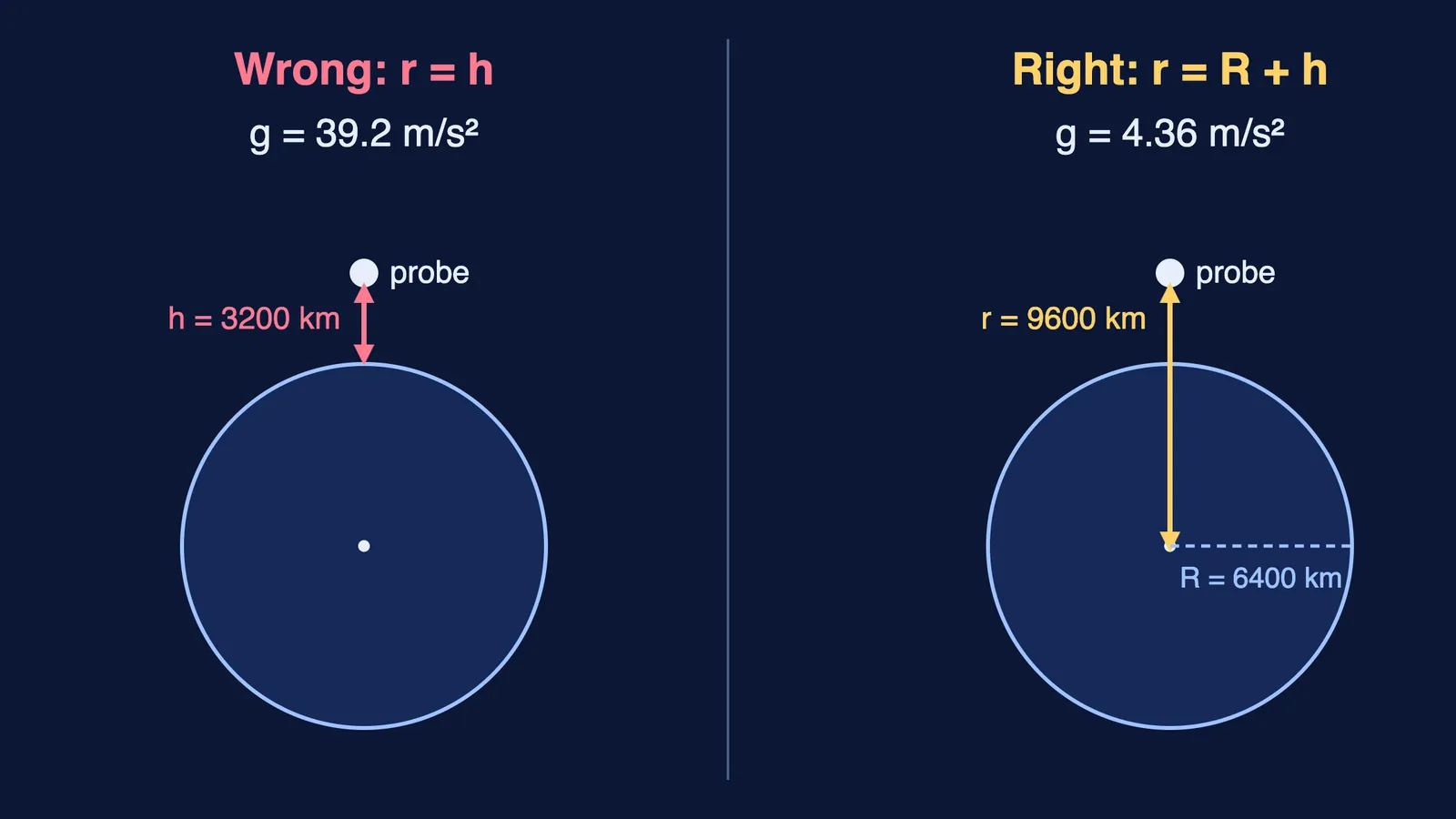
Putting the height h where the formula needs r = R + h.
Wrong: a probe is 3200 km above the surface, so g = gR²/h² = 9.8 × (6400/3200)² = 39.2 m/s². That is four times the surface value, out in space.
Why: Newton's law measures distance between centres. For a uniform sphere, the NCERT chapter shows the force outside acts as if all the mass sits at the centre.
Fix: r = 6400 + 3200 = 9600 km, so g = 9.8 × (6400/9600)² = 4.36 m/s².
Habit: before substituting, write "r = ___ from the centre".
Using g(1 − 2h/R) when h is not small.
Wrong: at h = 1280 km, g = 9.8 × (1 − 0.4) = 5.88 m/s².
Why: the shortcut is a binomial approximation, valid only for h much smaller than R. Here h is a fifth of R.
Fix: g = 9.8 × (6400/7680)² = 6.81 m/s². The shortcut is off by about 14%.
Habit: use the shortcut only if h/R is below about 0.05; otherwise square the ratio.
Using inverse-square inside the Earth.
Wrong: at depth 2000 km, g = 9.8 × (6400/4400)² = 20.7 m/s², more than at the surface.
Why: below the surface, the outer shell exerts no net force on you, so only the mass inside radius R − d pulls. For a uniform Earth, g falls linearly: g(1 − d/R).
Fix: g = 9.8 × (1 − 2000/6400) = 6.74 m/s².
Habit: inside, g goes down linearly; outside, it goes down as 1/r². Nowhere below ground does g exceed the surface value in this model.
Why do gravitation energy answers come out wrong?
Using mgh for a large height.
Wrong: lifting a 150 kg payload from the surface to h = 3200 km needs mgh = 150 × 9.8 × 3.2 × 10⁶ = 4.70 × 10⁹ J.
Why: the NCERT Points to Ponder note that mgh is only an approximation to the difference in −GMm/r; g itself shrinks on the way up.
Fix: ΔU = GMm(1/R − 1/1.5R) = mgR/3 = 3.14 × 10⁹ J; the shortcut overshoots by half.
Habit: if h is comparable to R, write U = −GMm/r at both ends and subtract.
Mixing up potential and potential energy.
Wrong: "the potential at the surface is −GMm/R joules."
Why: potential V is energy per kilogram, −GM/R in J/kg; it does not contain the test mass. Both are negative, with zero at infinity.
Fix: V = −gR = −6.27 × 10⁷ J/kg. The minimum energy to take an 80 kg instrument from the surface to infinity is m × (0 − V) = 5.02 × 10⁹ J.
Habit: write the unit next to every V and U; J/kg and J are not interchangeable.
Adding the full 11.2 km/s to escape from an orbit.
Wrong: a satellite circling at r = 4R needs another 11.2 km/s to escape.
Why: 11.2 km/s is escape speed from the surface. From radius r, escape speed is √(2GM/r), which is √2 times the orbital speed there.
Fix: orbital speed = √(gR/4) = 3.96 km/s; escape speed there = 5.60 km/s; the extra speed needed is only 1.64 km/s.
Habit: escape speed belongs to a radius, not to a planet. Our escape velocity simulation shows how launch speed decides fall, orbit or escape.
Which gravitation ratios and ideas get misapplied?
Using one Kepler constant for different central bodies.
Wrong: two satellites orbit at the same r = 16 000 km, one around Earth and one around a planet of twice Earth's mass, so their periods are equal.
Why: T² = 4π²r³/GM. The NCERT chapter notes the constant is the same for all planets of the Sun, with a separate one for satellites of the Earth: it depends on the central mass.
Fix: Earth satellite: v = √(gR²/r) = 5.01 km/s, T = 2πr/v ≈ 335 minutes. Around the heavier planet, T is smaller by √2: about 237 minutes.
Habit: compare periods with T² ∝ r³ only around the same central body.
Saying g is zero inside an orbiting spacecraft.
Wrong: an astronaut 640 km up floats, so g = 0 there.
Why: NCERT Points to Ponder say weightlessness comes from astronaut and craft both being in free fall, not from weak gravity.
Fix: g = 9.8 × (6400/7040)² = 8.10 m/s², about 83% of its surface value.
Habit: "weightless" means zero normal force, not zero gravity.
Mixing km and m inside a square root.
Wrong: orbital speed near the surface = √(gR) = √(9.8 × 6400) = 250 m/s.
Why: g is in m/s², so R must be in metres.
Fix: √(9.8 × 6.4 × 10⁶) = 7.92 km/s.
Habit: convert every length to metres on the first line.
What should you check in the last 60 seconds?
Stuck on why your answer is off? The Fermi Problem Library has worked problems with a step-by-step solver that explains the reasoning rather than printing an answer.
For syllabus maps, worked examples and a week-long plan, read our Gravitation for NEET preparation guide and our Gravitation for JEE Main preparation guide.