On this page
If you are preparing for JEE Main and NEET-UG together, Gravitation is one of the easiest units to plan for: the official syllabus text is the same for both exams. What changes is how the questions are asked, and that should change how you practise.
Is the Gravitation syllabus different for JEE Main and NEET?
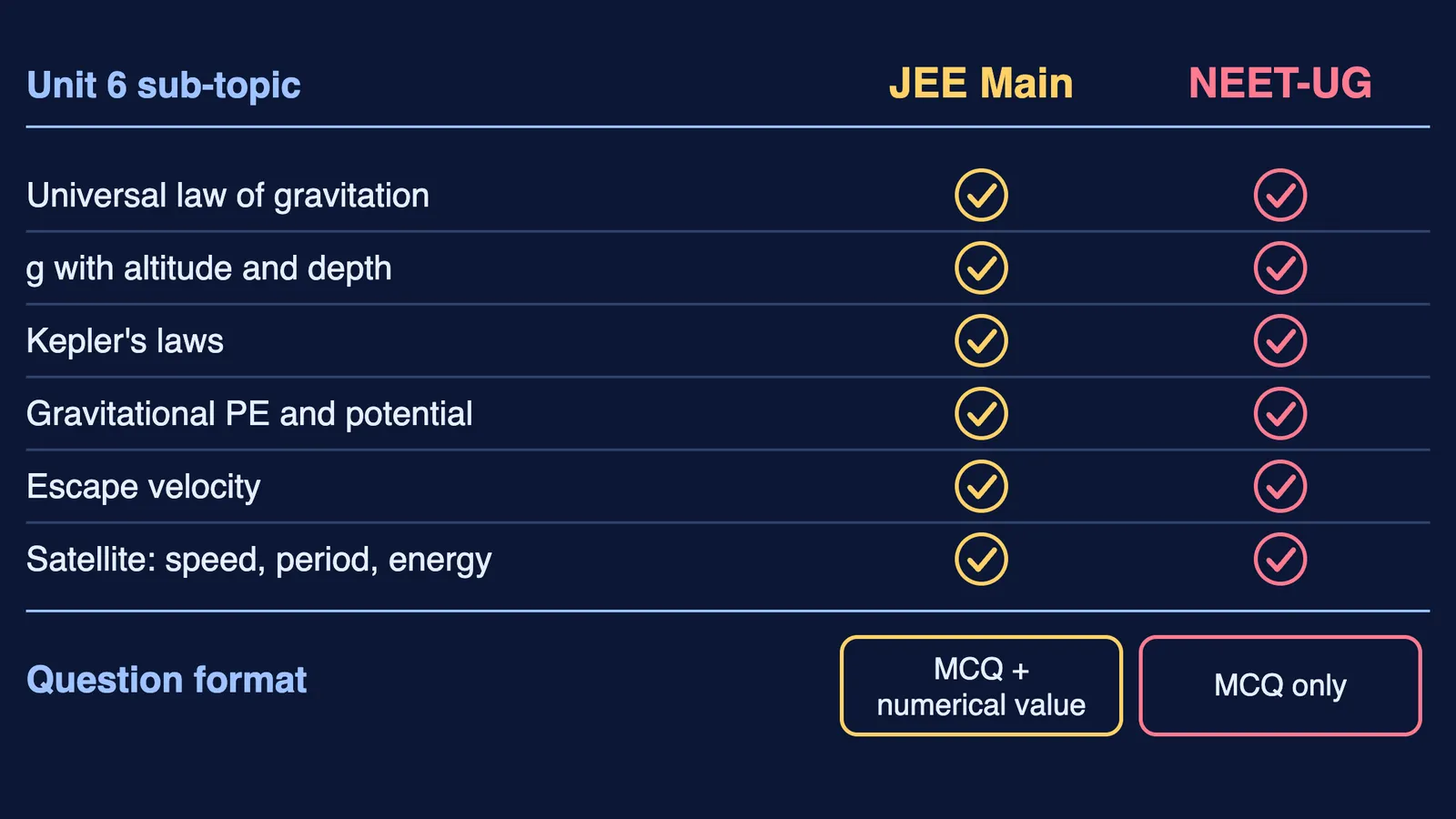
No. Unit 6, Gravitation, reads the same in both official syllabuses, apart from one semicolon and one capital letter.
The NTA's Syllabus for JEE (Main) - 2027, linked from the JEE Main website, and the NMC's updated syllabus for NEET (UG) 2026, dated 22-12-2025, both list these sub-topics in this order:
"The universal law of gravitation"
"Acceleration due to gravity and its variation with altitude and depth"
"Kepler's law of planetary motion"
"Gravitational potential energy" and "gravitational potential"
"Escape velocity"
"Motion of a satellite, orbital velocity, time period and energy of satellite"
No sub-topic appears in one list and not the other. Both map to Chapter 7, Gravitation, of the NCERT Class 11 Physics Part I textbook (Reprint 2026-27). Notice what neither list names: geostationary and polar satellites, weightlessness, and the field of a ring or a rod. Neither unit text promises them.
How are the question formats different?
The Information Bulletin for JEE (Main) 2027 says Paper 1 (B.E./B.Tech.) has Physics in two sections: Section A with 20 multiple-choice questions and Section B with 5 questions whose answer is a numerical value. For Section B, "the answer should be rounded off to the nearest integer", entered on an on-screen keypad. Both sections carry +4 for a correct answer and -1 for a wrong one, and the paper lasts 3 hours.
The Information Bulletin for NEET (UG) 2026, the latest on the NTA NEET website, sets 180 compulsory questions in 180 minutes, with 45 in Physics. Every one is an MCQ "with four options and single correct answer/best option", marked +4, -1 or 0.
So in JEE Main a Gravitation question may give you no options at all, and a calculation slip costs you -1 and there are no options to check it against. In NEET you always have four options, and on average a minute a question across the paper.
How does the style of Gravitation questions differ?
These are tendencies you will notice in official past papers, not rules.
NEET leans on statements and ratios. Many questions test one result from the NCERT chapter, such as how kinetic energy depends on orbital radius, and reward you for seeing how a quantity scales before you calculate anything.
JEE Main leans on chains of steps. A question often joins two results, for example an orbit's energy with conservation of energy, and expects you to carry real numbers through to an answer you can type.
Both punish the r-versus-h slip. Orbit formulas use the distance from Earth's centre, not the height above the surface. Our post on Gravitation mistakes in JEE and NEET collects this and other traps.
What does each exam's version of the same idea look like?
Both questions below rest on one NCERT result from section 7.10: a satellite in a circular orbit of radius r has kinetic energy GMm/2r and total energy -GMm/2r. Take g = 9.8 m/s² and Earth's radius R = 6400 km, as the NCERT chapter does. Both questions are original.
NEET style. Satellite A, of mass m, circles Earth at a height R above the surface. Satellite B, of mass 2m, circles at a height 3R. What is the ratio of their kinetic energies, K_A : K_B?
(a) 1 : 1 (b) 1 : 2 (c) 2 : 1 (d) 3 : 2
Answer: (a). Convert heights to radii first: r_A = 2R and r_B = 4R. Then K_A = GMm/4R and K_B = GM(2m)/8R = GMm/4R. Doubling the mass and doubling the radius cancel. Option (d) is what you get by using heights instead of radii; option (b) is what you get by ignoring the radii altogether.
JEE Main style (numerical value). Air drag slowly lowers a 500 kg satellite from a circular orbit 900 km above Earth's surface to one 600 km above it, staying nearly circular throughout. By how much does its kinetic energy change, in units of 10⁸ J? Give the nearest integer.
Answer: 6 (an increase). Write GM as gR² = 9.8 × (6.4 × 10⁶)² = 4.014 × 10¹⁴ m³/s². The radii are r₁ = 7.3 × 10⁶ m and r₂ = 7.0 × 10⁶ m.
K₁ = gR²m/2r₁ = 1.375 × 10¹⁰ J.
K₂ = gR²m/2r₂ = 1.434 × 10¹⁰ J.
ΔK = 5.89 × 10⁸ J, which rounds to 6.
The satellite speeds up while drag acts against it. The total energy falls by the same 5.89 × 10⁸ J, and the potential energy falls by twice that, so the lost potential energy pays both for the extra kinetic energy and for the work done against drag.
How to prepare for both
Read NCERT Chapter 7 once, closely. The syllabus text is identical, so one reading serves both exams. Pay attention to sections 7.8 to 7.10 on escape speed, satellites and orbital energy.
Learn every result as a scaling law. Write g, orbital speed, period and energies as powers of r. This is the fastest route to NEET options and a check on JEE Main answers.
Practise numerical-value questions without options. Use gR² in place of GM and carry three significant figures until the last step, then round once, as the JEE Main bulletin asks.
Time NEET-style sets at about a minute each. Mark every error as wrong formula, wrong r, or arithmetic, then redo only those.
Draw the orbit before you solve. A ten-second sketch with R, h and r marked prevents the most common slip in both exams.
Use the exam-specific guides for the rest. Our Gravitation guide for NEET and Gravitation guide for JEE Main each carry a one-week plan and more worked examples.
Finding it hard to picture why a satellite speeds up as it sinks? The Fermi Simulation Lab has interactive simulations for the ideas that are easier to see than to read.