On this page
Here are eight Gravitation questions we wrote for JEE Main Physics: six single-correct MCQs and two numerical-value questions (Q3 and Q6). None is taken from NCERT or a past paper. Each answer ends with the trap behind the likeliest wrong option.
What does JEE Main ask from Gravitation?
Unit 6 of NTA's Syllabus for JEE (Main) - 2027, linked from the JEE Main website, covers the universal law, g with altitude and depth, Kepler's law, potential energy and potential, escape velocity, and a satellite's orbital velocity, period and energy. Every question here sits inside that list and Chapter 7 of the NCERT Class 11 Physics textbook, Reprint 2026-27.
Use g = 9.8 m/s² and Earth's radius R = 6400 km, the values that NCERT chapter uses. Treat Earth as a uniform sphere; ignore rotation and air.
How should you use this question set?
Cover the answers. Allow two minutes per question, three for Q7 and Q8.
Mark r, the distance from the centre, on a rough sketch. Heights and depths come after.
For the numerical questions, write the unit and the power of ten before you round.
New to the chapter? Start with our guide on how to prepare Gravitation for JEE Main.
Easy: field, escape and surface gravity
Q1 (easy). Point masses of 2 kg and 18 kg are 1.2 m apart. How far from the 2 kg mass, between them, is the net gravitational field zero?
(A) 0.12 m (B) 0.30 m (C) 0.40 m (D) 0.90 m
Answer: (B). The two fields cancel when 2/r² = 18/(1.2 − r)², so (1.2 − r)/r = 3 and r = 0.30 m.
Trap: (A) sets the distance ratio equal to the mass ratio, 1 : 9. The field goes as 1/r², so the distances are in the ratio of the square roots, 1 : 3.
Q2 (easy). A satellite moves in a circular orbit at 6.0 km/s. What is the smallest extra speed, given along its motion, that lets it escape Earth?
(A) 2.49 km/s (B) 5.2 km/s (C) 6.0 km/s (D) 8.49 km/s
Answer: (A). From a circular orbit, escape speed is √2 times the orbital speed there: √2 × 6.0 = 8.49 km/s. The extra speed is 8.49 − 6.0 = 2.49 km/s.
Trap: (B) subtracts from 11.2 km/s, which is the escape speed from the surface, not from the orbit. See it in our escape velocity simulation.
Q3 (easy, numerical). A planet has 8 times Earth's mass and 2 times its radius. What does a 45 kg lander weigh on its surface, in newtons?
Answer: 882. g = GM/R², so g changes by 8/2² = 2, giving 19.6 m/s². Weight = 45 × 19.6 = 882 N.
Trap: 1764, which divides by the radius once instead of squaring it.
Medium: orbits, comets and launch energy
Q4 (medium). At the height of a satellite's circular orbit, g is one-ninth of its surface value. What is the satellite's orbital speed?
(A) 2.64 km/s (B) 3.73 km/s (C) 4.57 km/s (D) 7.92 km/s
Answer: (C). g falls as 1/r², so one-ninth means r = 3R. Then v = √(gR²/r) = √(gR/3) = √(9.8 × 6.4 × 10⁶/3) ≈ 4.57 km/s.
Trap: (A) uses √(g′R), the reduced g with Earth's radius instead of the orbit radius 3R. Our derivation of orbital velocity and time period shows where each r comes from.
Q5 (medium). A comet moves at 54 km/s at its closest point to the Sun, 0.6 AU away. Its farthest point is 36 AU from the Sun. What is its speed there?
(A) 0.015 km/s (B) 0.90 km/s (C) 6.97 km/s (D) 3240 km/s
Answer: (B). Angular momentum about the Sun is conserved, which is Kepler's second law. At the two ends, velocity is perpendicular to the radius, so r₁v₁ = r₂v₂: v₂ = 54 × 0.6/36 = 0.90 km/s.
Trap: (C) scales speed by √(r₁/r₂), the rule for circular orbits of different radii, not two points on one ellipse.
Q6 (medium, numerical). A 250 kg satellite is put into a circular orbit at a height R above Earth's surface. What is the least energy needed, from launch at rest on the surface? Give the answer in units of 10⁸ J, to the nearest integer.
Answer: 118. Total energy in orbit at r = 2R is −GMm/4R; at the surface it is −GMm/R. The difference is 3GMm/4R = 3mgR/4 = 3 × 250 × 9.8 × 6.4 × 10⁶/4 = 1.176 × 10¹⁰ J, or 117.6 ≈ 118 in units of 10⁸ J.
Trap: 78, which counts only the rise in potential energy, mgR/2, and forgets the kinetic energy the satellite needs to stay in orbit.
Hard: inside Earth and inside a shell
Q7 (hard). A narrow straight tunnel is bored along a diameter of Earth. A ball is dropped into it from rest at the surface. How fast is it moving at a depth R/2?
(A) 5.60 km/s (B) 6.86 km/s (C) 7.92 km/s (D) 3.96 km/s
Answer: (B). Inside a uniform Earth, g at distance r from the centre is g(r/R). The work per kilogram from R down to R/2 is the area under that line, 3gR/8. So v²/2 = 3gR/8 and v = √(3gR/4) ≈ 6.86 km/s.
Trap: (C) takes g as 9.8 m/s² all the way down, so v² = 2g(R/2) = gR.
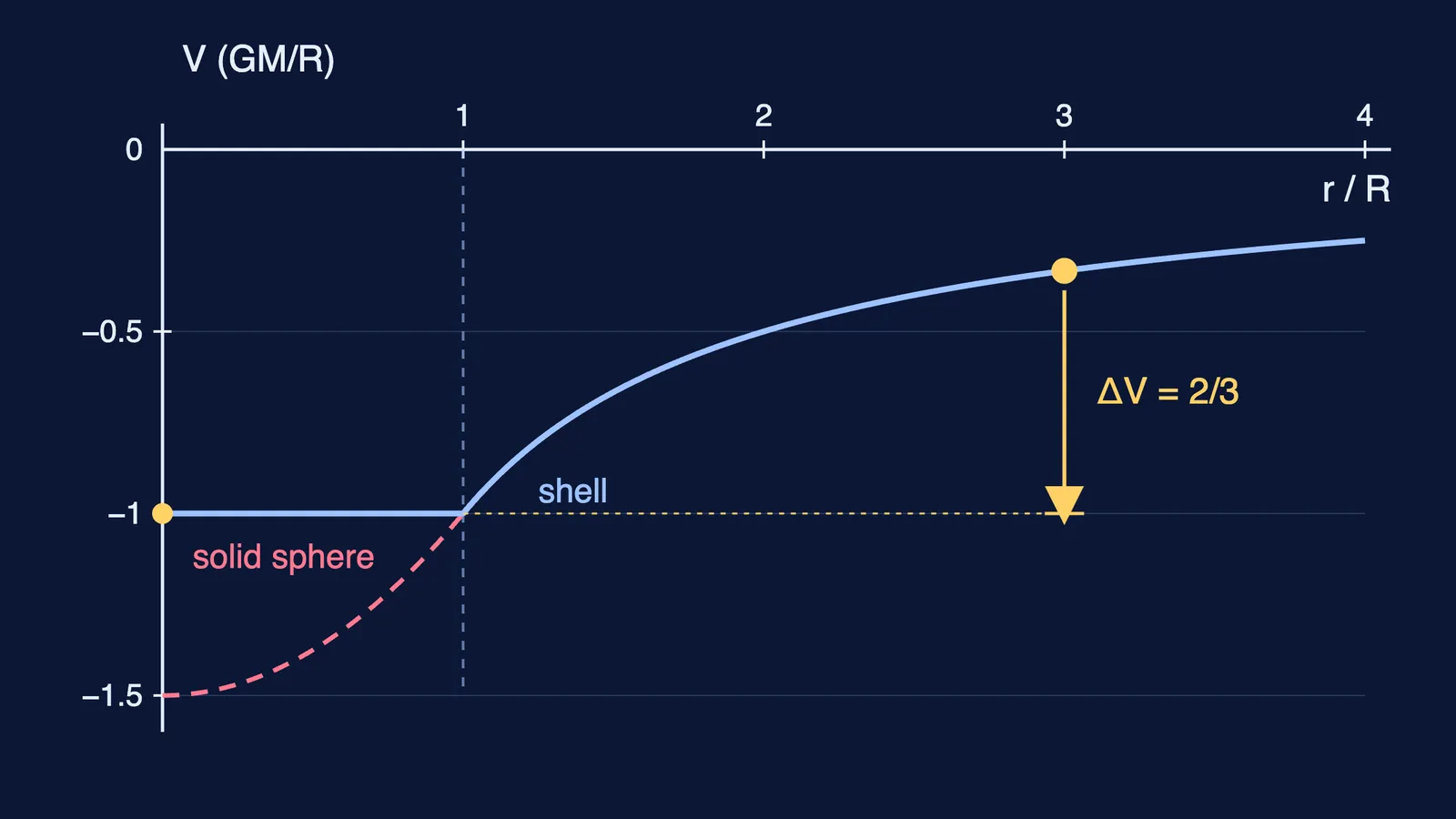
Q8 (hard). A thin uniform spherical shell has mass M and radius R. A small particle is released from rest 3R from the shell's centre and falls in through a tiny hole. With only the shell's gravity acting, what is its speed at the centre?
(A) √(2GM/3R) (B) √(4GM/3R) (C) √(2GM/R) (D) √(7GM/3R)
Answer: (B). Outside, the potential is −GM/r; inside a shell it stays −GM/R, so there is no force inside. Energy conservation from 3R to R: v²/2 = GM/R − GM/3R = 2GM/3R, so v = √(4GM/3R).
Trap: (D) uses the potential inside a solid sphere, which keeps falling to −3GM/2R at the centre.
If a solution skips a step you need, the Fermi Problem Library has worked problems with a step-by-step solver that explains the reasoning rather than printing an answer.
Redo Q5 and Q8 tomorrow without looking.