On this page
This sheet follows Chapter 7 of the NCERT Class 11 Physics Part I textbook (Reprint 2026-27). Formulas and examples were checked in Python (SymPy).
The topics match the CBSE Physics curriculum for 2026-27 for this unit. Geostationary and polar satellites are not in the 2026-27 NCERT chapter, so they are left out.
For derivations and questions, see our Gravitation Class 11 physics guide.
What are Kepler's laws as formulas?
Symbols: a semi-major axis (m); T period (s); G = 6.67 × 10⁻¹¹ N m² kg⁻²; M_s Sun's mass (kg); L angular momentum (kg m² s⁻¹); m planet mass (kg); r_p, v_p and r_a, v_a distance (m) and speed (m/s) at perihelion and aphelion.
Law of orbits: ellipse with the Sun at one focus; for a circle, a (m) is the radius.
Law of areas: ΔA/Δt = L/(2m), constant in m²/s, since L is conserved under a central force.
At perihelion and aphelion r ⊥ v, so m r_p v_p = m r_a v_a (kg m² s⁻¹).
Law of periods: T² = (4π²/GM_s) a³, with T in s and a in m.
Worked example: a planet at r_p = 1.0 × 10¹¹ m moves at v_p = 3.0 × 10⁴ m/s. At r_a = 1.5 × 10¹¹ m, v_a = (1.0/1.5) × 3.0 × 10⁴ = 2.0 × 10⁴ m/s. With T² ∝ a³ and Earth at 1 AU, 1 year, a = 4 AU gives T = 4^(3/2) = 8 years.
Watch for: T² ∝ a³ compares orbits around the same central body only.
Universal law of gravitation and superposition
Symbols: F force (N); G = 6.67 × 10⁻¹¹ N m² kg⁻²; m₁, m₂ masses (kg); r separation (m).
F = G m₁m₂/r² (N), attractive, along the line joining two point masses.
Superposition: F_R = F₁ + F₂ + … + F_n (N), added as vectors.
A uniform shell, or a sphere with spherically symmetric density, attracts an outside particle as if its mass were at its centre.
Inside a uniform spherical shell, the gravitational force is zero (N).
Worked example: two 50 kg spheres with centres 0.50 m apart attract with F = 6.67 × 10⁻¹¹ × 50 × 50 / 0.50² = 6.67 × 10⁻⁷ N.
Watch for: r is the centre-to-centre distance, not the gap between surfaces.
How does g change with height and depth?
Symbols: g acceleration due to gravity at the surface (m/s²); M_E, R_E mass (kg) and radius (m) of the Earth; h height and d depth (m).
g = GM_E/R_E² (m/s²), which gives M_E = gR_E²/G (kg).
At height h: g(h) = GM_E/(R_E + h)² (m/s²), exact for any h.
For h ≪ R_E: g(h) ≈ g(1 − 2h/R_E) (m/s²).
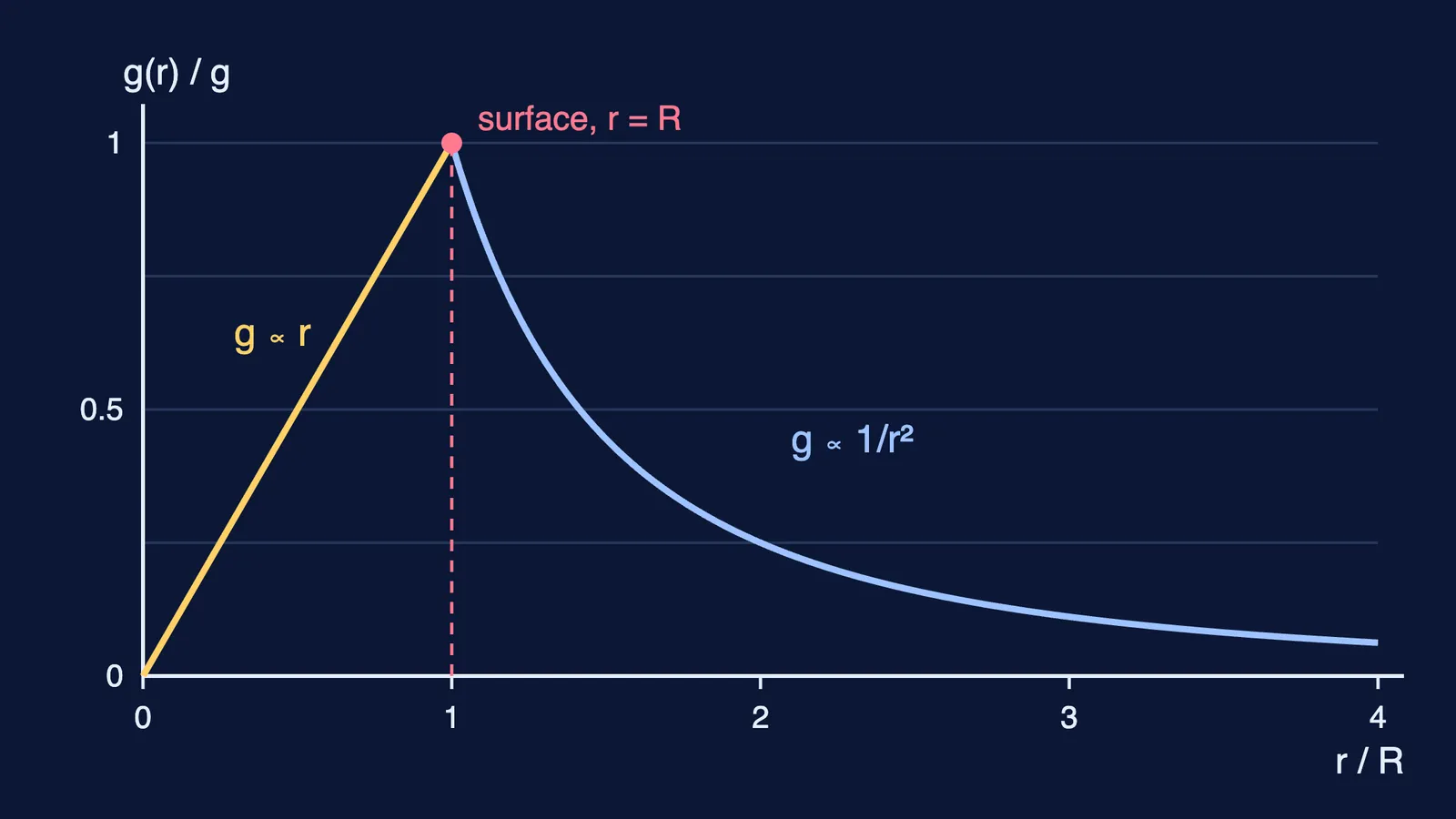
At depth d, uniform-density Earth: g(d) = g(1 − d/R_E) (m/s²), for 0 ≤ d ≤ R_E. At the centre, g = 0 m/s².
Worked example: with g = 9.8 m/s² and R_E = 6.4 × 10⁶ m, at h = 32 km the exact g(h) = 9.8 × (6400/6432)² = 9.703 m/s², and the approximation gives 9.8 × (1 − 0.010) = 9.702 m/s². At d = 32 km, g(d) = 9.8 × (1 − 0.005) = 9.751 m/s².
Watch for: 1 − 2h/R_E only works for small h; otherwise use the exact form.
Gravitational potential energy and potential: which formulas?
Symbols: U potential energy (J); V potential (J/kg); M, m masses (kg); r distance from the centre (m), r ≥ R_E for the Earth.
Near the surface, where g is constant: ΔU = mg(h₂ − h₁) (J).
General: U(r) = −GM_E m/r (J), with U = 0 at infinity.
Work to move m from r₁ to r₂: W = GM_E m(1/r₁ − 1/r₂) (J).
Two particles: U = −Gm₁m₂/r (J). For a system, add one such term per pair.
Potential, the potential energy per unit mass: V = −GM/r (J/kg).
Worked example: lifting a 1000 kg probe from the surface to h = R_E takes ΔU = GM_E m/(2R_E) = mgR_E/2 = 1000 × 9.8 × 6.4 × 10⁶ / 2 = 3.14 × 10¹⁰ J. Using mgh would give 6.27 × 10¹⁰ J, twice the true value.
Watch for: U is negative at every finite r; moving away makes it less negative, so it increases.
Escape speed, orbital speed and satellite energy
Symbols: v_e escape speed and v orbital speed (m/s); T period (s); K, U, E kinetic, potential and total energy (J); m satellite mass (kg); orbit radius R_E + h (m).
v_e = √(2GM_E/R_E) = √(2gR_E) (m/s), about 11.2 km/s for the Earth.
Orbital speed: v = √(GM_E/(R_E + h)) (m/s). Close to the surface, v ≈ √(gR_E) (m/s).
Period: T = 2π(R_E + h)/v (s), so T² = (4π²/GM_E)(R_E + h)³ (s²). Close to the surface, T₀ ≈ 2π√(R_E/g) (s).
K = GM_E m/(2(R_E + h)) (J); U = −GM_E m/(R_E + h) (J); E = K + U = −GM_E m/(2(R_E + h)) (J).
Elliptical orbit: E = −GM_E m/(2a) (J), a the semi-major axis (m). E < 0 means a bound orbit.
Worked example: a 500 kg satellite at h = 600 km, with GM_E = gR_E² = 4.01 × 10¹⁴ m³/s². Then r = 7.0 × 10⁶ m, v = 7.57 km/s and T = 5808 s, about 96.8 min. K = 1.43 × 10¹⁰ J, U = −2.87 × 10¹⁰ J and E = −1.43 × 10¹⁰ J.
Watch for: v_e does not depend on the launched mass; m cancels in ½mv_e² = GM_E m/R_E.
If orbit radius, speed and energy are hard to picture together, the Fermi Simulation Lab has interactive simulations for ideas easier to see than to read.
How to revise this formula sheet
Sketch g(r) from memory: a line inside, a 1/r² curve outside.
For any circular orbit, check K = −E and U = 2E before writing the answer.
Rework the 32 km example at h = 3200 km: the exact g(h) is 4.36 m/s², but 1 − 2h/R_E gives 0.
Carry units on every line: N m² kg⁻² for G, J/kg for V, J for U, m/s for v_e.
For where each result comes from, read our Gravitation Class 11 derivations, then test yourself with the Gravitation case study questions for Class 11.