On this page
The rationalised NCERT Class 11 Physics Part I, Chapter 7: Gravitation (reprint 2026-27) works out six results in its own text, from g above and below the surface to the energy of an orbiting satellite. The CBSE Physics syllabus for 2026-27 lists all of these for Class XI under Unit VI.
Each derivation has a setup, steps, the result in bold and a common slip. For the whole chapter, see our Gravitation Class 11 guide to derivations and questions.
How does g change with height above the Earth?
Setup: a point mass m at height h above a spherical Earth of mass M_E and radius R_E; the point is outside every shell of the Earth.
Outside a sphere, the Earth pulls as if all its mass sat at the centre, so F(h) = GM_Em/(R_E + h)², where G is the gravitational constant.
Divide by m: g(h) = GM_E/(R_E + h)².
At the surface, g = GM_E/R_E², so g(h) = g(1 + h/R_E)⁻².
For h much smaller than R_E, the binomial expansion gives (1 + h/R_E)⁻² ≈ 1 − 2h/R_E.
Result: g(h) = GM_E/(R_E + h)², which is about g(1 − 2h/R_E) when h ≪ R_E.
Where students slip: using the approximate form when h is not small next to R_E. At h = R_E it even gives a negative g, while the exact value is g/4.
How does g change with depth below the surface?
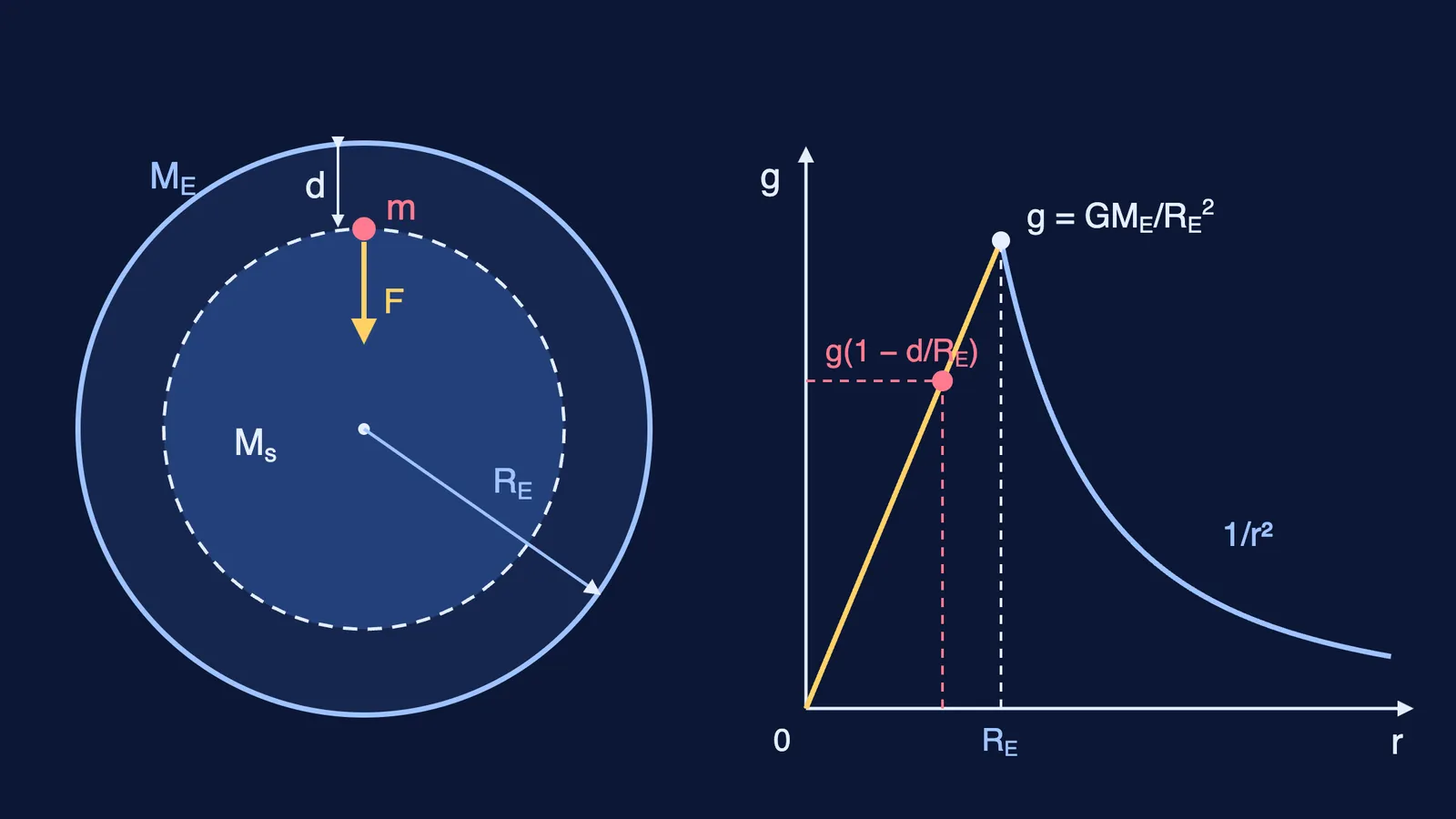
Setup: a point mass m in a mine at depth d, so it is R_E − d from the centre of an Earth of uniform density.
Split the Earth into an inner sphere of radius R_E − d and a shell of thickness d.
A uniform shell exerts no net force on a mass inside it, so only the inner sphere counts.
Mass scales as radius cubed at fixed density: M_s/M_E = (R_E − d)³/R_E³, where M_s is the inner sphere's mass.
The inner sphere acts as if its mass were at the centre: F(d) = GM_sm/(R_E − d)² = GM_Em(R_E − d)/R_E³.
Divide by m and use g = GM_E/R_E².
Result: g(d) = g(1 − d/R_E). This is exact for a uniform Earth, and g is largest at the surface.
Where students slip: keeping the full Earth mass M_E in step 4. The outer shell drops out; only M_s pulls.
Gravitational potential energy: W(r) = −GM_Em/r
Setup: a particle of mass m moved straight out from distance r₁ to r₂ (r₂ > r₁) from the Earth's centre, both points outside the Earth.
The pull F = GM_Em/r² changes with r, so mg × height no longer works.
Work done against gravity: W₁₂ = ∫ GM_Em/r² dr from r₁ to r₂ = −GM_Em(1/r₂ − 1/r₁).
Write this as a difference W(r₂) − W(r₁) with W(r) = −GM_Em/r + W∞, where W∞ is a constant.
Choose the potential energy at infinity to be zero, so W∞ = 0.
Result: W(r) = −GM_Em/r. With the zero set at infinity, this is the work an outside agent does to move m slowly from infinity to r.
Where students slip: treating mgh as the general formula. It is only the small-height approximation of this difference.
How is the escape speed √(2gR_E) derived?
Setup: a body of mass m thrown up with speed V_i from the Earth's surface; potential energy is zero at infinity.
Energy at launch: ½mV_i² − GM_Em/R_E.
Energy at infinity: ½mV_f², where V_f is the speed left there.
Energy is conserved, so ½mV_i² − GM_Em/R_E = ½mV_f² ≥ 0.
The smallest launch speed makes the left side exactly zero: V_i = √(2GM_E/R_E).
Replace GM_E with gR_E².
Result: v_e = √(2GM_E/R_E) = √(2gR_E). With g = 9.8 m/s² and R_E = 6400 km this gives about 11.2 km/s, the value NCERT quotes.
Where students slip: writing √(gR_E), which is the speed of a satellite skimming the surface, not the escape speed.
Orbital speed and period: T² = 4π²(R_E + h)³/(GM_E)
Setup: a satellite of mass m in a circular orbit at height h, moving at speed V; gravity supplies the centripetal force.
Set the forces equal: mV²/(R_E + h) = GM_Em/(R_E + h)².
Cancel m and one factor of (R_E + h): V = √(GM_E/(R_E + h)).
One orbit covers 2π(R_E + h), so T = 2π(R_E + h)/V = 2π(R_E + h)^(3/2)/√(GM_E).
Square both sides.
Result: V = √(GM_E/(R_E + h)) and T² = 4π²(R_E + h)³/(GM_E), Kepler's law of periods for satellites. For h close to zero this becomes T₀ = 2π√(R_E/g), which the NCERT chapter works out as about 85 minutes using g = 9.8 m/s² and R_E = 6400 km.
Where students slip: using h instead of R_E + h as the orbit radius. Every r in these formulas is measured from the Earth's centre.
Energy of an orbiting satellite: E = −GM_Em/[2(R_E + h)]
Setup: the same circular orbit, with potential energy zero at infinity.
From the orbital speed, K = ½mV² = GM_Em/[2(R_E + h)].
Potential energy: U = −GM_Em/(R_E + h).
Add them: E = K + U.
Result: E = −GM_Em/[2(R_E + h)]. Kinetic energy equals −E and potential energy equals 2E.
Where students slip: dropping the minus sign. Negative total energy keeps the satellite bound; at zero or above, it would escape. Our post on the 1 : −2 : −1 energy ratio of a satellite works through this with numbers.
How should you practise these derivations?
Draw the figure first: for g at depth, sketch the inner sphere and the shell.
Say which distance is from the centre. Do not mix up h, d and R_E + h.
Check limits. Put d = R_E into g(d) and you get zero at the centre; put h = 0 into V and you get √(gR_E).
Chain the last three. Orbital speed gives kinetic energy, and kinetic plus potential gives total energy, so practise them as one sequence.
Test yourself with the Gravitation case study questions for Class 11 once you can write each result from memory.
If the rise-then-fall shape of g is hard to picture, the Fermi Simulation Lab has interactive simulations for ideas that are easier to see than to read.