

On this page
Three original cases, easy to hard. If a derivation feels shaky, start with our Gravitation Class 11 guide to derivations and questions.
What do these Gravitation case studies cover?
Every case stays inside Chapter 7 of the CBSE 2026-27 Class XI Physics curriculum (Gravitation). Formulas and the values g = 9.8 m s⁻² and R = 6400 km come from the rationalised NCERT Class 11 Physics Chapter 7, Gravitation (Reprint 2026-27). Use NCERT's G = 6.67 × 10⁻¹¹ N m² kg⁻². None is copied from an exam paper.
Case 1: Two lead spheres in a school lab
A physics teacher in Pune builds a lesson around the experiment in which Henry Cavendish first measured G, in 1798, as NCERT describes. A large lead sphere of mass 12 kg sits with its centre 0.20 m from the centre of a small lead sphere of mass 0.80 kg. Both spheres are uniform, so each acts as if its mass were at its centre. Later the teacher places a second 12 kg sphere on the opposite side of the small sphere, on the same straight line, with its centre 0.30 m from the small sphere's centre.
(i) If the first separation were doubled to 0.40 m, the force would become: (a) 2F (b) F/2 (c) F/4 (d) 4F
(ii) Find the gravitational force between the 12 kg and 0.80 kg spheres at 0.20 m.
(iii) How many times larger is the Earth's pull on the small sphere than this force?
(iv) Find the net gravitational force on the small sphere once the second large sphere is in place, and give its direction.
Answers.
(i) (c). F ∝ 1/r².
(ii) F = Gm₁m₂/r² = 6.67 × 10⁻¹¹ × 12 × 0.80 / (0.20)² = 1.6 × 10⁻⁸ N.
(iii) Weight = 0.80 × 9.8 = 7.84 N. Ratio = 7.84 / (1.6 × 10⁻⁸) ≈ 4.9 × 10⁸.
(iv) The second sphere pulls the other way with 6.67 × 10⁻¹¹ × 12 × 0.80 / (0.30)² = 7.1 × 10⁻⁹ N. By superposition, net = 1.60 × 10⁻⁸ − 0.71 × 10⁻⁸ ≈ 8.9 × 10⁻⁹ N, towards the nearer (first) sphere.
Case 2: A gravimeter on a hill and down a mine
A Class 11 student on a geology trip carries a gravimeter, a meter that reads g. She takes readings at sea level on a beach in Chennai, at a hill station 2.0 km above sea level, and at the bottom of a mine shaft 3.2 km deep. Her teacher asks the class to model the Earth as a uniform sphere of radius 6400 km with g = 9.8 m s⁻² at the surface, and to ignore the Earth's rotation. A classmate predicts the mine, being deeper, will show the bigger change.
(i) At a depth d below the surface, g(d) equals: (a) g(1 − 2d/R) (b) g(1 − d/R) (c) g(1 + d/R) (d) g/(1 + d/R)²
(ii) Find g at the hill station.
(iii) Find g in the mine. Which place has the smaller g?
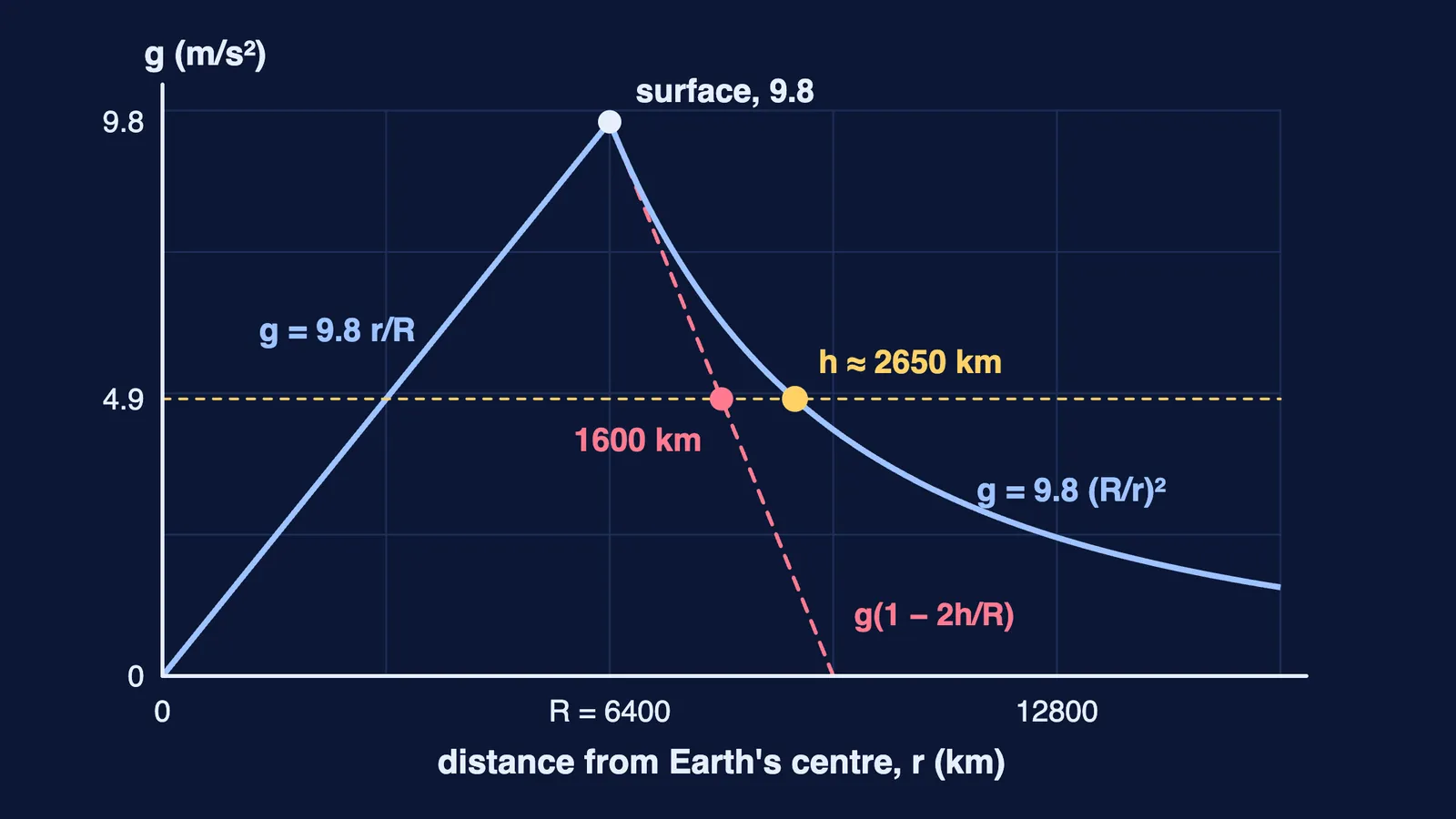
(iv) At what height would g fall to half its surface value? Show why the formula g(1 − 2h/R) gives the wrong height.
Answers.
(i) (b). Only the inner sphere of radius (R − d) pulls.
(ii) h is much smaller than R, so g(h) ≈ 9.8 × (1 − 2 × 2.0/6400) = 9.8 × 0.999375 ≈ 9.7939 m s⁻², a fall of about 0.0061 m s⁻².
(iii) g(d) = 9.8 × (1 − 3.2/6400) = 9.8 × 0.9995 = 9.7951 m s⁻², a fall of 0.0049 m s⁻². The hill station has the smaller g: near the surface, going up loses g twice as fast per km as going down.
(iv) g/(1 + h/R)² = g/2 gives 1 + h/R = √2, so h = (√2 − 1) × 6400 ≈ 2650 km. The shortcut gives 2h/R = 1/2, or 1600 km, but it needs h much smaller than R; at 1600 km the true g is 9.8/(1.25)² ≈ 6.27 m s⁻².
Case 3: An Earth-observation satellite changes orbit
A start-up in Bengaluru operates a 150 kg Earth-observation satellite in a circular orbit 600 km above the surface. The team plans to raise it to a circular orbit 800 km up. One engineer argues that since the thrusters add energy, the satellite will move faster in the new orbit. Take g = 9.8 m s⁻² and R = 6400 km, so GM = gR² = 4.01 × 10¹⁴ m³ s⁻², and ignore air drag.
(i) The orbital speed of a satellite in a circular orbit depends on: (a) its own mass (b) the orbit radius and the Earth's mass (c) its shape (d) the launch site
(ii) Find its orbital speed at 600 km.
(iii) Find its period and about how many orbits it completes in a day.
(iv) How much energy must the thrusters add for the move to 800 km? Is the engineer right about the speed?
Answers.
(i) (b). V = √(GM/r).
(ii) r = 6400 + 600 = 7000 km. V = √(4.01 × 10¹⁴ / 7.0 × 10⁶) ≈ 7.57 × 10³ m s⁻¹, about 7.57 km s⁻¹.
(iii) T = 2πr/V = 2π × 7.0 × 10⁶ / 7573 ≈ 5808 s, about 96.8 minutes. 86,400 / 5808 ≈ 14.9, so about 15 orbits a day.
(iv) E = −GMm/2r. At 7000 km, E = −4.30 × 10⁹ J; at 7200 km, E = −4.18 × 10⁹ J. Energy ≈ 1.19 × 10⁸ J. The engineer is wrong: the new speed is √(4.01 × 10¹⁴ / 7.2 × 10⁶) ≈ 7.47 km s⁻¹, about 106 m s⁻¹ slower.
How do you attack case-study questions on Gravitation?
Write r, the distance from the Earth's centre, first: r = R + h.
Replace GM by gR² at the start to save powers of ten.
Before using g(1 − 2h/R), check h is much smaller than R (Case 2).
For several masses, find each force, then add with directions (Case 1).
In orbits, more total energy means a higher, slower orbit (Case 3).
Read our guide to case-based questions and try our Gravitation assertion-reason questions. If one step keeps slipping, the Fermi Problem Library has worked problems with a step-by-step solver that explains the reasoning rather than printing an answer.


