

On this page
In Gravitation, most assertion-reason statements sound true. The skill is telling a true reason from the correct one. These 10 original questions run easy to hard.
What do these Gravitation questions cover?
Every item stays inside Unit 6, Gravitation, of the NEET (UG)-2026 syllabus published by the National Medical Commission. Each statement was checked against NCERT Class 11 Physics, Chapter 7, Gravitation (Reprint 2026-27). Treat the Earth as a uniform sphere and take potential energy as zero at infinity. New to the chapter? Read our guide on how to prepare Gravitation for NEET.
How do you answer assertion-reason questions?
Judge each statement alone. If both are true, say "A, because R" and check that it holds.
Assertion-reason keys (Q1 to Q6):
(A) Both A and R are true and R is the correct explanation of A.
(B) Both A and R are true but R is NOT the correct explanation of A.
(C) A is true but R is false.
(D) A is false but R is true.
Statement I and II keys (Q7 to Q10):
(A) Both statements are correct.
(B) Both statements are incorrect.
(C) Statement I is correct, Statement II is incorrect.
(D) Statement I is incorrect, Statement II is correct.
Assertion-reason questions on Gravitation
Q1 (easy). Assertion (A): If the distance between two point masses is tripled, the gravitational force between them becomes one-ninth. Reason (R): The gravitational force between two point masses is inversely proportional to the square of the distance between them.
Answer: (A). Both are true. F ∝ 1/r², so tripling r divides F by 3² = 9. R is the direct cause of A.
Trap: picking (B) because R "is just the law".
Q2 (easy). Assertion (A): The value of g at the bottom of a deep mine is less than at the Earth's surface. Reason (R): At a depth d, the outer shell of thickness d exerts no net force on a body; only the inner sphere of radius (R − d) pulls it.
Answer: (A). Both are true. Only the inner sphere's mass acts, giving g(d) = g(1 − d/R). R is how NCERT derives A.
Trap: thinking g grows because you are closer to the centre.
Q3 (medium). Assertion (A): Ignoring air resistance and the Earth's rotation, the escape speed from the Earth's surface does not depend on the direction of projection, provided the path misses the Earth. Reason (R): A heavier body needs a larger escape speed.
Answer: (C). A is true: escape is an energy condition, ½mv² ≥ GMm/R, and energy has no direction. R is false: m cancels, so v = √(2GM/R) is the same for any mass.
Trap: confusing escape energy with escape speed.
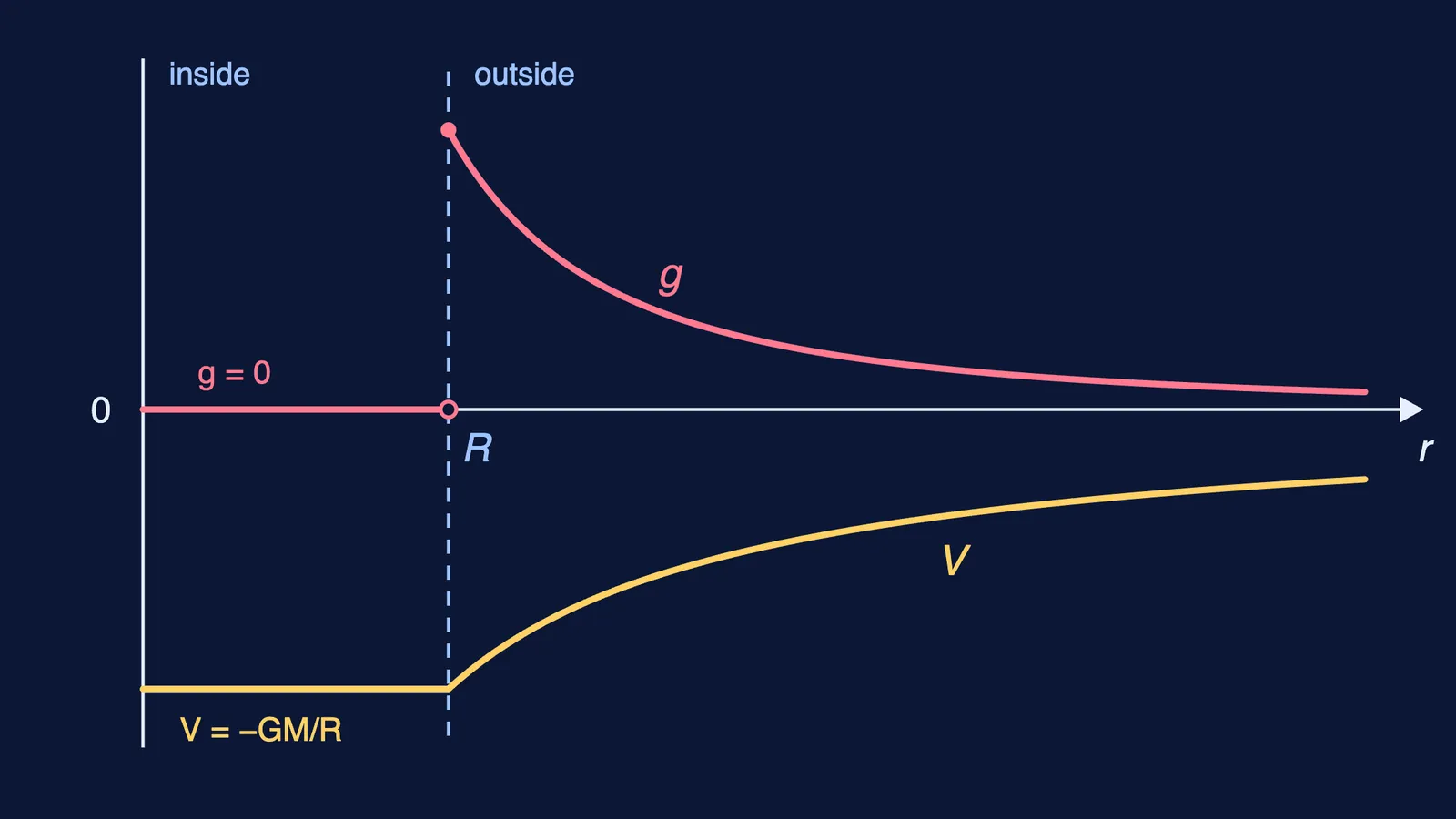
Q4 (medium). Assertion (A): Inside a thin uniform spherical shell, the gravitational potential is zero. Reason (R): The gravitational force exerted by the shell on a particle inside it is zero.
Answer: (D). A is false: the potential inside is constant, equal to its value on the shell, −GM/R. R is true. Zero field means the potential does not change, not that it is zero.
Trap: treating "field = 0" and "potential = 0" as the same condition.
Q5 (medium). Assertion (A): For all planets of the Sun, T²/a³ has the same value, where T is the period and a the semi-major axis. Reason (R): The gravitational force on a planet is central, so its angular momentum about the Sun is conserved.
Answer: (B). Both are true. Angular momentum conservation gives Kepler's second law, the law of areas, for any central force. The third law needs the inverse-square form.
Trap: matching a true fact to the wrong Kepler law.
Q6 (hard). Assertion (A): Moving a satellite from a circular orbit of radius r to one of radius 2r increases its total energy. Reason (R): The satellite's kinetic energy is larger in the orbit of radius 2r.
Answer: (C). A is true: E = −GMm/2r rises to −GMm/4r. R is false: K = GMm/2r halves, so the satellite moves more slowly.
Trap: assuming more energy means more speed.
Statement I and Statement II questions on Gravitation
Q7 (easy). Statement I: G has the same value everywhere, while g varies from place to place. Statement II: Two particles a finite distance apart have negative gravitational potential energy, taking zero at infinite separation.
Answer: (A). Both are correct. g depends on height, depth and the planet; G does not. U = −Gm₁m₂/r is negative at every finite r.
Trap: thinking G changes on the Moon.
Q8 (medium). Statement I: At a height equal to the Earth's radius, g falls to half its surface value. Statement II: At a depth of half the Earth's radius, g falls to one quarter of its surface value.
Answer: (B). Both are incorrect; the fractions are swapped. At h = R, r = 2R, so g/(2)² = g/4. At d = R/2, g(1 − 1/2) = g/2.
Trap: mixing up the height and depth formulas.
Q9 (hard). Statement I: For a satellite in a circular orbit, its kinetic energy equals the magnitude of its potential energy. Statement II: The total energy of such a satellite equals the negative of its kinetic energy.
Answer: (D). I is incorrect: K = GMm/2r is half of |U| = GMm/r. II is correct: E = K + U = −GMm/2r = −K.
Trap: assuming K and |U| balance in a stable orbit.
Q10 (hard). Statement I: A planet with the Earth's mass but half its radius has an escape speed √2 times the Earth's. Statement II: A body's weight on that planet is twice its weight on the Earth.
Answer: (C). I is correct: v = √(2GM/R), so halving R multiplies v by √2. II is incorrect: g = GM/R², so halving R makes g, and the weight, four times larger.
Trap: carrying the escape-speed factor over to g.
How should you use this set?
Sort every miss: wrong about A, wrong about R, or wrong about the link.
For each link miss, write the real reason in one line.
For each truth miss, reread the NCERT section.
If Q4 or Q6 felt abstract, the Fermi Simulation Lab has interactive simulations for ideas that are easier to see than to read.
For timed MCQs on this chapter, try our Gravitation NEET practice questions with solutions. For a method that works in any subject, see our strategy for assertion-reason questions.


