On this page
We wrote these eight Gravitation questions for NEET-UG Physics; none is copied from NCERT or a past paper. They run from the force law to a satellite changing orbit. Each answer comes with a short solution and the trap behind the wrong option most students pick.
What does NEET ask from Gravitation?
The National Medical Commission's updated syllabus for NEET (UG)-2026 lists Gravitation as Physics Unit 6: the universal law, g with altitude and depth, Kepler's law, potential energy and potential, escape velocity, and a satellite's orbital velocity, period and energy. All eight questions sit within that unit and Chapter 7 of the NCERT Class 11 Physics textbook, Reprint 2026-27.
Under the NTA information bulletin for NEET-UG 2026, a correct answer earned four marks and a wrong one cost one mark, so a guess you cannot narrow down is a risk.
How do you get the most from these questions?
Hide the solutions with a sheet of paper. Give yourself one minute for each easy question and two for each hard one.
Before any arithmetic, write how the answer scales: as r, 1/r or 1/r².
Check whether the question gives a height h or a distance r from the centre.
After marking, read every trap and note the ones that caught you.
Take g = 9.8 m/s² and R = 6400 km, the values the NCERT chapter uses, and treat Earth as a uniform sphere. If the ideas feel shaky, start with our guide on how to prepare Gravitation for NEET, then come back.
If a solution below loses you, the Fermi Problem Library has worked problems with a step-by-step solver that explains the reasoning rather than printing an answer.
Easy: the force law, g with height and Kepler
Q1 (easy). Two small spheres attract each other with a force of 36 N. One mass is tripled and the distance between them is doubled. What is the new force?
(A) 9 N (B) 18 N (C) 27 N (D) 54 N
Answer: (C). F ∝ m₁m₂/r², so F changes by 3/2² = 3/4: 36 × 3/4 = 27 N.
Trap: (D) divides by 2 instead of 4. Doubling the distance cuts the force to a quarter.
Q2 (easy). What is g at a height of R/3 above Earth's surface?
(A) 3.27 m/s² (B) 5.51 m/s² (C) 6.53 m/s² (D) 7.35 m/s²
Answer: (B). g' = g/(1 + h/R)² = 9.8/(4/3)² = 9.8 × 9/16 ≈ 5.51 m/s².
Trap: (A) uses g(1 − 2h/R), which only works when h is much smaller than R. At h = R/3 it is far off.
Q3 (easy). Two moons circle a planet with periods of 2 days and 16 days. What is the ratio of the outer moon's orbital radius to the inner moon's?
(A) 4 (B) 8 (C) 16 (D) 64
Answer: (A). Kepler's third law: r³ ∝ T², so r₂/r₁ = (16/2)^(2/3) = 8^(2/3) = 4.
Trap: (B) assumes radius grows in step with period. The period grows faster than the radius.
Medium: depth, escape speed and lifting work
Q4 (medium). At what depth below Earth's surface is g the same as at a height R above it?
(A) 1600 km (B) 3200 km (C) 4800 km (D) 6400 km
Answer: (C). At height R, r = 2R, so g falls to g/4. At depth d, g(1 − d/R) = g/4 gives d = 3R/4 = 4800 km.
Trap: (A) sets d/R = 1/4, the fraction of g that is left, instead of 3/4, the fraction that is lost.
Q5 (medium). A planet has the same average density as Earth but three times its radius. Earth's escape speed is 11.2 km/s. What is the planet's?
(A) 6.5 km/s (B) 11.2 km/s (C) 19.4 km/s (D) 33.6 km/s
Answer: (D). v = √(2GM/R) and M ∝ ρR³, so v ∝ R√ρ. Same density, triple radius: 3 × 11.2 = 33.6 km/s.
Trap: (C) multiplies by √3, keeping Earth's mass. Three times the radius at the same density means 27 times the mass.
Q6 (medium). How much work is needed to raise a 200 kg probe slowly from Earth's surface to a height of R/2?
(A) 2.09 × 10⁹ J (B) 4.18 × 10⁹ J (C) 6.27 × 10⁹ J (D) 1.25 × 10¹⁰ J
Answer: (B). W = GMm(1/R − 1/r) with r = 1.5R and GM = gR², so W = mgR/3 = 200 × 9.8 × 6.4 × 10⁶/3 ≈ 4.18 × 10⁹ J.
Trap: (C) is mgh, which assumes g stays at 9.8 m/s² all the way up. It does not.
Hard: changing orbits and g inside Earth
Q7 (hard). A 500 kg satellite circles Earth at a height R. How much energy moves it to a circular orbit at a height 3R?
(A) 3.92 × 10⁹ J (B) 7.84 × 10⁹ J (C) 1.57 × 10¹⁰ J (D) 6.27 × 10¹⁰ J
Answer: (A). Total energy in orbit is −GMm/2r. The radius goes from 2R to 4R, so ΔE = GMm(1/4R − 1/8R) = mgR/8 ≈ 3.92 × 10⁹ J.
Trap: (B) counts only the change in potential energy. The satellite slows down in the higher orbit, and the kinetic energy it loses pays for half of that rise. Our explainer on the energy needed to move a satellite to a higher orbit walks through the same idea.
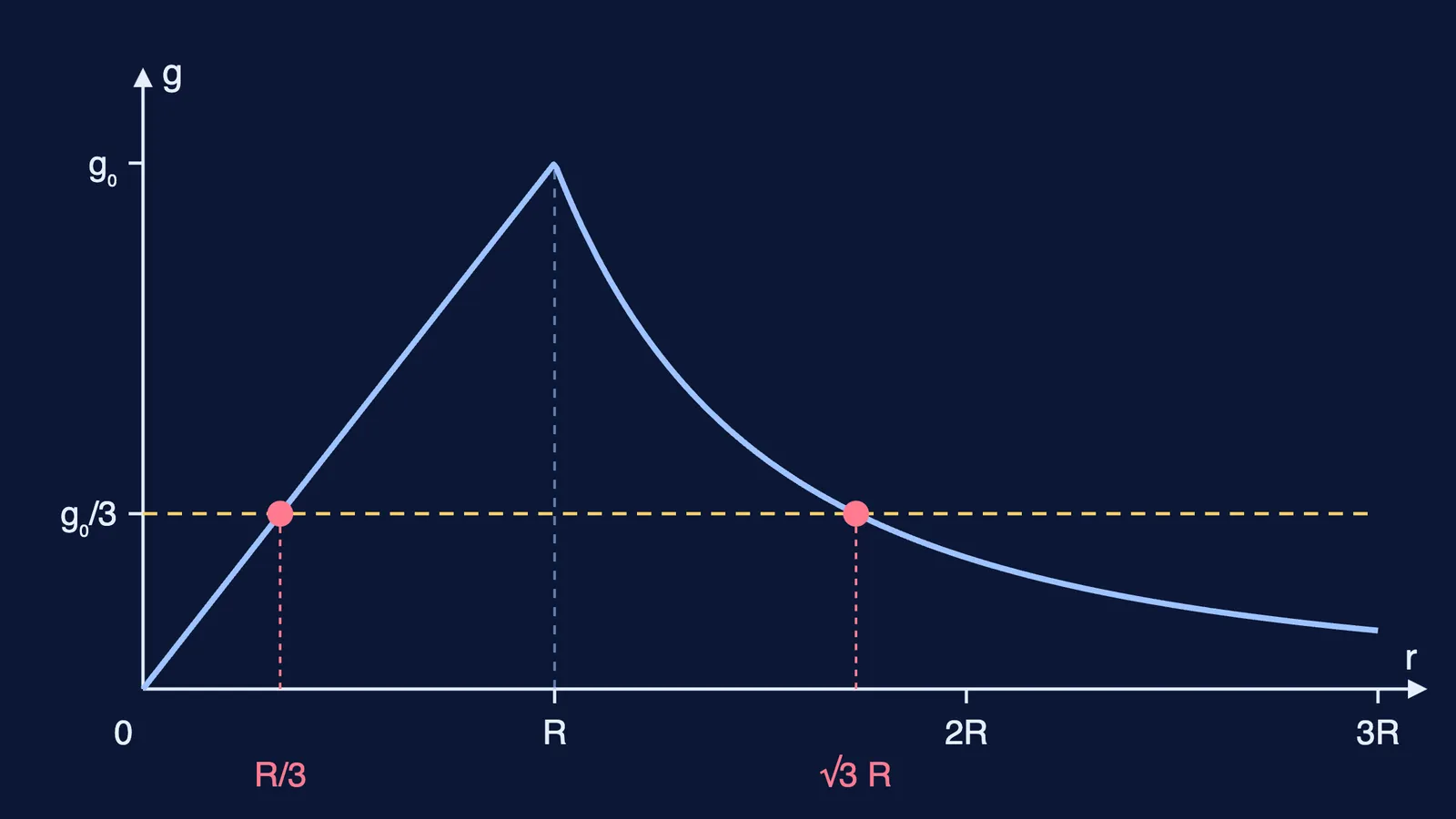
Q8 (hard). On one radial line, g is one-third of its surface value at one point inside Earth and at one point above it. What is the ratio of their distances from Earth's centre, outer to inner?
(A) √3 (B) 3 (C) 3√3 (D) 9
Answer: (C). Inside, g ∝ r, so r = R/3. Outside, g ∝ 1/r², so r = √3 R. The ratio is √3 ÷ (1/3) = 3√3 ≈ 5.2.
Trap: (D) treats g outside as falling like 1/r, which would put the outer point at 3R.
Want the background to Q7? Read why a satellite's kinetic, potential and total energies are in the ratio 1 : −2 : −1.