On this page
A common gravitation question in Class 11 physics and JEE practice asks how much work is needed to shift a satellite of mass m from an orbit of radius r₁ to a higher orbit of radius r₂. Many students write the change in potential energy. The right answer is half of that, and here is why.
What energy is needed to move a satellite to a higher orbit?
Start from the energies of a circular orbit of radius r around a planet of mass M. The OpenStax University Physics section on satellite orbits and energy gives the kinetic energy as K = GMm/2r and the total energy as E = K + U = GMm/2r − GMm/r = −GMm/2r.
The kinetic energy comes from setting gravity equal to the centripetal force, GMm/r² = mv²/r, so mv² = GMm/r. The potential energy is U = −GMm/r, negative because we take zero at infinite distance.
The work the engines must do is the change in total energy:
W = E₂ − E₁ = (−GMm/2r₂) − (−GMm/2r₁) = (GMm/2)(1/r₁ − 1/r₂)
Since r₂ > r₁, W is positive: you must add energy to climb.
Why is the work less than the change in potential energy?
Compare the three changes between the two orbits:
Potential energy rises: ΔU = GMm(1/r₁ − 1/r₂)
Kinetic energy falls: ΔK = −(GMm/2)(1/r₁ − 1/r₂)
Total energy rises: ΔE = ΔU + ΔK = (GMm/2)(1/r₁ − 1/r₂)
The satellite moves more slowly in the higher orbit, because orbital speed is v = √(GM/r). The kinetic energy it loses is turned into potential energy, so the engines supply only the rest. OpenStax puts the rule in one line: for circular orbits, the magnitude of the kinetic energy is exactly one-half the magnitude of the potential energy (OpenStax). That is why the work done always comes out to ΔU/2.
If the negative signs are what trip you up, our post on why gravitational potential energy is negative is the place to start, and the 1 : −2 : −1 ratio of kinetic, potential and total energy is the same idea seen from one orbit.
Worked example: how much work moves a satellite from R to 2R?
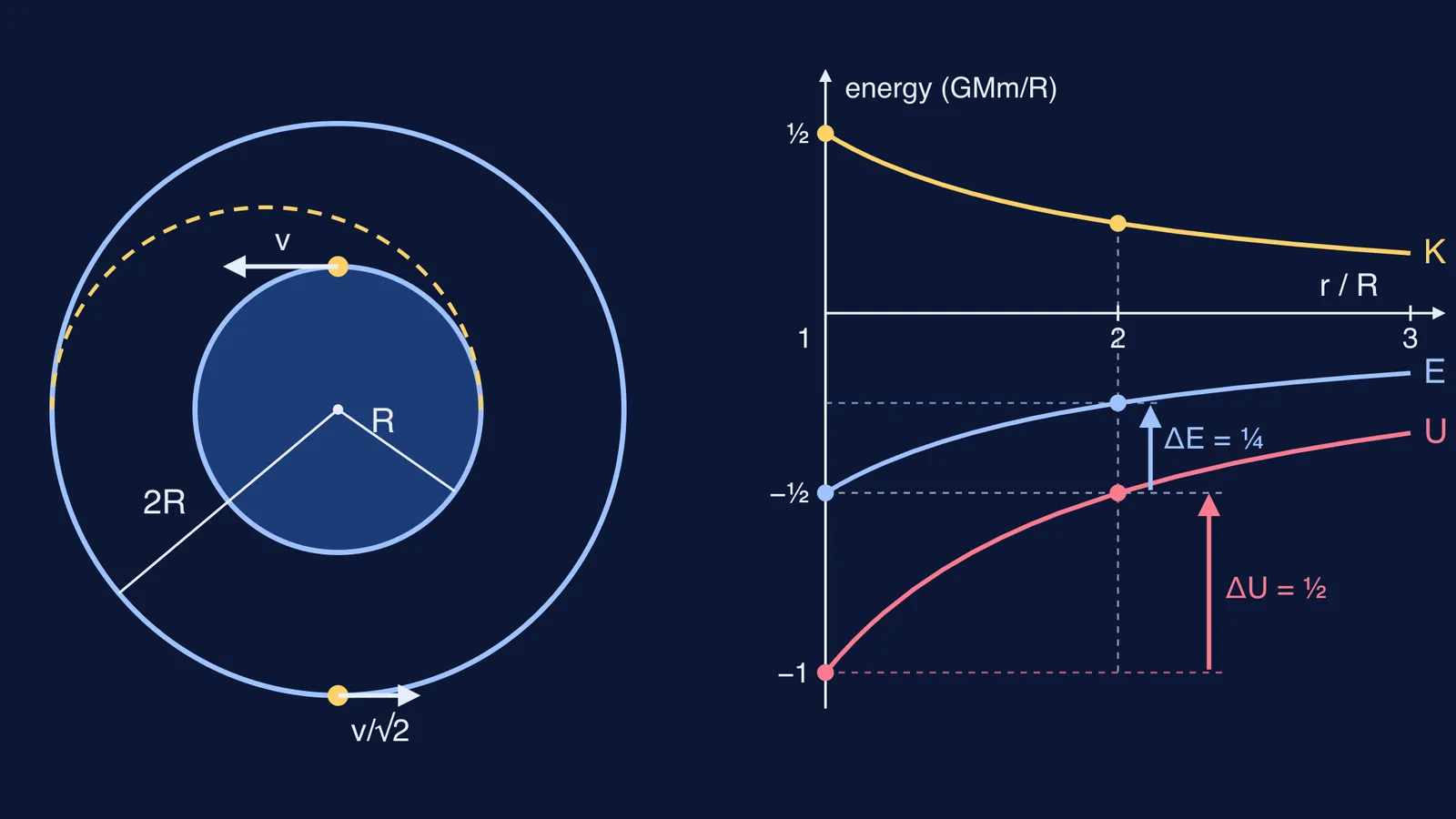
Take a satellite of mass m in a circular orbit of radius r₁ = R (Earth's radius, an idealised orbit skimming the surface) and move it to r₂ = 2R.
Total energy at R: E₁ = −GMm/2R.
Total energy at 2R: E₂ = −GMm/4R.
Work needed: W = E₂ − E₁ = GMm/2R − GMm/4R = GMm/4R.
Change in potential energy: ΔU = −GMm/2R − (−GMm/R) = GMm/2R, which is twice W.
Using GM = gR², the answer can also be written W = mgR/4.
Now put in numbers. NASA's Earth fact sheet gives GM = 3.986 × 10¹⁴ m³/s² and a mean radius of 6,371 km. That makes GM/R ≈ 6.26 × 10⁷ J/kg. For a 1,000 kg satellite:
Work by the engines: W ≈ 1.56 × 10¹⁰ J
Rise in potential energy: ΔU ≈ 3.13 × 10¹⁰ J
Orbital speed falls from about 7.91 km/s to about 5.59 km/s, a factor of √2
The engines supply about 15.6 GJ; the other 15.6 GJ of potential energy comes out of the satellite's own kinetic energy.
Which formula does the question actually want?
Read the start and end states before you write anything. Use this checklist:
Orbit to orbit: W = E₂ − E₁ = (GMm/2)(1/r₁ − 1/r₂).
From rest on the surface to an orbit of radius r: W = E_orbit − U_surface = GMm(1/R − 1/2r), ignoring Earth's rotation. For r = 2R this is 3GMm/4R, not GMm/4R.
Lifting a body to a height and leaving it at rest there (no orbit): W = ΔU = GMm(1/R − 1/r).
From an orbit to escape: W = 0 − (−GMm/2r) = GMm/2r.
Always measure r from Earth's centre. If the question gives height h, use r = R + h.
When you are stuck on which start and end state a question means, the Fermi Problem Library has worked problems with a step-by-step solver that explains the reasoning rather than printing an answer.
Does a real rocket use exactly this much energy?
No. ΔE is the energy the satellite itself gains. The fuel burned is much more, because the engine also has to accelerate its own propellant and hardware. OpenStax makes the same point in its Soyuz example: the mass of the propulsion system far exceeds that of the payload (OpenStax).
Nor is the move one smooth climb: a speed boost first stretches the orbit into an ellipse, as our post on what happens when a satellite's speed is increased slightly explains. In an exam, only the start and end orbits matter.
To revise the energy ideas behind this, look up orbital energy and gravitational potential energy in the Fermi Concept Library, then try one orbit-to-orbit and one surface-to-orbit problem back to back.