On this page
This Unit V chapter of the CBSE 2026-27 Biotechnology (045) curriculum asks one question: once a genome has been read, how do scientists turn a string of letters into genes, proteins and meaning?
What does this chapter cover in the 2026-27 syllabus?
The curriculum lists seven topics: predicting and counting genes, genome similarity, comparative genomics with SNPs, functional genomics, proteomics, information sources, and bioinformatics tools. Unit V carries 40 marks, shared by three chapters, so no separate figure exists for this one.
The prescribed book is CBSE's A Text Book of Biotechnology Class XII. We could not find an official PDF of it on cbseacademic.nic.in, so this guide follows the curriculum's topic list and uses NCERT as the reference: Chapter 5, Genome Technology and Engineering, in NCERT Biotechnology XII (Reprint 2025-26), and Chapter 9, Introduction to Bioinformatics, in NCERT Biotechnology XI (Reprint 2026-27).
How is this different from core Biology? The Molecular Basis of Inheritance board guide covers the Human Genome Project. Here you work with the data: reads, alignments, databases and tools. One listed practical is an NCBI database search.
How are genes predicted and counted?
Once a genome has been assembled, it is annotated. Annotation means locating and classifying features such as coding regions, exon-intron junctions, repeats and pseudogenes (NCERT XI, Ch 9).
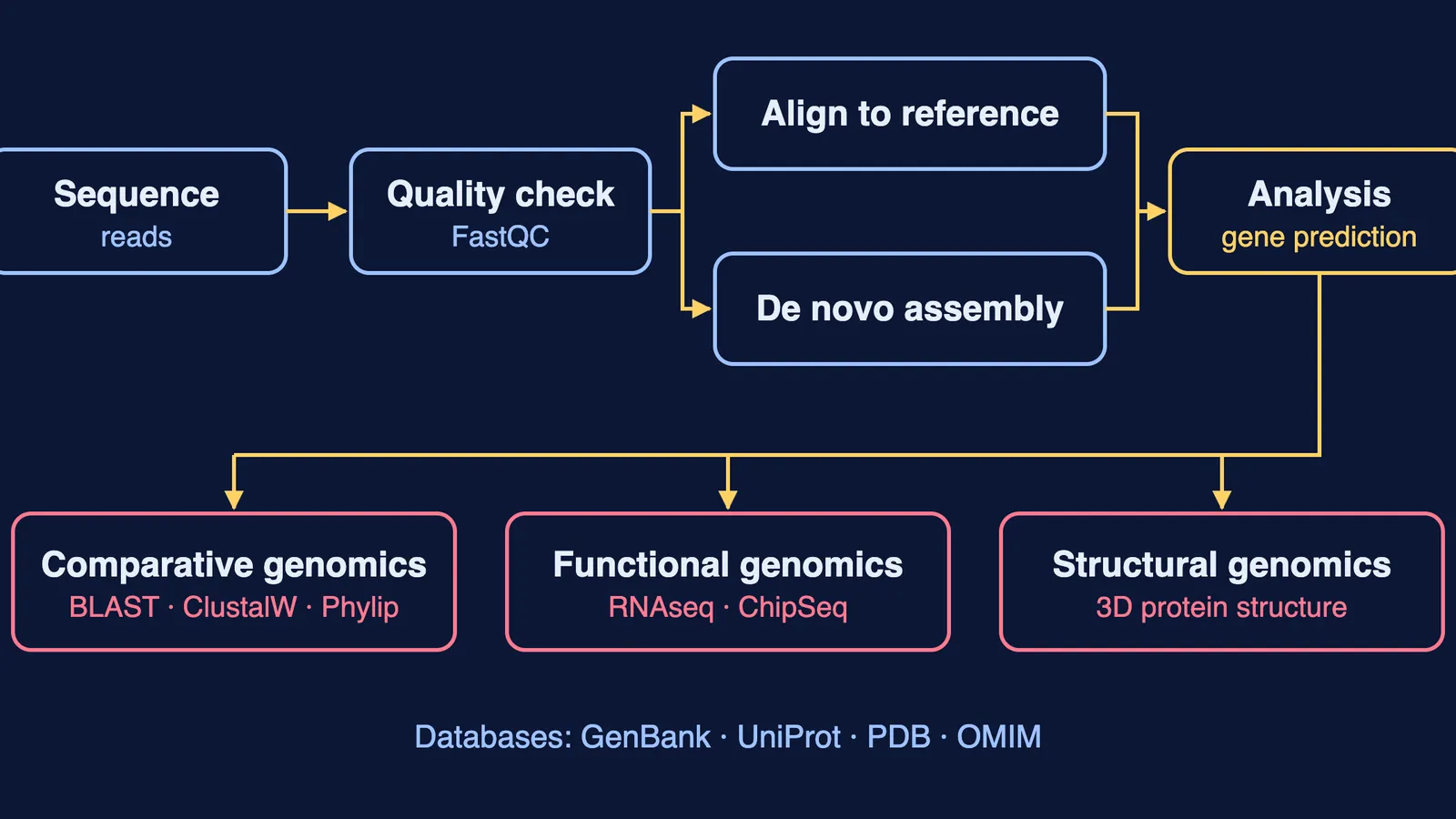
Gene prediction tools follow one of three models:
Ab initio: works without matching against known sequences.
Similarity-based: searches the new sequence against known ones, using programs such as BLAST.
Integrated: combines the results of both.
Counting connects to expression. In RNASeq, cDNA made from a sample's RNA is sequenced, reads are mapped to genes, and the number of reads on each gene is taken as proportional to its expression (NCERT XII, Ch 5). If, in an imaginary sample, gene P collects 1,200 reads and gene Q 300, P is about four times as active (1,200 ÷ 300 = 4).
How do you measure genome similarity and SNPs?
Comparative genomics compares genes and genomes across species, or among individuals of one species (NCERT XII, Ch 5). It separates a shared core genome from species-unique genes and helps annotate a new genome against a known relative. NCERT names BLAST, ClustalW and Phylip as tools for comparing many sequences and tracing evolutionary relationships.
Single-base differences like these, tracked across many individuals, are the kind of variant studied as single nucleotide polymorphisms (SNPs); NCERT XI notes that databases store SNP frequencies across populations. For quick pairwise checks, NCERT lists bl2seq (one sequence against another) and BLAT, which finds highly similar matches (above 95 per cent) of at least 40 nucleotides (NCERT XI, Ch 9).
What are functional genomics and proteomics?
Functional genomics asks how the information in a genome is actually carried out in a cell, in health and disease. Its toolkit in NCERT XII is RNAseq, ChipSeq (which maps where a transcription regulator binds across the genome) and metagenomics. Structural genomics instead studies the 3D structures of encoded proteins, or DNA organisation in chromosomes.
Proteomics studies the full protein set. The 2026-27 marking scheme describes 2-D gel electrophoresis: isoelectric focusing separates proteins by pI, then SDS-PAGE at right angles separates them by mass, so two properties give a sharper pattern. Mass spectrometry then characterises ions by mass-to-charge ratio (m/z), as NCERT XI, Ch 12 explains.
Which bioinformatics databases and tools should you know?
NCERT XI lists these information sources (Ch 9):
GenBank: annotated, publicly available DNA sequences; launched in 1982.
UniProt: protein sequences and functions.
PDB: 3D structures of proteins, nucleic acids and complexes.
PubMed: biomedical literature.
KEGG: pathways, diseases, drugs and chemicals.
OMIM: human genes and genetic disorders.
A FASTA file starts with a ">" line describing the sequence; FASTQ adds quality scores. If this chapter interests you, see our guide to bioinformatics after 12th.
Practice questions in the CBSE pattern
The 2026-27 sample paper has 1-mark MCQs, 2- and 3-mark short answers, 4-mark case-based questions and 5-mark long answers. Our own questions in those types:
(1 mark, MCQ) A tool predicts genes in a new genome by searching it against sequences already in a database. Which model is this? (a) ab initio (b) similarity-based (c) de novo assembly (d) metagenomics
(2 marks) Give one aim of functional genomics and one of structural genomics.
(3 marks) Align GGATCCTTAGCAATGCCGTTAGCAT with GGATCCTAAGCAATGCCGTTGGCAT. Find the differing positions and the per cent identity. (Answer: positions 8 and 21; 23 of 25, so 92 per cent.)
(4 marks, case-based) A lab sequences a soil bacterium with no sequenced relative. Name its workflow, the step before assembly, and how comparative genomics finds its unique genes.
(5 marks) Two proteins share the same mass but differ in pI. Explain why SDS-PAGE alone cannot separate them and how 2-D electrophoresis does.
For the rDNA basics behind this chapter, revisit Biotechnology principles and processes.
Not sure where to begin? Fermi's AI tutor works out what you already know and builds a plan for the session.