On this page
Every sequenced genome is a long string of A, C, G and T, and someone who knows both biology and code has to turn it into answers. If you enjoy biology and like writing programs, here is what bioinformatics involves, how to enter it from India, and what to practise now.
What does a bioinformatics professional actually do?
The US National Human Genome Research Institute defines bioinformatics as a field "using computer technology to collect, store, analyze and disseminate biological data and information, such as DNA and amino acid sequences or annotations about those sequences."
Generating a high-quality draft human genome cost about $14 million in 2006 and below $1,500 by late 2015, according to NHGRI's sequencing cost fact sheet. Cheaper sequencing means more data, and every dataset needs people who can analyse and explain it.
India now has large datasets of its own. In January 2025 the government released the Indian Genomic Data Set, making 10,000 whole genome samples available to researchers through the Indian Biological Data Centre portals, PIB reported.
A typical day might involve lining up millions of short DNA reads against a reference genome, finding where a patient's DNA differs, writing a script that repeats the analysis on a thousand samples, or making a chart a biologist can act on.
Which bioinformatics course can you take after 12th?
The route depends on your Class 12 subjects.
If you have PCM: some engineering programmes combine computing and biology from the first year. IIIT Delhi's BTech in Computer Science and Biosciences, for example, admits through JEE Main and JAC Delhi counselling and asks for 70% aggregate in five subjects (including PCM) and 70% in maths in Class 12, per its 2026 admission page. Biology is not required, so you will learn it in college.
If you have PCB without maths: the usual path is a BSc in biotechnology, life sciences, microbiology or bioinformatics. Many central and participating universities admit through CUET (UG), so check each university's own eligibility page. Our guide to choosing between a BTech and a BSc in biotechnology covers that choice in detail.
If you take PCMB: you keep both doors open, at the cost of a heavier timetable.
After a bachelor's degree, many students specialise through an MSc or MTech. GAT-B is the national entrance test for Department of Biotechnology supported postgraduate programmes, and DBT lists computational biology among its supported areas, per the Regional Centre for Biotechnology, which manages the test.
What jobs does bioinformatics lead to?
The work splits into a few broad roles:
Genomics data analyst: runs established pipelines on sequencing data and reports the results.
Research scientist: asks biological questions and builds new methods, usually after an MSc or PhD.
Bioinformatics software developer: builds the tools, databases and portals other scientists use.
Clinical genomics specialist: helps interpret DNA variants found in patients, working alongside doctors.
Employers include research institutes, hospitals, diagnostic labs, and pharmaceutical, agricultural and software companies.
Which skills should you build in Class 11 and 12?
The curriculum task force of the International Society for Computational Biology's education committee developed a set of bioinformatics core competencies, published in PLOS Computational Biology in 2018. They range from general biology and depth in an area such as genetics or molecular biology, through statistical methods, bioinformatics tools and command-line scripting, to communication and teamwork. You do not need all of these at 16, but you can start four of them now:
Molecular biology: know NCERT's chapters on the molecular basis of inheritance thoroughly, especially transcription, translation and the genetic code.
Python: learn loops, strings, dictionaries and reading files. Our list of first Python project ideas for school students is a good starting point.
Statistics: mean, variance, probability and reading a graph honestly.
Practice problems: Rosalind calls itself "a platform for learning bioinformatics through problem solving".
If a biology or computing idea will not click from the textbook, the Fermi Concept Library gives every concept in biology, mathematics and computing its own lesson.
What is a first bioinformatics task to try at home?
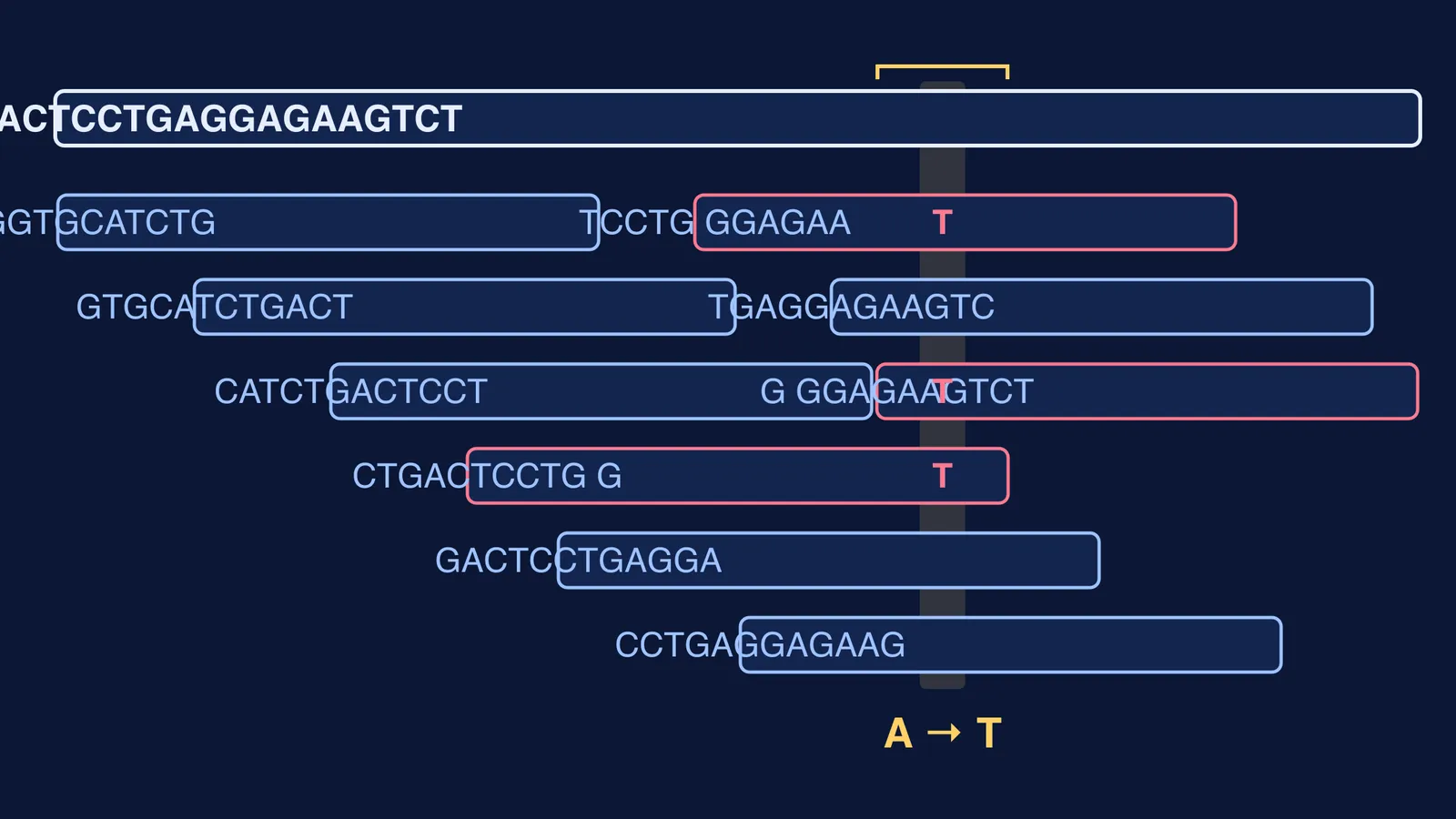
The human HBB gene makes beta-globin. Its coding sequence on NCBI (NM_000518.5) begins ATG GTG CAT CTG ACT CCT GAG GAG. In sickle cell disease, glutamic acid is replaced by valine at position 6 of beta-globin, written Glu6Val, as MedlinePlus Genetics explains.
Store the sequence as a Python string.
Split it into three-letter codons with a loop.
Translate each codon using a codon table stored as a dictionary.
Change the A in the seventh codon (GAG) to T and translate again.
Compare the two outputs. Notice that protein numbering skips the starting methionine, so codon 7 is amino acid 6.
When the code works but the logic trips you up, the Fermi Problem Library has a step-by-step solver that explains the reasoning rather than printing an answer.
Parents weighing options for a biology student who is not set on medicine can read next: PCB but not NEET? Degrees to discuss with your child early.