

On this page
If you want to build a career in biotechnology, you face an early choice: a B.Sc (Bachelor of Science) or a B.Tech (Bachelor of Technology). Both degrees study living organisms to create useful products, but they prepare you for different sides of the industry.
The choice comes down to how you want to work. Do you want to discover how a cell works in a laboratory, or do you want to design the machinery that manufactures a vaccine at scale?
Should you choose B.Tech or B.Sc biotechnology?
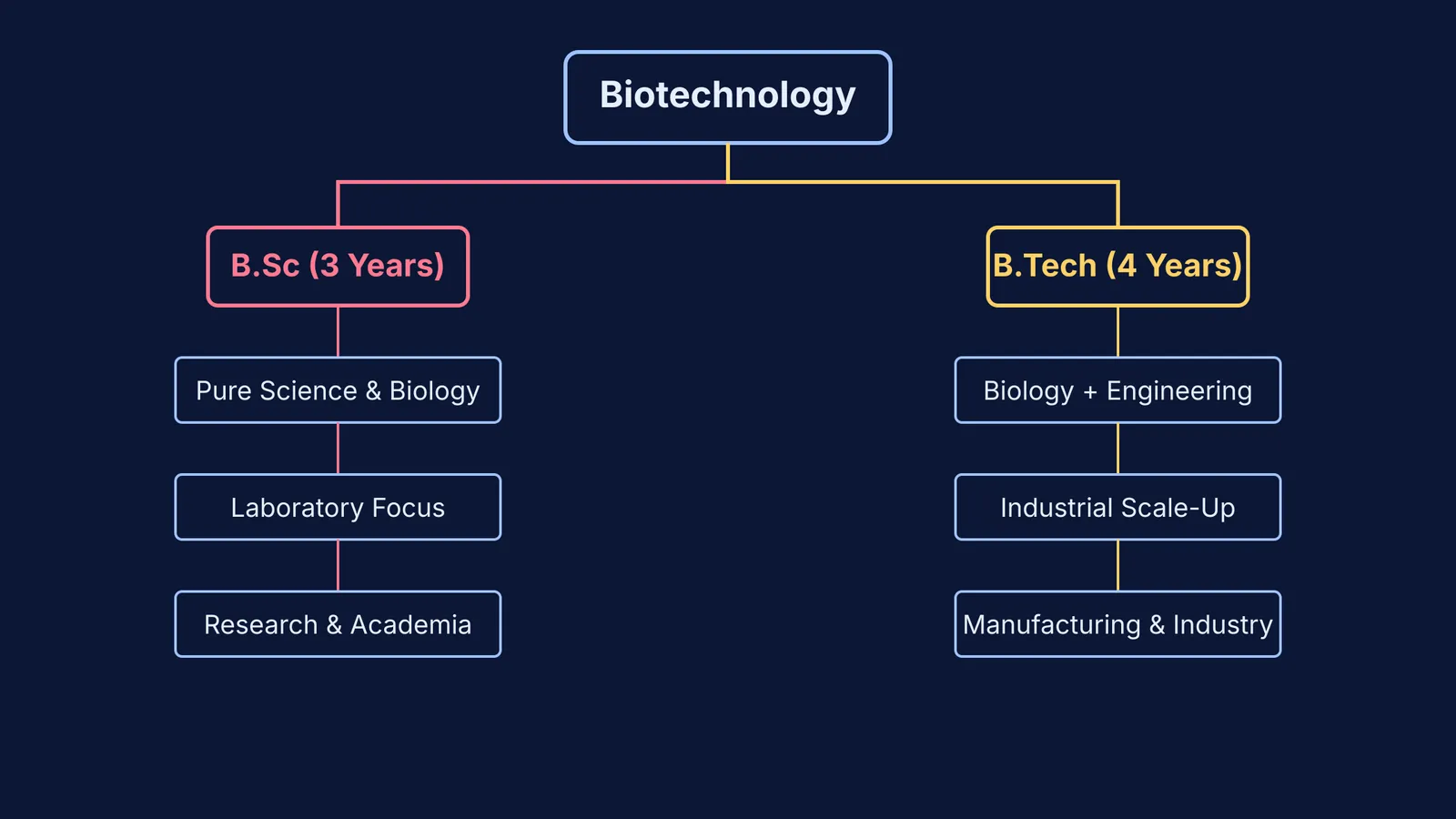
The most obvious difference between the two paths is their duration. A B.Sc in Biotechnology is a three-year undergraduate degree. It focuses on the theoretical and research aspects of biology.
A B.Tech in Biotechnology is a four-year engineering degree. Because it is a technical course, B.Tech programmes are typically approved by the All India Council for Technical Education (AICTE).
Both paths require a science background in Class 12. For a B.Sc, you must have studied Physics, Chemistry and Biology (PCB). For a B.Tech, you must have studied Physics, Chemistry and Mathematics or Biology (PCM, PCB or PCMB).
What is the difference in the syllabus?
A B.Sc syllabus is heavily focused on pure biology. Over three years, you will study cell structure, genetics, microbiology and immunology. You will learn the science behind Biotechnology for NEET: restriction enzymes, PCR and cloning vectors and how organisms function at a molecular level.
A B.Tech syllabus combines those life sciences with core engineering principles. In your early semesters, you will study engineering mathematics, physics and engineering drawing. Later, you will take advanced modules such as bioprocess engineering, bioreactor design and thermodynamics.
Both degrees require a solid grasp of complex sciences. If you hit a concept gap while studying either syllabus, the Fermi Concept Library holds every concept in physics, chemistry, biology, mathematics and computing, each with its own lesson and its place in the map.
Do you want a lab or engineering focus?
The daily work in these two degrees looks very different. A B.Sc is a laboratory-focused degree. Your practical work will involve test tubes, microscopes, DNA isolation and tissue culture. The goal is to answer the "why" and "what" of biological processes.
A B.Tech is an engineering-focused degree. While you still spend time in a biology lab, you will also learn how to scale those laboratory discoveries into industrial production. If a scientist discovers a new RNAi treatment, as explored in Biotechnology applications for NEET: Bt crops, RNAi and gene therapy, an engineer designs the system to manufacture thousands of doses safely. The goal of a B.Tech is to answer the "how".
What are the paths to research or industry?
Because a B.Tech includes an extra year of study and practical engineering applications, graduates are often considered ready for the industry immediately. You can find roles in pharmaceutical companies, food processing and quality assurance. The average starting salary for a B.Tech graduate in India is approximately ₹2.9 LPA.
A B.Sc is the traditional first step towards a career in research or academia. While you can find entry-level jobs as a lab technician or research assistant with an average starting salary of ₹2.7 LPA to ₹3.4 LPA for roles like biochemist or molecular biologist, most B.Sc graduates pursue higher education. To secure high-level research and development (R&D) roles, you will usually need to complete an M.Sc and eventually a Ph.D.
How to choose your degree?
To decide which path is right for you, consider the subjects you enjoy and the environment you want to work in.
Check your subjects: Do you enjoy Mathematics and Physics just as much as Biology? If you like solving equations and designing systems, a B.Tech is a natural fit. If you prefer pure biology and laboratory experiments, lean towards a B.Sc.
Consider the timeline: A B.Sc gets you to graduation in three years, giving you a head start on a master's degree. A B.Tech takes four years but prepares you to enter the workforce directly.
Define your career goal: If you want to become a research scientist or a university professor, the B.Sc to M.Sc to Ph.D. route is the standard path. If you want to work in manufacturing, product development or industrial biotechnology, choose a B.Tech.


