On this page
This guide covers Unit III, Chapter 2 of CBSE Class 11 Biotechnology (045). We could not find an official PDF of CBSE's prescribed "A Text Book of Biotechnology" on cbseacademic.nic.in, so this post follows the curriculum's topic list and uses the NCERT Biotechnology XI book (Reprint 2026-27), which the curriculum names as a reference.
How many marks does Genes and Genomes carry in Class 11 Biotechnology?
The CBSE Biotechnology curriculum for 2026-27 prints Unit III, Genetics and Molecular Biology, at 20 marks in the 70-mark theory paper. That unit holds two chapters, Concepts of Genetics and this one, and CBSE gives no separate figure for each. CBSE publishes no Class 11 Biotechnology sample paper, so the mark labels on our practice questions are our suggestion.
The NCERT reference covers the curriculum's nine topics in Chapter 7, Basic Processes and Chapter 8, Genetic Disorder. Chapter 7 also has sections on DNA repair and regulation of gene expression; the curriculum does not list those for this chapter.
How is this different from core Biology?
Core Biology meets these ideas in Class 12, in Molecular Basis of Inheritance (see our Class 12 board guide to molecular basis of inheritance). The Biotechnology version comes a year earlier and goes into more machinery: each replication protein's job, the three eukaryotic RNA polymerases, tRNA charging, wobble pairing, transitions and transversions, and a chapter on syndromes and pedigrees. If nucleotides feel shaky, revise them first with our Class 11 Biomolecules guide.
What should you learn under each topic?
Everything below is from the NCERT Chapter 7 text.
DNA as genetic material: Griffith (1928), Avery, MacLeod and McCarty (1944), Hershey and Chase (1952).
Genome facts: NCERT puts the human genome at about 3,000 Mb, with more than 20,000 genes making up roughly 2% of it.
Replication: semiconservative (Meselson and Stahl, 1958). Helicase unzips, topoisomerase relieves twisting, SSB proteins hold strands apart, primase lays a 10-12 nucleotide RNA primer, DNA polymerase III builds 5'→3', polymerase I swaps primers for DNA, ligase seals. The lagging strand is made as Okazaki fragments of about 1,000-2,000 nucleotides.
Transcription: the bacterial sigma factor finds the promoter (Pribnow box, TATAAT); no primer is needed. Eukaryotic pre-mRNA gets a 5' cap, loses introns by splicing and gains a poly-A tail.
Genetic code: triplet, 64 codons, 61 for 20 amino acids; UAA, UAG, UGA stop; AUG starts and codes for methionine; unambiguous, degenerate, non-overlapping, nearly universal.
Translation: tRNA charging, initiation, elongation (A, P and E sites; peptidyl transferase), termination by release factors.
Mutations: chromosomal (aberrations, aneuploidy, polyploidy) and gene (point) mutations; addition and deletion shift the reading frame; substitutions are transitions or transversions.
Worked example: one gene, three mutations
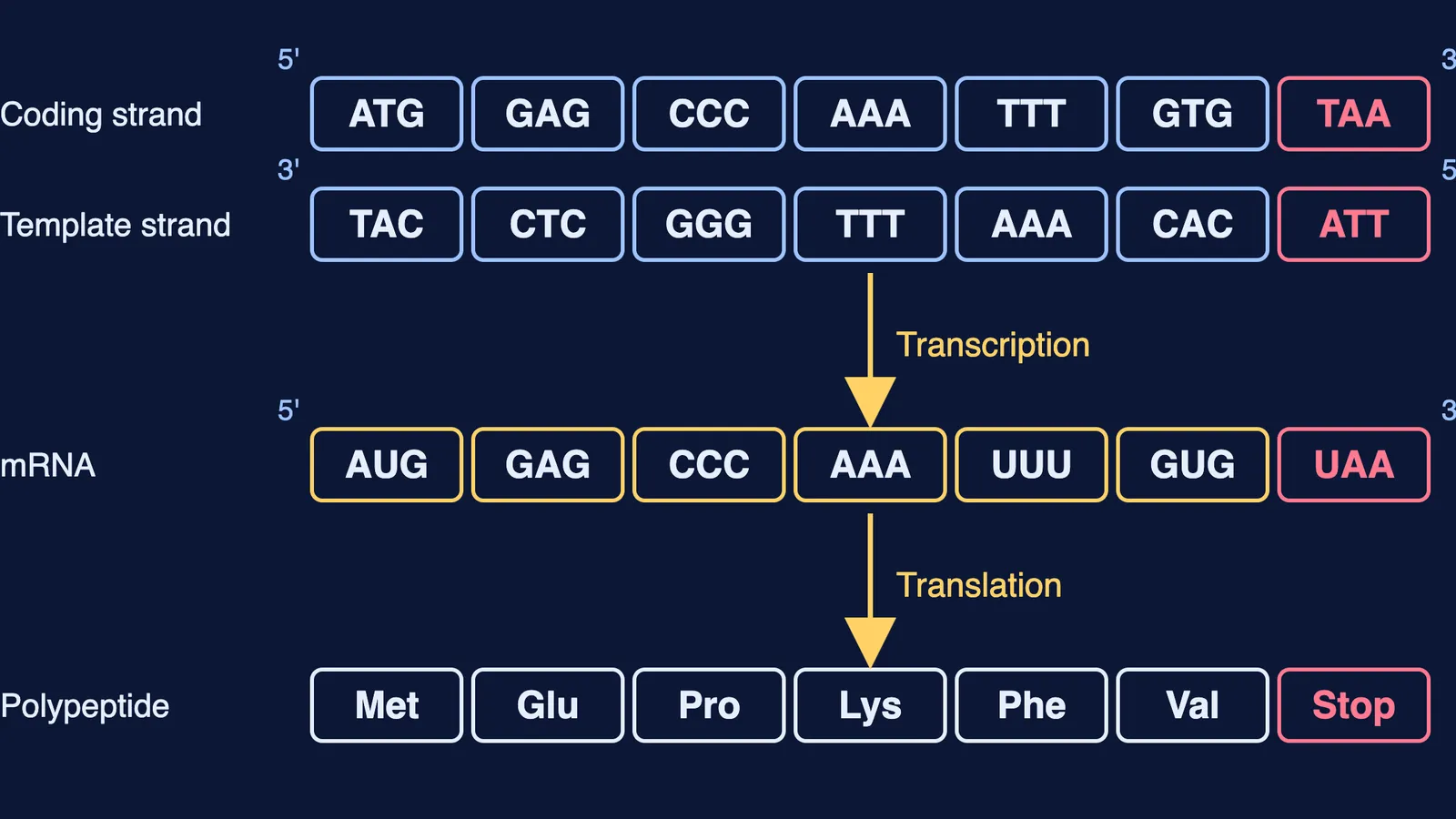
Take an invented coding strand, 5'-ATG GAG CCC AAA TTT GTG TAA-3'. Its template strand is 3'-TAC CTC GGG TTT AAA CAC ATT-5'. The mRNA copies the coding strand with U for T: 5'-AUG GAG CCC AAA UUU GUG UAA-3'. Reading the NCERT codon table gives Met-Glu-Pro-Lys-Phe-Val, then stop: six amino acids.
GAG → GAA (G to A, purine for purine: a transition). GAA also codes for Glu, so the chain is unchanged: the code is degenerate.
GAG → UAG in the mRNA (G to T in DNA, purine for pyrimidine: a transversion). UAG is a stop codon, so the chain ends after Met.
Delete the first C of CCC. The frame shifts: AUG GAG CCA AAU UUG UGU..., giving Met-Glu-Pro-Asn-Leu-Cys, and the original UAA is no longer read in frame.
We checked every codon against NCERT's table by script.
Which human genetic disorders should you know?
From NCERT Chapter 8, learn three groups.
Chromosomal: structural changes (deletion, duplication, inversion, translocation) and numerical ones. Down syndrome is trisomy 21 (47, XX, +21 or 47, XY, +21), which NCERT gives as about 1 in 800 live births; Klinefelter syndrome is 47, XXY; Turner syndrome is 45, X.
Monogenic: sickle cell anaemia (autosomal recessive, haemoglobin-β gene on chromosome 11), achondroplasia (autosomal dominant), haemophilia (X-linked recessive), hypophosphatemia (X-linked dominant). Our principles of inheritance guide has more on crosses.
Polygenic: hypertension, coronary heart disease and diabetes.
This is a study summary, not medical advice.
Practice questions
Name the enzyme that removes RNA primers in *E. coli* and the one that joins Okazaki fragments. (1 mark, our suggestion)
A coding strand reads 5'-ATG TTT AAA TAG-3'. Write the mRNA and the amino acids it codes for. (2 marks, our suggestion)
One DNA site changes C to T and another changes A to C. Classify each substitution and give the reason. (2 marks, our suggestion)
Why can a deletion of one base harm a protein more than a substitution? (3 marks, our suggestion)
A buccal smear from a boy shows one Barr body. Which karyotype does this suggest, and how could it arise? (3 marks, our suggestion)
Answers: Q1 DNA polymerase I; DNA ligase. Q2 5'-AUG UUU AAA UAG-3'; Met-Phe-Lys, stop. Q3 C to T: transition (pyrimidine for pyrimidine); A to C: transversion (purine for pyrimidine).
Stuck on where to begin this week? Fermi's AI tutor works out what you already know and builds a plan for the session.