On this page
Chapter 9 of Exploring Society: India and Beyond, Part I (NCERT book code 0781, file code gees1, First Edition April 2025, reprinted February 2026 and marked Reprint 2026-27) opens Theme D, Governance and Democracy. CBSE publishes no separate 2026-27 curriculum for Classes 6 to 8, so these classes follow the NCERT book, and the chapter is assessed by the school.
What does the chapter cover?
The chapter text moves in four steps.
What government does, and its three functions. A school story weighs three ways to form a student committee and calls voting for grade representatives the democratic one. Making rules is the legislative function, carrying them out the executive function, and checking they are followed the judicial function.
Four questions that separate governments. Who decides that "this is the government"? How is it formed? What are its parts and what do they do? What is it working for?
Democracy and its forms. Principles such as equality, freedom, universal adult franchise, fundamental rights and an independent judiciary; then direct and representative democracy.
Other forms, and why democracy matters. Monarchy, theocracy, dictatorship and oligarchy, then the problems democracies can still face.
What are the main types of government in Class 7?
Definitions in our words, from the NCERT chapter.
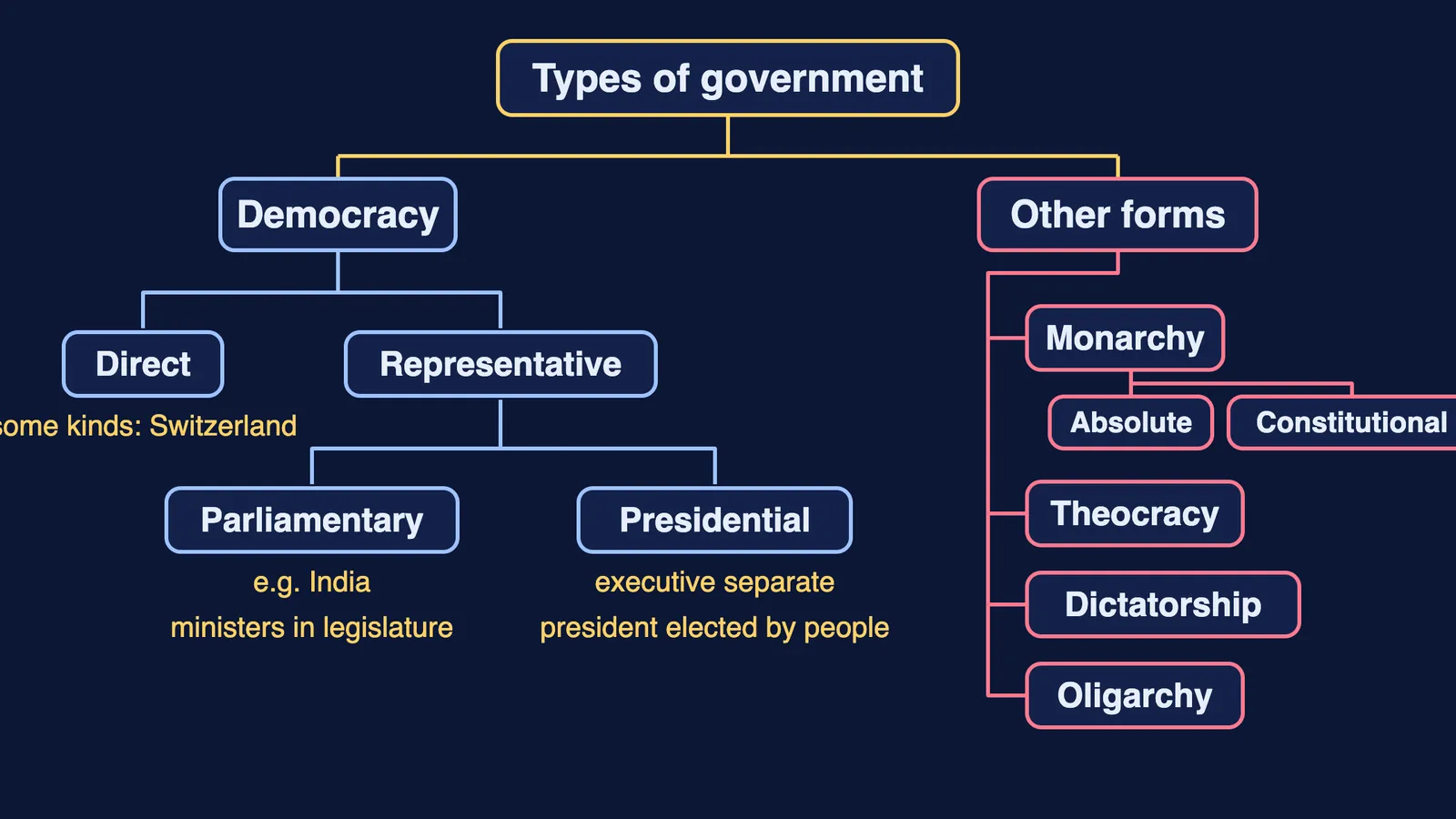
Direct democracy: every citizen takes part in every decision. The book notes some kinds of it in Switzerland; it is hard to run in large countries.
Representative democracy: people elect representatives through universal adult franchise, and the government stays accountable to them.
Parliamentary democracy: ministers are also members of the legislature and stay in office while they keep its confidence. In India this means the confidence of the Lok Sabha.
Presidential democracy: the people elect the president, who does not need the legislature's confidence to remain in office.
Absolute monarchy: the monarch, usually hereditary, has complete control over making laws, enforcing them and judging disputes.
Constitutional monarchy: a king or queen is head of state with nominal power, while an elected parliament makes laws and a prime minister leads the executive.
Theocracy: religious rules and religious leaders are the source of authority.
Dictatorship: one person or a small group holds absolute power, with no limits set by a constitution or law.
Oligarchy: a small, powerful group, often wealthy families, makes the important decisions.
A worked example: classify a country with the four questions
Country P. A queen inherits the throne from her father, but her duties are only ceremonial. Citizens over 18 elect a parliament that makes the laws. A prime minister and ministers chosen from parliament run the government and stay in office only while parliament supports them. P's constitution says the government must work for the welfare of every citizen.
Who decides "this is the government"? The voters, through elections.
How is it formed? By election; only the ceremonial head of state is hereditary.
What are its parts and what do they do? An elected legislature makes laws; the executive is drawn from it and needs its confidence.
What is it working for? The welfare of all citizens.
Answer: a constitutional monarchy that works as a parliamentary democracy.
Country Q. Voters elect a president, who heads the government, for a fixed term. A separate elected assembly makes the laws, and it cannot remove the president by a vote of no confidence. Q's constitution promises every citizen equality before the law.
Who decides? The voters.
How is it formed? Separate elections for the president and the assembly.
What are its parts and what do they do? The executive works independently of the legislature and does not need its confidence.
What is it working for? Equal rights for all citizens.
Answer: a presidential democracy.
How does this chapter link to the rest of the book?
It looks back to Chapter 4, New Beginnings: Cities and States, for the mahajanapadas, and leads into Chapter 10, The Constitution of India: An Introduction. For the Indian side in more depth, see our guide to how the state government works. To look ahead, read What is democracy and why democracy? for Class 9 and the new Governance and Public Policy chapter for Class 9.
Practice questions
Marks are our suggestion.
Name the three functions of government and give a school example of each. (3 marks)
How is a parliamentary democracy different from a presidential democracy? Give two points. (2 marks)
Country R has a king who makes every law and appoints judges who report to him. Which type of government is this? Give one reason. (2 marks)
Explain how a constitutional monarchy can still be a democracy. (3 marks)
In the town of Lakeview, every resident votes on every rule at a monthly meeting. Use the four questions to classify Lakeview's government, and give one limitation the chapter names for this form. (5 marks)
Not sure where to begin revising this theme? Fermi's AI tutor works out what you already know and builds a plan for the session.