On this page
Chapter 11 of the new Class 7 Social Science book asks three questions: how people exchanged things before money, why money appeared, and how its form has changed. It opens Theme E, Economic Life Around Us, in Exploring Society: India and Beyond, Part I (book code gees1, first edition April 2025, reprint 2026-27), on pages 229 to 246.
Classes 6 to 8 follow the NCERT book. CBSE's 2026-27 curriculum page lists documents for Classes 9 to 12 only, so this chapter has no separate syllabus or marks split. It is assessed by the school.
What is the barter system in Class 7?
The chapter defines barter as exchanging goods and services without money, and calls it the earliest form of exchange. People traded commodities such as cowrie shells, salt, tea, cloth, seeds and cattle.
Barter has not vanished. The book describes the Junbeel Mela in Morigaon district, Assam, a three-day fair that it traces to the 15th century, when Tiwa, Karbi, Khasi and Jaintia chiefs began meeting yearly. Hill produce is still swapped there for rice cakes and other food from the plains.
What are the limitations of the barter system?
The book's farmer has only an ox but needs shoes, a sweater and medicines. His trouble shows five problems, each named in the chapter:
Double coincidence of wants: you must find someone who has what you want and wants what you have.
No common standard measure of value: nobody can say how many shoes an ox is worth.
Divisibility: you cannot hand over part of an ox.
Portability: an ox is hard to take from place to place.
Durability: wheat taken in exchange rots or gets eaten by rats.
Worked example: what does money fix?
These numbers are ours, not the book's. Meher, a farmer, can sell her ox for ₹24,000. A bag of wheat is worth ₹600, so the ox equals 40 bags. She needs shoes (₹1,200), a sweater (₹900) and medicines (₹300).
In wheat: shoes cost 2 bags, the sweater 1.5 bags and the medicines 0.5 bags. She must split bags, haul all 40 around, and store the 36 left over before they spoil.
In money: she pays ₹1,200 + ₹900 + ₹300 = ₹2,400 and keeps ₹21,600 for later.
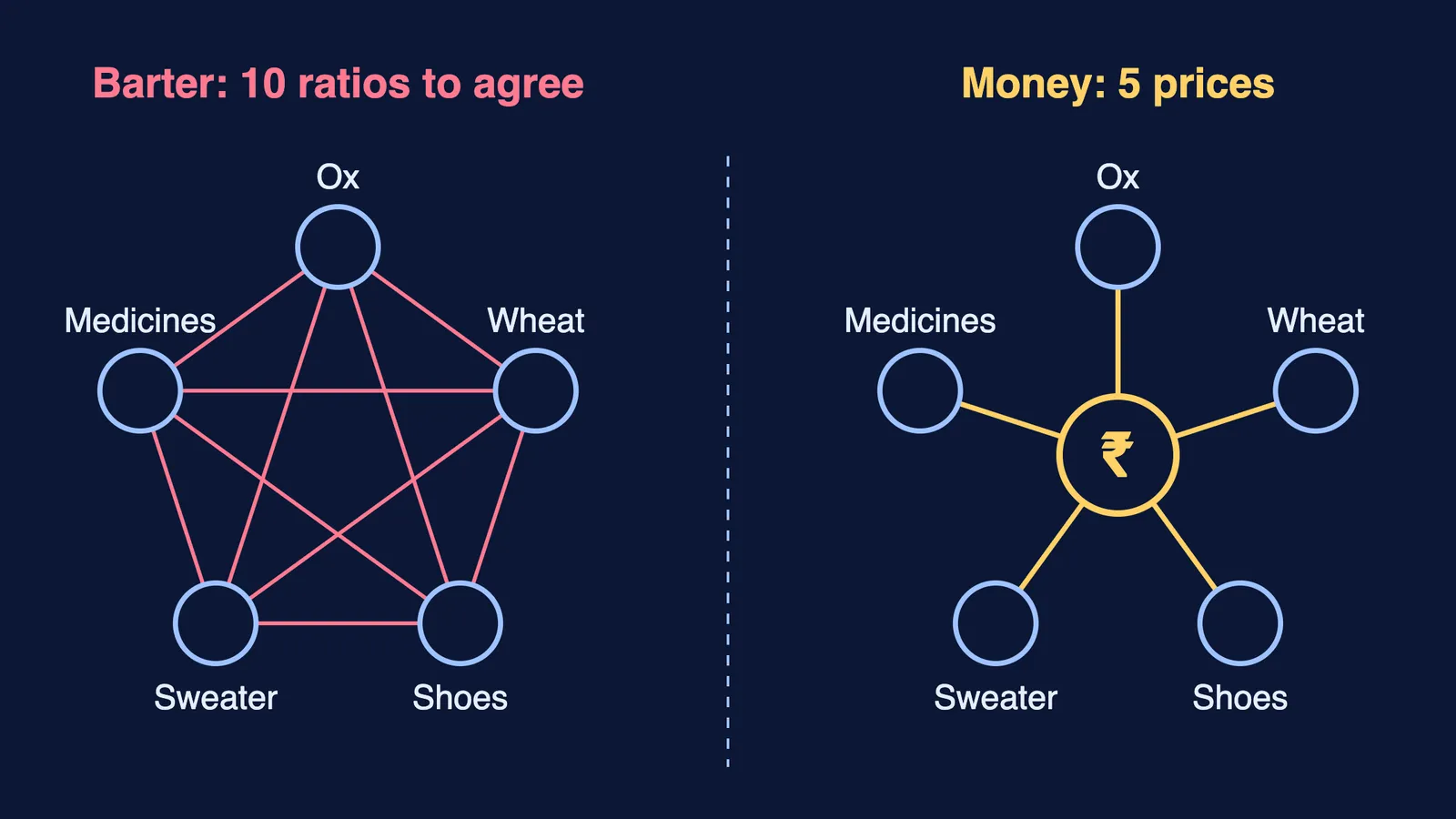
Now count the bargains. With these five goods, barter needs a ratio for every pair: 5 × 4 ÷ 2 = 10 ratios. With money, each good needs one price, so 5.
The book lists money's functions. It is a medium of exchange, accepted by everyone. It is a store of value that keeps for later, unlike wheat. It is a common denomination that lets you compare goods through prices. And it is a standard of deferred payment, so you can pay part now and the rest later.
How did money change from coins to UPI?
The chapter gives a broad timeline: barter around 6000 BCE, cowries from about 1000 BCE, metal coinage from about 600 BCE, official paper money in 1861, debit and credit cards from 1980, and UPI in 2016.
Coins: rulers minted their own, in gold, silver, copper or alloys. Early Indian coins went by the names kārṣhāpaṇas or paṇas, with punched symbols called rūpas. Chola silver coins (850–1279 CE) carried a tiger emblem. Roman gold coins dug up at Pudukkottai, Tamil Nadu, and finds in Kerala lead scholars to conclude that trade favoured India. (The Fig. 11.12 caption spells it "Pudukottai"; the chapter's text uses the correct Pudukkottai.)
Annas and the ₹ sign: 1 anna was 1/16 of a rupee. The ₹ sign was adopted in 2010, designed by Udaya Kumar of IIT Bombay.
Paper money: paper money began in China and reached India in the late 18th century. The book notes that only the Reserve Bank of India may legally issue currency.
Digital money: cards, net banking and UPI move money between bank accounts. The book's fruit seller Krishnappa takes payment by QR code.
How does this chapter connect to the rest of the book?
It builds on Theme B's crops and carnelian beads, and Chapter 12, Understanding Markets, comes next.
For the older syllabus, compare the Class 10 chapter on money and credit and the old Class 7 chapter, Markets Around Us. In Class 9, Building Blocks in Economics begins with scarcity and choice.
Practice questions
Marks are our suggestion; your school sets the real paper.
Define double coincidence of wants with an example of your own. (2)
Name the five problems of barter and give one line on each. (5)
A village trades seven goods by barter. How many exchange ratios must it agree, and how many prices would money need? (3)
How many annas made ₹3? (1)
A cycle repair costs ₹240 and you have ₹150. Which function of money lets you settle the rest later, and how much is left to pay? (2)
Answers to 3 to 5: 21 ratios and 7 prices; 48 annas; standard of deferred payment, ₹90.
Stuck on matching barter problems to money's functions? Fermi's AI tutor works out what you already know and builds a plan for the session.