On this page
Fractions in Disguise is Chapter 1 of NCERT's Ganita Prakash, Part II, the new Class 8 maths textbook (code hegp2, First Edition December 2025), as its prelims and contents page show. The chapter is about percentages and where they turn up in shops, banks and news. Every example and question below uses our own numbers, not the book's.
CBSE's 2026-27 curriculum page lists syllabi for Classes IX to XII only, so Classes 6 to 8 follow the NCERT book directly. The chapter is assessed by the school.
What does Fractions in Disguise cover?
The chapter PDF has three sections:
Fractions as Percentages. A percentage is a fraction whose denominator is 100, so x% = x/100. You convert by finding an equivalent fraction over 100, or by multiplying the fraction by 100.
Percentage of Some Quantity. Finding y% of a value, free-hand (mental) computations such as 10%, 20%, 5% and 25%, the FDP trio of fractions, decimals and percentages, working back to the whole from a part, and percentages above 100.
Using Percentages. Comparing scores, reading food labels, percentage increase and decrease, profit and loss (cost price, marked price, selling price), gross and net profit, taxes such as GST, growth with and without compounding, depreciation, and "tricky percentages".
The book traces "per cent" to the Latin per centum (by the hundred), and the idea of "per hundred" to Kautilya's Arthaśhāstra in the 4th century BCE.
Why does the book call percentages fractions in disguise?
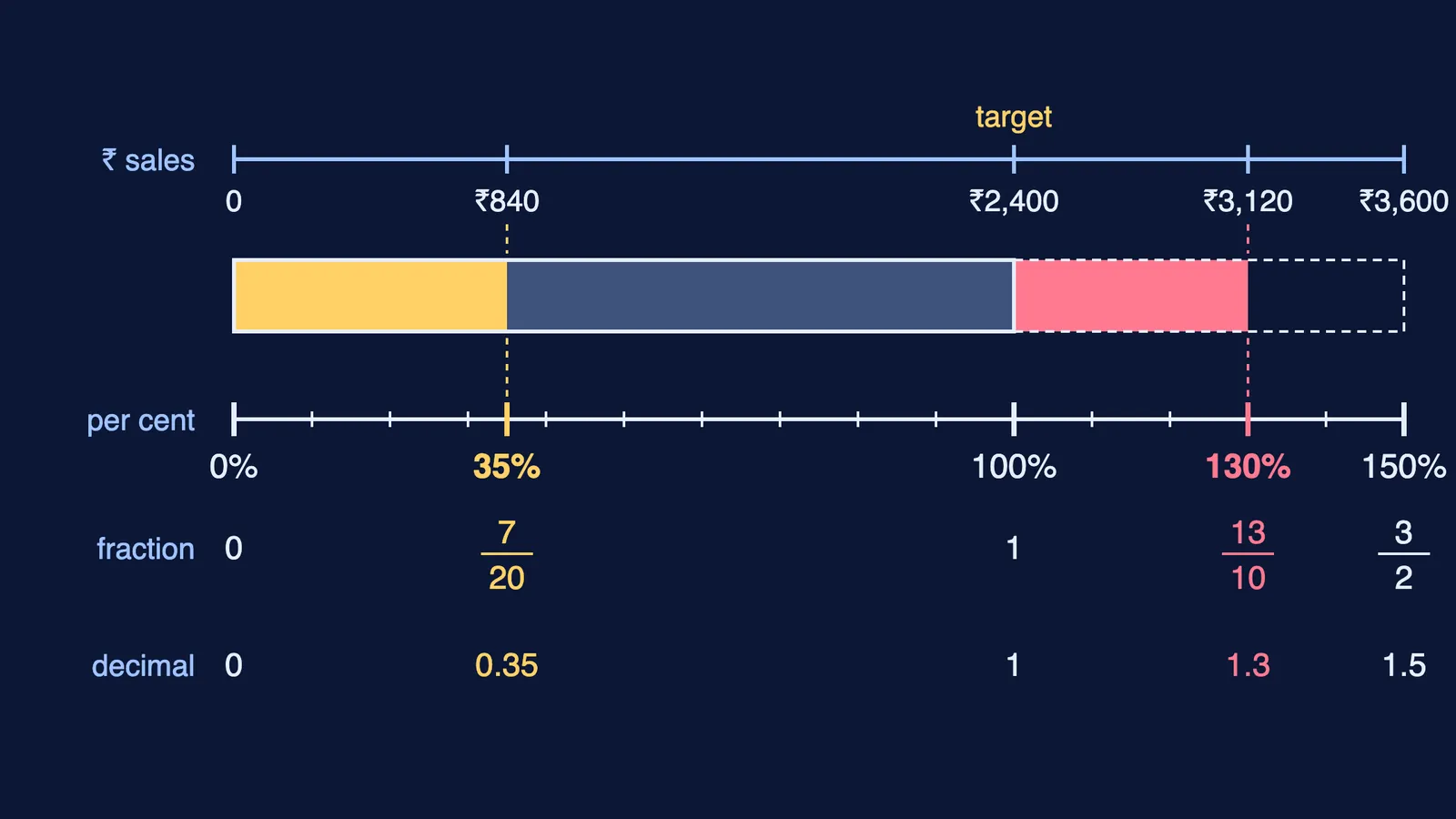
Because 35% is just 35/100, which simplifies to 7/20 and equals 0.35: one number written three ways. The chapter picks 100 as a shared denominator because it suits our base-10 number system and makes two proportions easy to compare.
Worked example: a school fete stall
A stall's sales target is ₹2,400 (the hero diagram shows it to scale).
By noon it has sold ₹840. 840/2400 = 7/20. Multiply by 100: 35% of the target, or 0.35 as a decimal.
Find the whole from a part. If you knew only that ₹840 was 35%, 5% is 840 ÷ 7 = ₹120, and 100% is 120 × 20 = ₹2,400.
By evening it has sold ₹3,120. 3120/2400 = 13/10 = 1.3, so 130% of the target. That means 30% above target, not "130% more".
Profit on one item. A glass of lemonade costs ₹16 to make and sells for ₹26. The ₹10 profit on cost price is 10/16 × 100 = 62.5%.
How do compounding and successive discounts work?
Interest. Take a fictional deposit of ₹7,000 at 8% p.a. for 3 years, so p = 7000, r = 0.08 and t = 3. With the interest paid out each year (no compounding), the book's formula p(1 + rt) gives 7000 × 1.24 = ₹8,680. With interest added back each year (compounding), p × (1 + r)ᵗ gives 7000 × 1.08 × 1.08 × 1.08 = ₹8,817.98. Compounding earns ₹137.98 more, because each year's interest is on a bigger principal.
Two discounts. A shirt marked ₹960 has "25% + 20% off". The first discount leaves 960 × 0.75 = ₹720; the second leaves 720 × 0.80 = ₹576. The total saving is ₹384, which is 40%, not 45%. A straight 45% off would cost ₹528.
Mark-up then discount. A seller marks an item 40% above cost, then offers 40% off: 1.4 × 0.6 = 0.84, so it sells at 84% of cost, a 16% loss. The two percentages have different bases: the chapter's "tricky percentages" trap.
How does this chapter connect to the rest of Ganita Prakash?
The About the Book note says Chapter 3, Proportional Reasoning-2, continues Proportional Reasoning-1 from Part I. Fractions in Disguise uses the same reasoning: if a number is N, 35% of it is the missing term in 100 : N :: 35 : ?. Compounding multiplies by the same factor every year, which is the pattern behind a geometric progression in Class 9 (see our guide to sequences, AP and GP in Ganita Manjari). For more on amounts above the whole, read what 150 percent means, and for tax on bills, how to calculate GST on a bill.
Not sure which of these ideas to practise first? Fermi's AI tutor works out what you already know and builds a plan for the session.
Practice questions
These are our own questions. The mark values are our suggestion for a school test.
Write 9/25 as a percentage and as a decimal. (1 mark) [36%, 0.36]
A water tank holds 63 litres when it is 45% full. What is its full capacity? (2 marks) [140 litres]
A notebook's price rises from ₹44 to ₹55. Find the percentage increase. (2 marks) [25%]
A lamp bought for ₹650 is sold at a 14% loss. Find the selling price. (2 marks) [₹559]
₹9,000 is deposited at 6% p.a. for 2 years. Find the amount with and without compounding. (3 marks) [₹10,112.40 and ₹10,080]
A price rises by 10% and then falls by 10%. Is it back where it started? (2 marks) [No: 1.1 × 0.9 = 0.99, so it is 1% lower]