

On this page
A shop says sales are at 150 percent of last year. A report says school enrolment is above 100 percent. Both sound impossible, because you can't eat more than a whole pizza. But a percentage compares one amount with a reference amount, and the amount can be bigger than the reference.
What does 150 percent mean?
A percentage is a number expressed as a fraction of 100, and the word comes from the Latin per centum, "by a hundred" (Wikipedia: Percentage). So 150% means 150/100, which is 1.5.
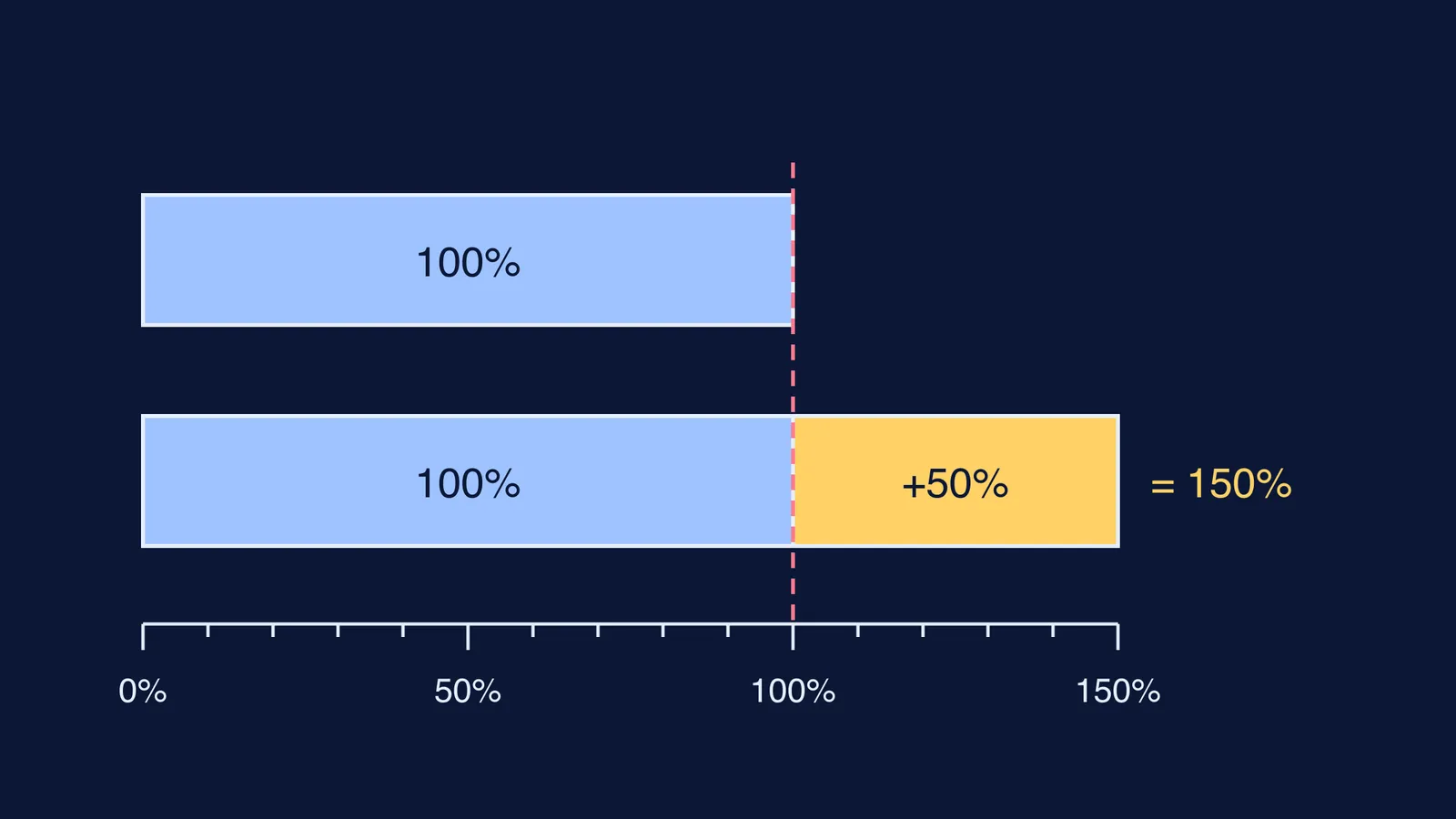
150 percent of something is one and a half times that thing: the whole, plus half of it again.
The same article notes that no mathematical rule stops percentages going above 100; values like 111% are common in comparisons and percent changes.
Students get stuck because they treat 100% as a ceiling. It is one only when you measure part of a fixed whole, like marks out of a paper: you can't score more than 80 out of 80. When the comparison is with a past value, a target or a capacity, the number can go past 100.
How can something be more than 100 percent?
Here are three everyday cases.
Prices. A price index sets a reference year equal to 100. In the World Bank's consumer price index for India, 2010 = 100, and the value for 2025 is 233.06 (World Bank: consumer price index, India). In plain words, a basket of goods that cost ₹100 in 2010 cost about ₹233 in 2025. In 2015 the same index stood at 146.79, so prices were already close to 150% of their 2010 level.
Attendance and enrolment. India's gross enrolment ratio for primary school was 112% in 2023, in UNESCO Institute for Statistics data published by the World Bank (World Bank: primary enrolment, India). The gross enrolment ratio is total enrolment, of any age, divided by the population of the official age group for that level. Children who start late, start early or repeat a year are counted on top but not underneath, so the ratio can pass 100 (World Bank Data Help Desk). It's the same idea as a school hall with 400 seats holding 600 people for annual day: the hall is at 150% of its seating, and 200 people are standing.
Growth. Say your monthly pocket money goes from ₹200 to ₹300. The new amount divided by the old one is 300 ÷ 200 = 1.5, so it is 150% of the old amount.
Is 150% of a number the same as a 150% increase?
No, and exam questions use this gap on purpose.
"150% of 200" means 1.5 × 200 = 300.
"A 150% increase on 200" means you add 150% of 200 to the original: 200 + 300 = 500, which is 250% of the original.
The price index works the same way. A 2025 value of 233 in the World Bank's India price index means prices were 233% of the 2010 level, which is a rise of about 133%, not 233%.
Three rules cover almost every question:
"X% of" a number: multiply by X/100.
"Increase by X%": multiply by 1 + X/100.
"Decrease by X%": multiply by 1 − X/100. This is why a decrease can't go past 100% for things like price or length, which can't fall below zero.
For more Class 8 examples, see our guide to the percentage increase and decrease formula. And for why falls and rises aren't symmetric, read why a 50 percent drop needs a 100 percent rise to recover.
How do you work out 150 percent of a number?
A worked example, step by step:
Write the percentage as a decimal: 150% = 1.5.
Multiply: 150% of 64 = 1.5 × 64 = 96.
Check by splitting: 100% of 64 is 64, 50% of 64 is 32, and 64 + 32 = 96.
Now the reverse, which catches many students. A ticket now costs ₹750, and that is 150% of the old price. What was the old price? Divide, don't subtract: 750 ÷ 1.5 = ₹500. Taking 50% off ₹750 gives ₹375, which is wrong, because the 50% belonged to the old price, not the new one.
Before you write an answer, run this quick check:
Name the reference: percent of what?
Decide whether the question says "of" or "increase by".
Convert the percentage to a decimal before multiplying.
Sanity-check: above 100% means the answer is bigger than the reference.
Chemistry has its own version: what 109% oleum means.
If the "of" versus "increase by" step keeps tripping you up in word problems, the Fermi Problem Library has worked problems with a step-by-step solver that explains the reasoning rather than printing an answer. To revise ratios and percentages from the ground up, each idea has its own lesson in the Fermi Concept Library.
Next time a figure above 100% looks impossible, ask what it is a percentage of.


