

On this page
In Class 8 mathematics, the topic of comparing quantities introduces students to how numbers change in the real world. Whether you are working out the new price of a discounted shirt, a population growth rate, or a change in test marks, you need to measure the change relative to the starting point. Understanding how to use the percentage increase and decrease formula is essential because these calculations appear everywhere in daily life and in higher mathematics.
What is the percentage increase and decrease formula?
The formula connects three things: the initial value, the final value, and the percentage rate of change (which we can call r). Instead of calculating the change separately and then adding or subtracting it, you can find the final value in one single step by factoring out the initial value.
For a percentage increase, the formula is: Final value = Initial value × (1 + r/100)
For a percentage decrease, the formula is: Final value = Initial value × (1 − r/100)
This means a change of x percent in a quantity results in a final amount that is 100 + x percent of the original amount. For example, if an item initially costs 200 and the price rises by 10%, the new price is 200 × 1.10 = 220, as explained by Wikipedia. The multiplication factor of 1.10 combines the original 100% of the price with the additional 10%.
How to find the percentage change itself?
Sometimes you are given the old and new values, and your task is to find the percentage increase or decrease itself. The most important rule here is to always divide the absolute change by the number you started with, not the number you ended up with.
Percentage change = (Change / Initial value) × 100
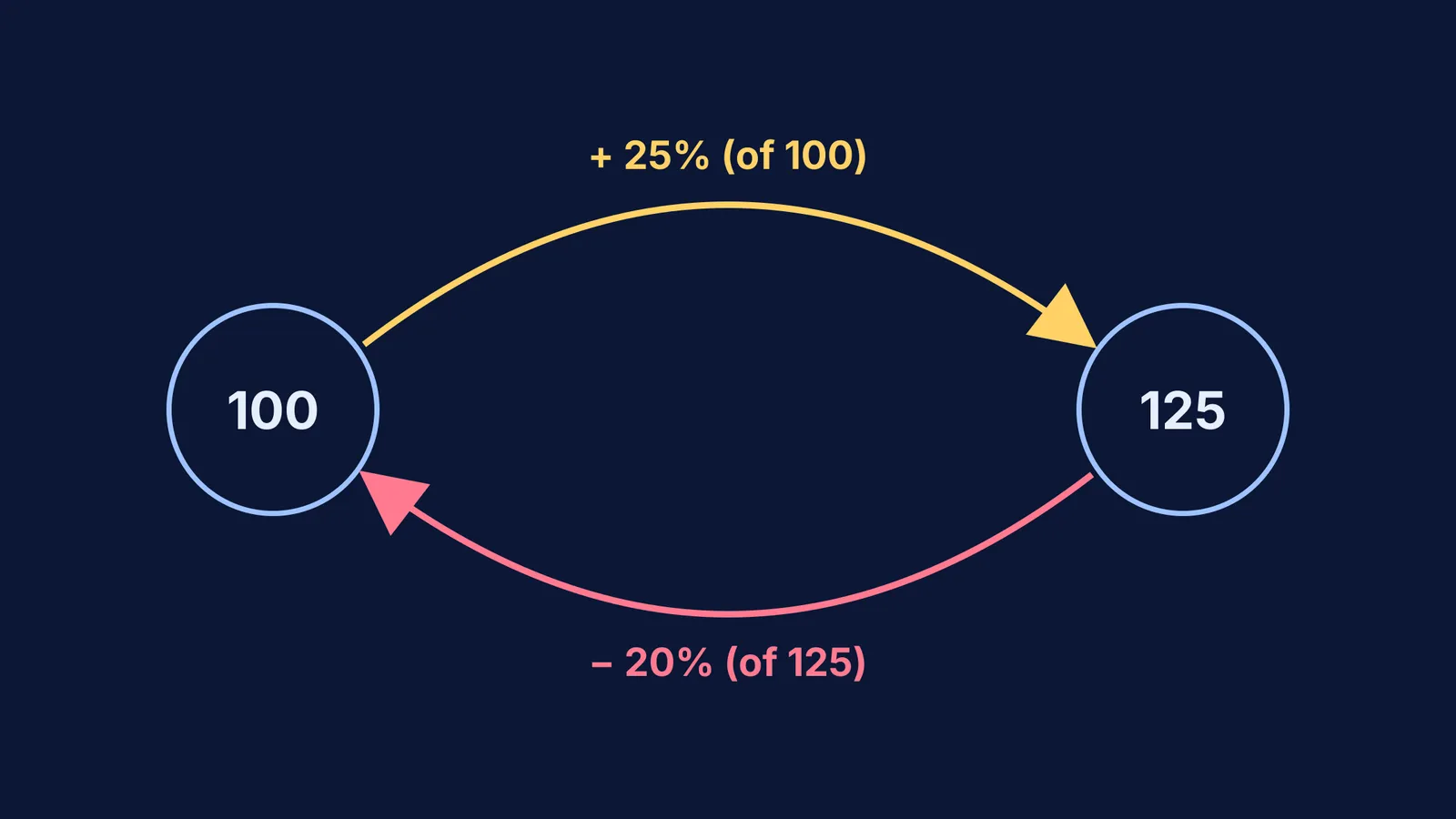
If an item's price goes from 100 to 125, the absolute change is 25. The percentage increase is (25 / 100) × 100 = 25%. By contrast, if the price later drops from 125 back to 100, the absolute change is still 25, but the percentage decrease is (25 / 125) × 100 = 20% (Wikipedia).
Why do percentage increases and decreases not cancel out?
A common error among students is thinking that if a price goes up by a certain percentage, dropping it by the exact same percentage will return it to the original price. This is incorrect because the base—the number you are taking a percentage of—has changed.
An important property of these changes is their non-symmetrical reversibility; a percentage increase requires a different percentage decrease to return to the original value.
For example, as Wikipedia notes, if you start with 100 and increase it by 25%, the new value is 125. If you then apply a 25% decrease to 125, you are subtracting 25% of 125 (which is 31.25), leaving you with 93.75. You do not get back to 100. To restore the initial amount from 125, you must subtract 25. Since 25 is exactly 20% of 125, it takes a 20% decrease to reverse a 25% increase.
How do you calculate successive percentage changes?
The same shifting base causes confusion when dealing with successive percentage changes. If a shop increases prices by a certain rate and then increases them again by the same rate, the total increase is not the simple sum of the two rates.
Instead of adding the rates, you must apply the percentage increase and decrease formula twice. If the rate of increase is the same both times, you multiply the initial value by the factor squared: Final value = Initial value × (1 + r/100)²
If the rates are different, perhaps an increase followed by a decrease, you multiply by both respective factors. For example, if the 10% increase in price considered earlier (on the 200 item, raising its price to 220) is followed by a 10% decrease, you calculate 220 × 0.90 to find the final price will be 198. This is a net decrease of 1%, as detailed by Wikipedia. The two percentage changes are measured relative to different initial values, specifically 200 and 220.
Because the second rate is calculated on an already altered base, the overall change is different from adding the two rates together. This principle also applies to compound interest, where interest is earned on both the principal and the previously accumulated interest. Understanding that percentage changes compound sequentially is a key skill for solving more advanced mathematics problems in later years.
How can you avoid errors in word problems?
When tackling word problems about comparing quantities in Class 8, follow a simple checklist to keep your base straight:
Identify the chronological base: What was the value before the change happened?
Find the absolute change: Subtract the smaller number from the larger number.
Apply the formula: Always use the initial base in the denominator when finding the rate.
If you find yourself stuck on the underlying ideas, the Fermi Concept Library covers every concept in physics, chemistry, biology, mathematics and computing, each with its own lesson and its place in the map. When you are ready to practice, the Fermi Problem Library provides worked problems with a step-by-step solver that explains the reasoning rather than printing an answer.
Mastering the choice of base now will help you significantly later, whether you are setting up quadratic word problems in algebra or calculating empirical and molecular formulas from percentage composition data in chemistry.


