

On this page
When you get a test paper back and see your marks have fallen significantly, the instinctive reaction is to think that recovering will require the exact same amount of effort you lost. But mathematics tells a different story. The reason bouncing back feels so difficult is rooted in how percentages work. Because the base from which you calculate the percentage changes after a fall, the recovery percentage is always larger than the initial drop.
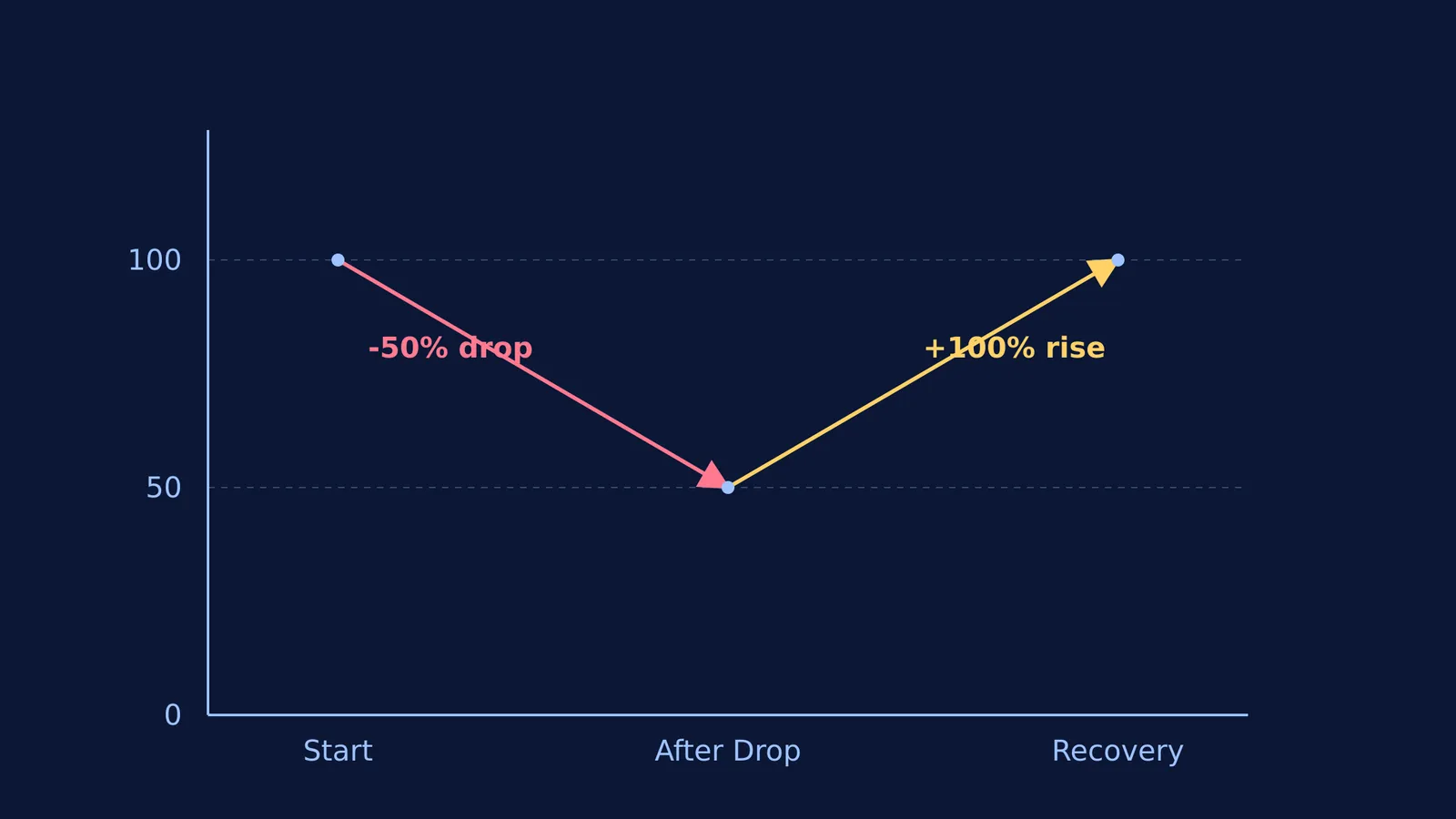
Why a 50 percent drop needs a 100 percent rise to recover?
The core reason for this discrepancy is that the two percentage changes are measured relative to different initial values. Mathematics defines this property as "non-symmetrical reversibility" (Wikipedia).
If your marks drop by 50%, your new score becomes the starting point for your next exam. To get back to where you started, you must gain back all the marks you lost, but those regained marks are now measured against your lowered base.
For example, if you usually score 80 marks and you drop by 50%, your new score is 40. To return to your original 80, you need to gain 40 marks. Earning 40 marks on a base of 40 is a 100% increase.
If you ever encounter questions like this in How adding to or scaling data changes the mean and variance or Quadratic word problems in Class 10: speed, age and area, remember that percentages do not compound symmetrically. If you experience a 10% increase followed by a 10% decrease, you end up at 99% of your original value, not 100% (Wikipedia).
How to calculate percentage recovery after a drop?
You can calculate exactly how much your marks need to improve using the "reversing percentage" formula (Wikipedia). If you know the percentage drop (expressed as a decimal, so 20% is 0.20), the math requires you to divide the drop by the new base.
Required Gain = Drop / (1 - Drop)
Here is how this non-symmetrical relationship plays out for common grade drops:
A 10% drop requires an 11.1% gain to recover.
A 20% drop requires a 25% gain to recover.
A 25% drop requires a 33.3% gain to recover.
A 33% drop requires a 50% gain to recover.
A 50% drop requires a 100% gain to recover.
As the drop gets larger, the mathematical effort required to bounce back grows exponentially. This is why digging yourself out of a deep hole takes considerably more work than maintaining a steady average.
How does this look in your exam marks?
Imagine you are preparing for a major exam where the total marks are high and fluctuations are common.
If you score 200 in a mock test and then suffer a 25% drop in the next one, you lose 50 marks, bringing your score to 150. To get back to 200, you need to add 50 marks. Because you are now starting from 150, that 50-mark gain is 33.3% of your current base (50 ÷ 150) (Wikipedia).
The psychological impact of this mathematical fact is huge. Students often feel discouraged when they work incredibly hard but their percentage growth seems small. You might put in a third more effort just to climb back to your original baseline, which can feel unrewarding if you do not understand the math behind it.
How do you plan your academic recovery?
Knowing the maths means you can set realistic targets instead of feeling defeated by the numbers. If you have experienced a steep drop, trying to make a 100% leap in a single test is overwhelming.
Instead, use a step-by-step checklist to recover:
Find your true gap: Calculate the exact number of marks you need, not just the percentage. A 50% drop means you need a 100% rise in your current marks (Wikipedia).
Break it down: Do not try to double your score in one test. If you need 40 marks, aim for 10 marks per week over a month.
Change the method: A drop usually means your current strategy missed a core concept. If you have concept gaps, the Fermi Concept Library has every concept in physics, chemistry, biology, mathematics and computing, each with its own lesson and its place in the map.
If you are not sure where to start, the Fermi Problem Library has worked problems with a step-by-step solver that explains the reasoning rather than printing an answer. By fixing the foundational gaps, you prevent further drops. Fermi's AI tutor can work out what you already know and build a plan for the session, so you sit down to a clear next step instead of feeling paralyzed by the gap between your current score and your target.
Treat a drop as a signal to change your study strategy rather than a reflection of your ability. By adjusting your methods and understanding the true scale of the climb, you can recover your grades systematically.


