On this page
Chapter 8, First Aid, closes Unit 2 (Science and Sports) of Khel Praveen, the new NCERT Class 9 Physical Education and Well-being book (First Edition, April 2026).
What does First Aid Class 9 cover, and how many marks is it?
The chapter covers soft tissue injuries and PRICE, the aims and golden rules of first aid, basic life support (BLS) with CPR, nosebleeds, and ways to move an injured person.
The CBSE 2026-27 Physical Education and Well-being curriculum gives 20 theory and 80 practical marks. Theory is 2 marks per unit (2 × 8 units = 16 marks) plus a 4-mark viva. First aid shares its unit's 2 marks with that unit's other topics; there is no separate chapter figure. The subject is school-assessed, not a board exam.
A note on labels: the curriculum lists first aid under its Unit 2, Health, Fitness and Wellness, and expands BLS as "Basic Life Skills", while the textbook uses "Basic Life Support". These notes follow the textbook's wording.
What are the aims and golden rules of first aid?
The NCERT chapter defines first aid as quick care for someone who is hurt or suddenly unwell, given before medical help reaches them. Its job is stability and safety, not diagnosis. The aims, called the Three Ps:
Preserve life: breathing, heartbeat and bleeding come first.
Prevent worsening: for example, PRICE for an injury.
Promote recovery: comfort and reassure the person.
The seven golden rules, in short: stay calm; check for danger first; call for help early (the book gives 112 for India); give the right first aid; handle gently, especially if a head, neck or bone injury is possible; use what you have; stay with the person.
How does the PRICE method work for sports injuries?
A soft tissue injury, like a twisted ankle, harms muscles, tendons or ligaments without an open wound. PRICE is R.I.C.E. with Protection added first:
P, Protection: stop and support the injured part.
R, Rest: take the load off it.
I, Ice: wrapped in cloth, to ease pain and swelling.
C, Compression: an elastic bandage.
E, Elevation: limb raised above heart level.
The book calls POLICE and PEACE and LOVE newer methods for longer-term recovery; its boxes on them differ from PRICE on details such as ice. For school and the playground, it names PRICE.
For a nosebleed, Fig. 8.2 shows four steps: pinch the fleshy part below the bone; sit and lean slightly forward; hold until the bleeding stops; rest for at least 10 minutes. If it lasts beyond 10 to 15 minutes or recurs often, the book says to see a doctor.
What is DRSABCD in basic life support?
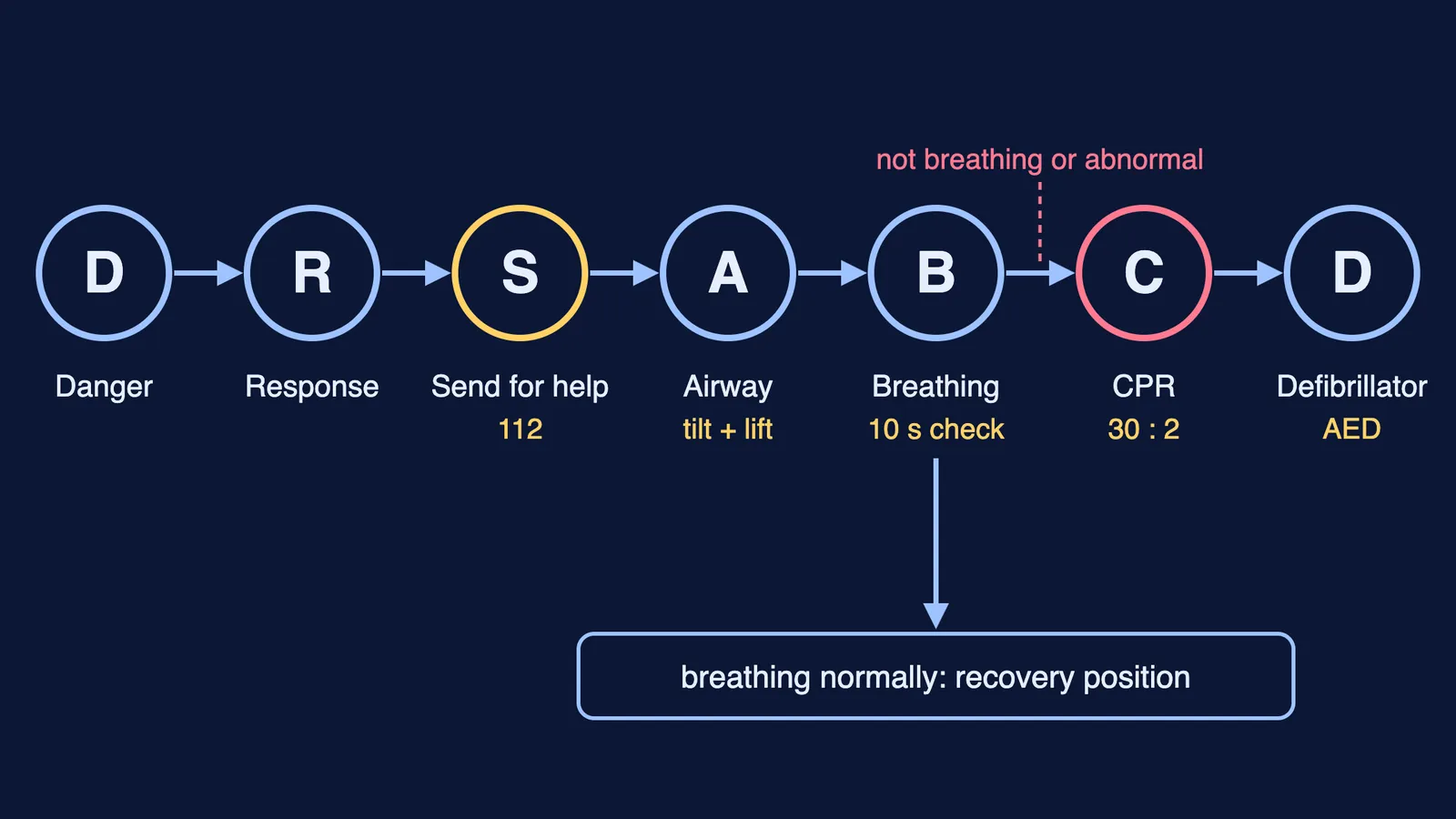
BLS is help for someone whose breathing or heart has stopped, until professionals take over. The chapter teaches the DRSABCD plan (diagram above):
D, Danger: is the scene safe?
R, Response: does the person respond?
S, Send for help: call 112 or ask someone to.
A, Airway: check for blockage, then head tilt and chin lift.
B, Breathing: look, listen and feel for 10 seconds. Normal breathing: recovery position.
C, CPR: if not breathing, or breathing abnormally, 30 chest compressions then 2 breaths.
D, Defibrillator: use an AED if there is one.
The book's CPR table gives almost 2 compressions a second (100 to 120 a minute), with depths of 5+ cm (adults, over 8 years), 5 cm (children, over 1 year) and 4 cm (infants, under 1 year).
Worked example (our numbers): how long do 30 compressions take? At 100 a minute, 30 ÷ 100 = 0.3 minutes = 18 seconds. At 120 a minute, 30 ÷ 120 = 0.25 minutes = 15 seconds. So one set takes 15 to 18 seconds.
What goes in a first aid kit, and how do you move an injured person?
The book's kit figure includes bandages, gauze, a cold pack, gloves, antiseptic wipes, scissors, tweezers, a thermometer, an emergency blanket and emergency contacts.
Transfer techniques move a casualty without extra harm; the book pictures the blanket drag, fireman's carry, walking assist and others. The book adds that a person with a suspected spinal or neck injury should not be moved unless there is immediate danger.
Practice questions for Chapter 8 First Aid
Our own questions; mark labels are our suggestion.
Expand PRICE and give one reason for each step. (2 marks)
A batsman collapses at the crease and does not respond. List the DRSABCD steps in order. (2 marks)
How long do 30 compressions take at 110 a minute? Show your working. (1 mark)
A classmate lies hurt beside a fallen electric wire. Which golden rule comes first, and why? (2 marks)
Related reading: sports injuries and PRICE in Class 12 PE, the Class 11 guide to physical fitness, wellness and lifestyle, and our note on a basic first aid course for students.
Mixing up the lists? Fermi's AI tutor works out what you already know and builds a plan for the session.