

On this page
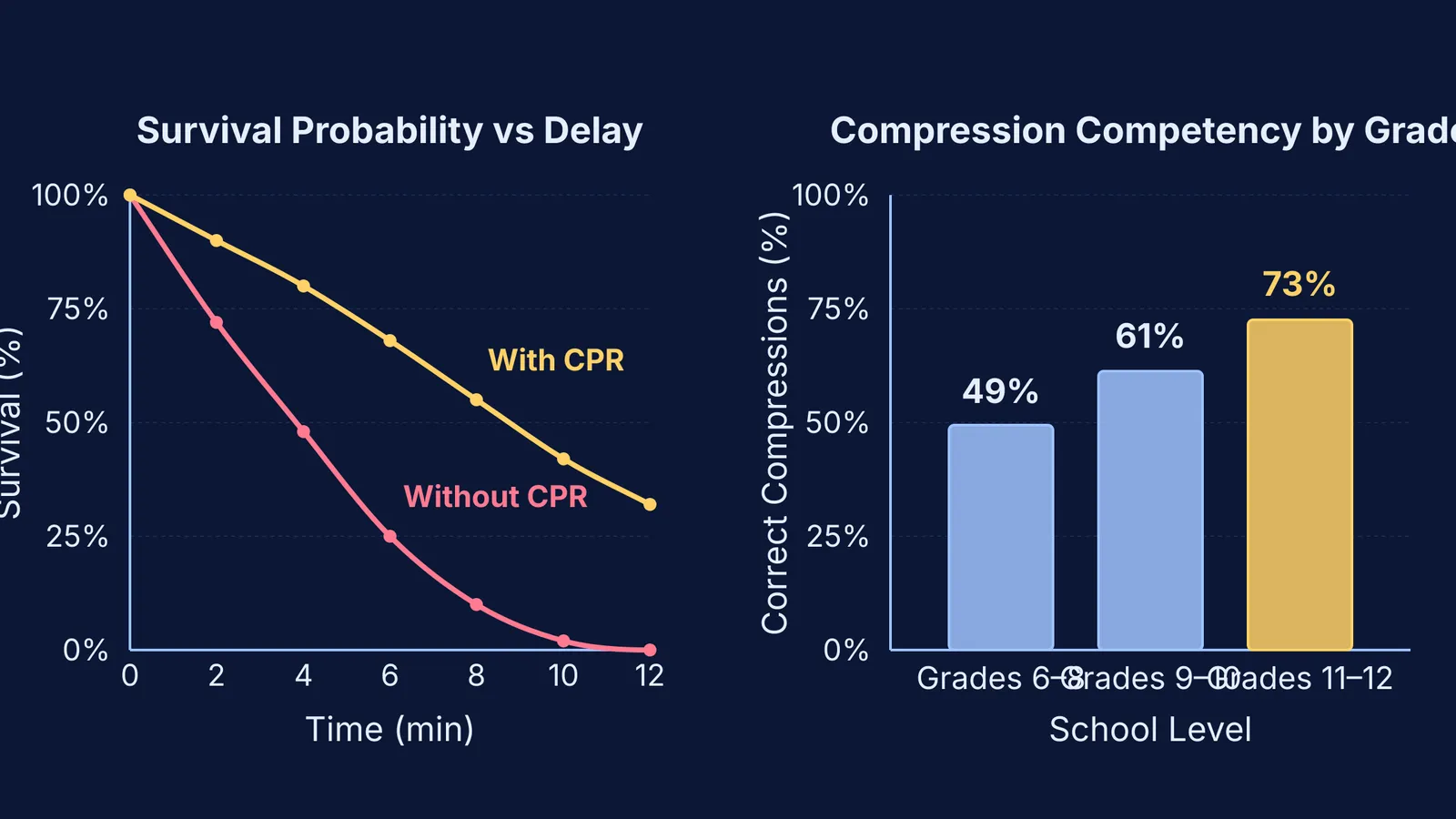
According to the American Heart Association, approximately 73.4% of out-of-hospital cardiac arrests occur at home, yet only 40.2% of victims receive bystander CPR before emergency personnel arrive. When someone collapses, a classmate twists a joint, or hot water spills in a kitchen, professional medical help cannot arrive instantly. In sudden cardiac arrest, survival chances drop by 7% to 10% for every minute without resuscitation. Immediate cardiopulmonary resuscitation (CPR) can double or triple a patient's chances of survival, making basic first aid one of the most critical life skills a young person can acquire.
Why should school students learn basic first aid?
Most medical crises happen in ordinary settings like homes and school playgrounds. In India, community bystander CPR rates remain below 10%, leaving victims vulnerable during critical early minutes. A clinical study led by Dr. Sanjeev Bhoi at AIIMS New Delhi, published in the Turkish Journal of Emergency Medicine, evaluated 810 school students and found that 49.4% of middle school pupils, 61.3% of secondary students, and 72.5% of senior secondary students performed correct chest compressions after structured hands-on training. Theoretical comprehension begins reliably in Class 6, while senior secondary students develop the body mass and muscular strength needed for sustained compression depth.
The World Health Organization endorsed the "Kids Save Lives" global statement, documented in Resuscitation, which recommends at least two hours of CPR training annually for all schoolchildren starting from age 12. Beyond immediate response, trained students act as multipliers who teach their parents and siblings at home. Understanding how compressions maintain blood flow connects textbook physiology to real life. The Fermi Concept Library covers concepts across biology and human physiology, each with its own lesson and place in the map, helping students understand cardiovascular mechanics from first principles.
What does a basic student first aid course cover?
Accredited introductory courses based on international resuscitation guidelines focus on five practical, high-impact skills that teenagers can perform safely:
Primary assessment: Checking the DRSABCD protocol (Danger, Response, Send for help, Airway, Breathing, CPR, Defibrillation) to ensure scene safety before approaching.
Cardiopulmonary resuscitation (CPR): Delivering chest compressions at 100 to 120 beats per minute at a depth of 5 centimetres to circulate oxygenated blood.
Automated External Defibrillator (AED) usage: Applying adhesive pads and following automated voice prompts to deliver a corrective shock if indicated.
Choking intervention: Delivering back blows and abdominal thrusts to dislodge foreign airway obstructions.
Wound and burn management: Applying firm, direct pressure on bleeding wounds and cooling thermal burns under cool water.
Burn care requires discarding household myths. In a study of 2,495 pediatric burn patients in the Annals of Emergency Medicine, applying cool running water for 20 minutes within three hours of injury reduced the odds of requiring skin grafting by 40%. Butter, ice, or toothpaste only trap heat and increase infection risk. Knowing how to cool burns safely aligns with principles taught in safe kitchen science experiments. Visualizing fluid pressure and flow also clarifies why complete chest recoil between compressions is vital. The Fermi Simulation Lab provides interactive simulations for ideas that are easier to see than to read.
Where can students get certified in first aid?
Several established organizations in India provide recognized first aid credentials:
Indian Red Cross Society: The Indian Red Cross Society First Aid Portal offers Junior certificates for students under 12 and Senior courses for students aged 12 and above, covering CPR, bandaging, and basic triage.
St. John Ambulance India: Offers certified practical first aid workshops across district chapters nationwide.
School co-curricular programmes: The National Cadet Corps (NCC), Scouts and Guides, and Junior Red Cross wings provide hands-on training under Central Board of Secondary Education health and disaster management guidelines.
Hospital community training: Major tertiary hospitals offer certified American Heart Association courses using sensor-equipped manikins.
Under Section 134A of the Motor Vehicles Act, Good Samaritans in India enjoy statutory protection from civil or criminal liability when assisting victims in good faith. In any emergency, call 112 to mobilize dispatchers.
How should students respond during a medical emergency?
When an emergency occurs, an organized routine based on established emergency resuscitation standards prevents panic and speeds up response:
Assess danger: Verify that the scene is free from hazards such as traffic, exposed wiring, or fire before stepping in.
Check responsiveness: Tap both shoulders and speak loudly. If the person is unresponsive, shout for nearby help.
Call 112: Designate a specific bystander to call 112 and request an ambulance with an AED.
Check breathing: Tilt the head gently, lift the chin, and observe the chest for 5 to 10 seconds.
Take action: If breathing normally, roll the person into the recovery position. If not breathing, start continuous chest compressions at 100 to 120 beats per minute until paramedics arrive.
Students studying body fluids, cardiac cycle, and circulation learn that the brain suffers irreparable damage after only four minutes without blood flow. Dedicated practice turns passive bystanders into capable lifesavers. Allocating a few hours a year to practical first aid is part of building an enduring daily routine that balances academic focus with essential life skills.


