On this page
Equilibrium is Unit 6 of the CBSE Class 11 Chemistry syllabus for 2026-27. The current NCERT chapter on equilibrium runs in two halves: chemical equilibrium, then ionic equilibrium in solution. For worked problems, see our Equilibrium Class 11 chemistry guide.
What does equilibrium mean in physical processes?
Dynamic equilibrium: the state where a forward and a reverse process run at the same rate, so amounts stay constant while molecules keep crossing. Example: water evaporating and condensing equally in a sealed bottle.
Normal melting point: the temperature at which a pure solid and its liquid coexist at 1 atm (1.013 bar), as the NCERT chapter defines it.
Normal boiling point: the temperature at which a pure liquid and its vapour coexist at 1 atm; 100°C for water.
Saturated solution: a solution holding all the solute it can at that temperature, so dissolving and crystallising run at equal rates.
Henry's law: at a fixed temperature, the mass of a gas that dissolves rises in proportion to its pressure above the liquid. Example: opened soda goes flat.
How do you write Kc and Kp, and what do K and Q tell you?
Law of chemical equilibrium (law of mass action): at a fixed temperature, product concentrations raised to their coefficients, divided by reactant concentrations raised to theirs, give a constant.
Kc: that constant written with molar concentrations. Example: for H2 + I2 ⇌ 2HI, Kc = [HI]²/[H2][I2].
Kp: the same constant using partial pressures of gases, in bar. Kp = Kc × (RT) raised to Δn, where Δn is moles of gaseous products minus moles of gaseous reactants.
Homogeneous equilibrium: all reactants and products in one phase.
Heterogeneous equilibrium: more than one phase. Example: CaCO3(s) ⇌ CaO(s) + CO2(g), where Kp = pCO2 because pure solids and liquids are left out of the expression.
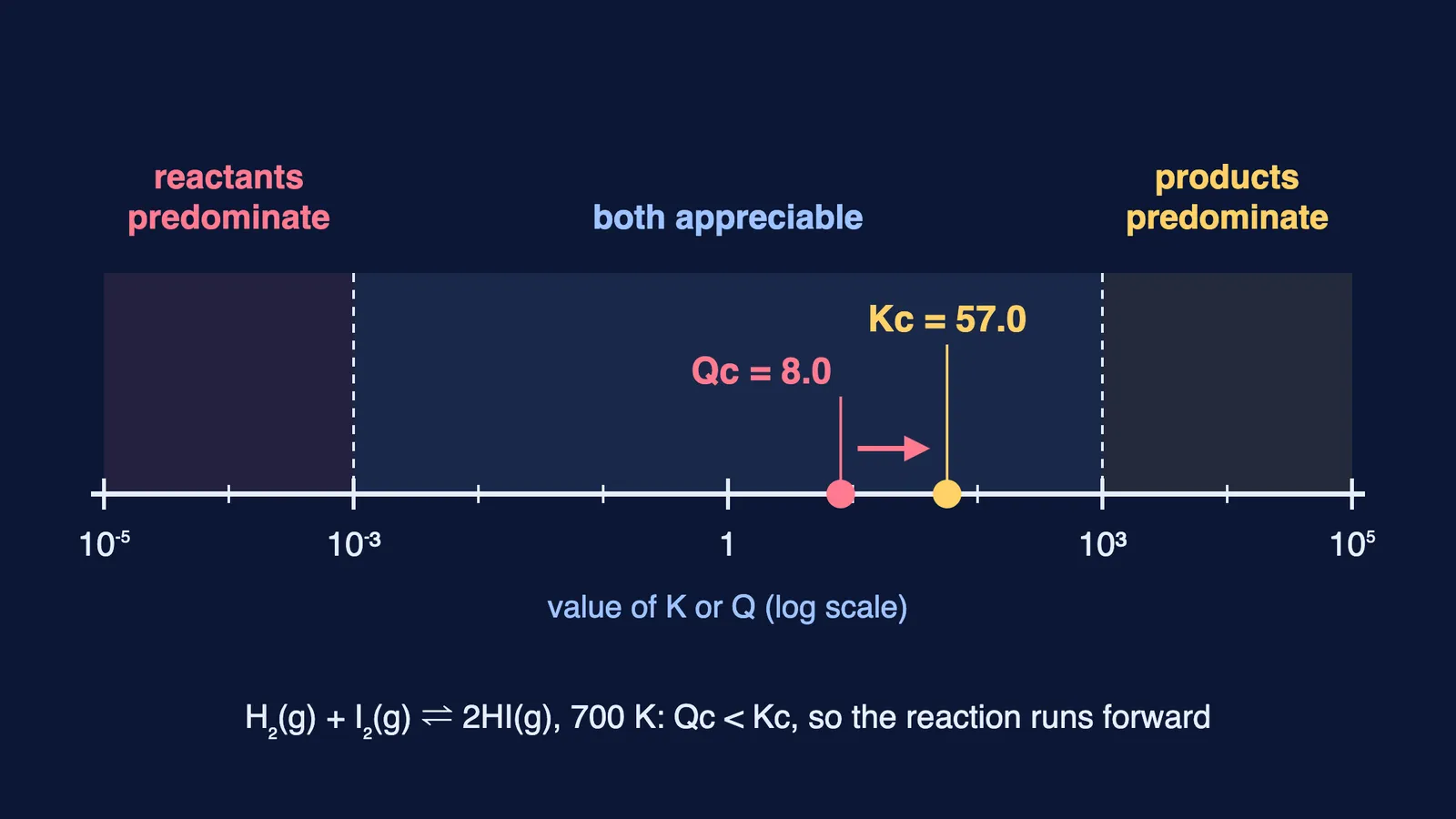
Extent of reaction: Kc above 10³ means products predominate, below 10⁻³ reactants predominate, and in between both are present in appreciable amounts.
Reaction quotient (Q): the same ratio as K, but with concentrations at any moment. Qc < Kc means forward, Qc > Kc backward, equal means at equilibrium. Example: the NCERT chapter has an H2–I2 mixture at 700 K with Qc = 8.0 against Kc = 57.0, so more HI forms.
Standard Gibbs energy change (ΔG°): linked to K by ΔG° = −RT ln K. A negative ΔG° gives K > 1, so products are favoured.
What is Le Chatelier's principle, and what shifts an equilibrium?
Le Chatelier's principle: disturb an equilibrium by changing concentration, pressure or temperature, and the system adjusts in the direction that partly undoes the disturbance.
Concentration change: adding a reactant or removing a product drives the reaction forward until Qc equals Kc again.
Pressure change: compressing a gas mixture favours the side with fewer moles of gas. Example: in CO(g) + 3H2(g) ⇌ CH4(g) + H2O(g), halving the volume shifts it forward.
Inert gas at constant volume: adding argon to a fixed vessel changes no partial pressure, so nothing shifts.
Temperature change: the one factor that changes K. K falls with rising temperature for an exothermic reaction and rises for an endothermic one.
Catalyst: speeds up forward and reverse reactions equally through a lower-energy path, so equilibrium comes sooner but its composition is unchanged. Don't confuse with: temperature, which changes K.
What are acids, bases and ionization constants?
Electrolyte: a substance whose water solution conducts electricity through ions. Strong electrolytes ionize almost completely (NaCl); weak ones only partly (acetic acid, under 5% ionized, per the NCERT chapter).
Arrhenius acid and base: an acid gives H+ in water, a base gives OH−.
Brönsted-Lowry acid and base: a proton donor and a proton acceptor.
Conjugate acid-base pair: two species that differ by one proton. Example: NH4+ and NH3.
Lewis acid and base: an electron-pair acceptor and an electron-pair donor. Example: BF3 has no proton but accepts NH3's lone pair. Don't confuse with: Brönsted acids, which need a proton to give.
Ionic product of water (Kw): [H+][OH−], 1.0 × 10⁻¹⁴ at 298 K; it changes with temperature.
pH: the negative base-10 log of hydrogen-ion activity, equal to [H+] in dilute solution. pH + pOH = pKw.
Ionization constant (Ka, Kb): the equilibrium constant for a weak acid or base ionizing in water; pKa = −log Ka. For a conjugate pair, Ka × Kb = Kw.
Degree of ionization (α): the fraction of a weak electrolyte that has split into ions. Example: NCERT finds α = 0.12 for 0.02 M HF.
Polyprotic acid: an acid with more than one ionizable proton per molecule. Example: H2SO4, H3PO4.
What are the common ion effect, buffers and Ksp?
Common ion effect: adding an ion that an equilibrium already contains pushes that equilibrium back. Example: sodium acetate suppresses the ionization of acetic acid.
Salt hydrolysis: a salt's ions reacting with water and changing pH. Salts of a strong acid and strong base stay neutral; sodium acetate gives a solution above pH 7.
Buffer solution: a solution whose pH barely moves when you dilute it or add a small amount of acid or base. Example: acetic acid with sodium acetate, around pH 4.75.
Solubility product (Ksp): the equilibrium constant between a sparingly soluble salt and its ions in a saturated solution. Example: the NCERT chapter gives BaSO4 Ksp = 1.1 × 10⁻¹⁰ at 298 K, so its molar solubility is 1.05 × 10⁻⁵ mol L⁻¹.
Ionic product (Qsp): the Ksp expression with concentrations at any moment. If Qsp > Ksp, salt precipitates; if Qsp < Ksp, more dissolves. Don't confuse with: Ksp, fixed at a given temperature.
How to learn these terms
Learn look-alikes in pairs: K and Q, Ksp and Qsp, Brönsted and Lewis, catalyst and temperature.
Keep a card: "only temperature changes K"; other factors shift the position, not the constant.
Draw a number line with K marked; practise placing Q and the arrow.
Put the symbols to work with our Equilibrium Class 11 formulas sheet, then try the Equilibrium case study questions for Class 11. If an idea feels shaky, the Fermi Concept Library has its own lesson for every concept in chemistry.