On this page
These formulas come from Unit 6 of the NCERT Class 11 Chemistry textbook, Part I (Reprint 2026-27), grouped by topic with units, a worked example and one pitfall each.
The CBSE 2026-27 Chemistry curriculum covers equilibrium constants, Q and Gibbs energy, ionic equilibrium, buffers and solubility equilibria in Unit 6. For marks and practice, see our Equilibrium Class 11 chemistry guide.
How do you write Kc and Kp, and how are they related?
For aA + bB ⇌ cC + dD at fixed temperature:
Kc = [C]ᶜ[D]ᵈ ÷ ([A]ᵃ[B]ᵇ), equilibrium concentrations in mol L⁻¹; units (mol L⁻¹)^Δn.
Kp = (p_C)ᶜ(p_D)ᵈ ÷ ((p_A)ᵃ(p_B)ᵇ), gases, partial pressures in bar; units bar^Δn.
Kp = Kc(RT)^Δn, with R = 0.0831 bar L mol⁻¹ K⁻¹, T in K, Δn = gaseous product moles − gaseous reactant moles.
Leave pure solids and liquids out of Kc and Kp.
NCERT also notes Kc and Kp become dimensionless when each term is divided by its standard state (1 mol L⁻¹, 1 bar).
Reversed reaction: K′c = 1 ÷ Kc. Equation multiplied by n: K″c = Kcⁿ. Reactions added: K_net = K₁ × K₂ × …. Units follow the new Δn.
Worked example. For PCl₅(g) ⇌ PCl₃(g) + Cl₂(g), take Kc = 0.040 mol L⁻¹ at 500 K.
Δn = 2 − 1 = 1.
Kp = 0.040 × (0.0831 × 500)¹ = 1.66 bar.
Reversed, K′c = 1 ÷ 0.040 = 25 L mol⁻¹.
Watch for: Δn counts gas moles only; for CaCO₃(s) ⇌ CaO(s) + CO₂(g), Δn = 1. More on this: how K changes when a reaction is reversed or multiplied.
How are Q, K and Gibbs energy related?
Qc has the form of Kc but uses concentrations at any moment; units as Kc.
Qc < Kc: net forward. Qc > Kc: net backward. Qc = Kc: equilibrium.
ΔG = ΔG° + RT ln Q, with ΔG and ΔG° in J mol⁻¹, R = 8.314 J mol⁻¹ K⁻¹, T in K (NCERT).
At equilibrium ΔG = 0 and Q = K, so ΔG° = −RT ln K, and K = e^(−ΔG°/RT). K is dimensionless here (standard states 1 mol L⁻¹, 1 bar); ΔG° < 0 gives K > 1.
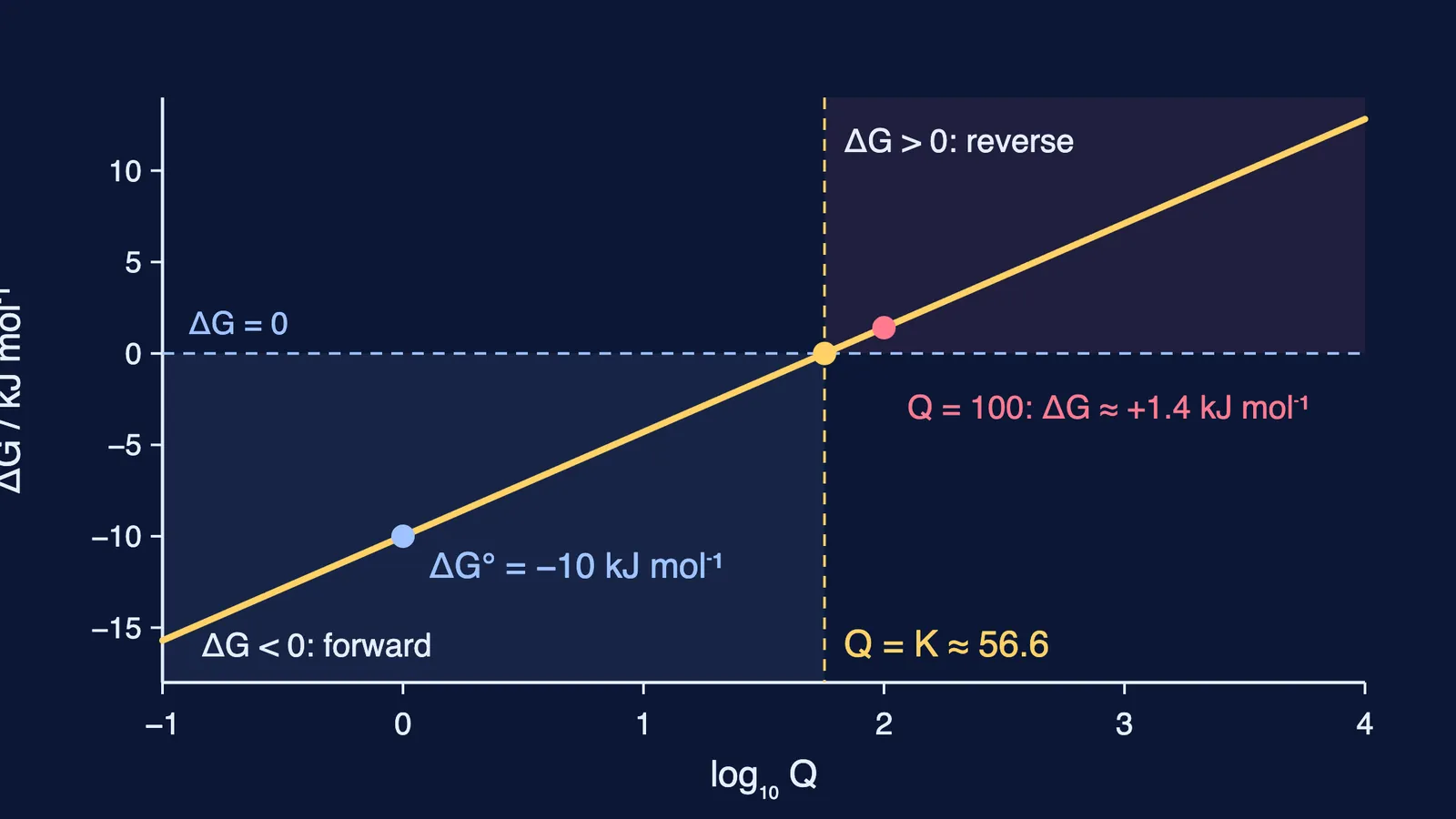
Worked example. A reaction has ΔG° = −10.0 kJ mol⁻¹ at 298 K.
ln K = 10 000 ÷ (8.314 × 298) = 4.04, so K = 56.6.
In a mixture with Q = 100: ΔG = −10 000 + (8.314 × 298 × ln 100) = +1410 J mol⁻¹.
ΔG > 0 and Q > K: net reaction backward.
Watch for: convert kJ to J before dividing by R.
How do you calculate pH and pOH?
Ionic product of water: Kw = [H₃O⁺][OH⁻] = 1.0 × 10⁻¹⁴ mol² L⁻² at 298 K (NCERT).
pH = −log[H₃O⁺], with [H₃O⁺] in mol L⁻¹ (pH has no unit).
pOH = −log[OH⁻], [OH⁻] in mol L⁻¹.
pKw = pH + pOH = 14, at 298 K only; neutral pH is 7 there.
Worked example. pH of 0.0050 M NaOH at 298 K:
[OH⁻] = 5.0 × 10⁻³ mol L⁻¹, so pOH = 2.30.
pH = 14 − 2.30 = 11.70.
Watch for: for an extremely dilute acid such as 10⁻⁸ M HCl, include water's own ionization; the pH is just below 7, not 8.
Ka, Kb and degree of ionization
Weak acid HX, concentration c (mol L⁻¹), degree of ionization α:
Ka = [H₃O⁺][X⁻] ÷ [HX] = cα² ÷ (1 − α). NCERT treats Ka as dimensionless, taking the standard state of every species as 1 M.
If α ≪ 1 (roughly below 0.05): α ≈ √(Ka ÷ c) and [H₃O⁺] = cα ≈ √(Ka c) mol L⁻¹.
Weak base MOH: Kb = [M⁺][OH⁻] ÷ [MOH] = cα² ÷ (1 − α), dimensionless in the same way.
pKa = −log Ka, pKb = −log Kb. Conjugate pair: Ka × Kb = Kw, so pKa + pKb = 14 at 298 K (NCERT).
Weak acid–weak base salt: pH = 7 + ½(pKa − pKb) (no unit) at 298 K, independent of concentration.
Worked example. A 0.20 M solution of a weak acid HA has Ka = 2.0 × 10⁻⁵.
α ≈ √(2.0 × 10⁻⁵ ÷ 0.20) = 0.010 (1.0% dissociated).
[H₃O⁺] = 0.20 × 0.010 = 2.0 × 10⁻³ mol L⁻¹, so pH = 2.70.
Its conjugate base A⁻ has Kb = 1.0 × 10⁻¹⁴ ÷ (2.0 × 10⁻⁵) = 5.0 × 10⁻¹⁰.
Watch for: check α after the shortcut; if it is above about 5%, solve cα² ÷ (1 − α) = Ka as a quadratic.
Buffer solutions and solubility product
Acidic buffer (weak acid + its salt), Henderson–Hasselbalch: pH = pKa + log([A⁻] ÷ [HA]) (conjugate base from the salt over acid).
Basic buffer (weak base + its salt): pOH = pKb + log([BH⁺] ÷ [B]), both in mol L⁻¹, then pH = 14 − pOH at 298 K.
Salt MₓXᵧ(s) ⇌ xMᵖ⁺(aq) + yX^q⁻(aq) with molar solubility S (mol L⁻¹): Ksp = [Mᵖ⁺]ˣ[X^q⁻]ʸ = (xS)ˣ(yS)ʸ = xˣyʸS^(x+y); unit (mol L⁻¹)^(x+y), though NCERT quotes Ksp values without units.
In pure water, S = (Ksp ÷ xˣyʸ)^(1/(x+y)).
Qsp > Ksp: precipitate forms. Qsp < Ksp: more solid dissolves.
Common ion lowers S: for MX₂ in c mol L⁻¹ of X⁻, S ≈ Ksp ÷ c² when 2S ≪ c.
Worked example. A salt MX₂ has Ksp = 4.0 × 10⁻¹² mol³ L⁻³.
In water: Ksp = S(2S)² = 4S³, so S = (1.0 × 10⁻¹²)^(1/3) = 1.0 × 10⁻⁴ mol L⁻¹.
In 0.010 M NaX: S ≈ 4.0 × 10⁻¹² ÷ (0.010)² = 4.0 × 10⁻⁸ mol L⁻¹.
Watch for: for MX₂, [X⁻] = 2S, so the term is (2S)² = 4S², not 2S².
How to revise this formula sheet
Write Δn for ten NCERT exercise reactions, ignoring every (s) and (l).
Keep two R values apart on one card: 0.0831 bar L mol⁻¹ K⁻¹ for Kp, 8.314 J mol⁻¹ K⁻¹ for ΔG°.
Test the conditions with our Equilibrium case study questions for Class 11. If a step keeps going wrong, the Fermi Problem Library has worked problems with a step-by-step solver that explains the reasoning rather than printing an answer.