On this page
Read each passage as data: what is fixed, what changes, and which way the reaction must move. Below are three original practice cases, easiest first, each with four parts and worked answers.
What do Equilibrium case-study questions test?
In the CBSE Chemistry curriculum for 2026-27, Unit 6, Equilibrium, carries 7 of the 70 theory marks in Class XI. Class 11 papers are set by schools, so treat these cases as practice in the case-based style, not as a fixed pattern.
Every idea used here is in the current NCERT chapter, Unit 6 of Chemistry Part I (Reprint 2026-27): Le Chatelier's principle, the reaction quotient Qc, Kp = Kc(RT)^Δn, and the Henderson–Hasselbalch equation for buffers. For a full chapter recap, see our Equilibrium Class 11 chemistry guide; for how to read a passage under time pressure, see how to answer case-based questions.
Case 1: Pink, blue and violet in the school lab
In a Class 11 practical at a school in Kochi, Meera dissolves a little cobalt chloride in hydrochloric acid. The solution in her test tube looks violet, a mix of pink and blue, because of this equilibrium:
[Co(H₂O)₆]²⁺ (pink) + 4Cl⁻ ⇌ [CoCl₄]²⁻ (blue) + 6H₂O
She splits the solution into three tubes. Tube A goes into a beaker of hot water and turns blue. Tube B goes into an ice-salt mixture. Into tube C she drops a few crystals of sodium chloride and shakes until they dissolve.
(i) In tube B, the colour turns: (a) deep blue (b) pink (c) colourless (d) stays violet
(ii) Is the forward reaction endothermic or exothermic?
(iii) What colour change do you expect in tube C, and why?
(iv) Meera dilutes a fourth tube with water to twice its volume at room temperature. Show with Qc which way the equilibrium shifts.
Answers.
(i) (b). Cooling favours the backward reaction, so pink [Co(H₂O)₆]²⁺ builds up.
(ii) Endothermic. Heating shifted it forward (blue), and Le Chatelier's principle says heat favours the endothermic direction.
(iii) Bluer. Dissolved NaCl adds Cl⁻, a reactant, so the reaction moves forward to use it up.
(iv) Qc = [CoCl₄²⁻] / ([Co(H₂O)₆²⁺][Cl⁻]⁴), with water left out as the solvent. Halving every concentration gives Qc = (½) / (½ × (½)⁴) = 16 Kc. Since Qc > Kc, the reaction moves backward and the tube turns pinker.
Case 2: Making hydrogen for a fertiliser plant
A fertiliser plant in Gujarat makes hydrogen for its ammonia unit by the shift reaction CO(g) + H₂O(g) ⇌ CO₂(g) + H₂(g). In a pilot test, an engineer fills a 10.0 L steel vessel with 1.0 mol of CO and 3.0 mol of steam and holds it at a fixed high temperature. At equilibrium, the outlet analyser shows 0.75 mol of H₂.
(i) For this reaction: (a) Kp = Kc (b) Kp = Kc(RT) (c) Kp = Kc/RT (d) Kp = Kc(RT)²
(ii) Calculate Kc at this temperature.
(iii) The vessel is compressed to 5.0 L at the same temperature. What happens to the amount of H₂?
(iv) At the same temperature, the vessel is filled with 1.0 mol of CO and only 1.0 mol of steam. What percentage of CO is converted, and what does this tell the engineer?
Answers.
(i) (a). Δn = 2 − 2 = 0, so (RT)⁰ = 1.
(ii) At equilibrium: CO = 0.25 mol, H₂O = 2.25 mol, CO₂ = H₂ = 0.75 mol. The volume cancels, so Kc = (0.75 × 0.75) / (0.25 × 2.25) = 0.5625 / 0.5625 = 1.0, with no units.
(iii) No change. With equal moles of gas on both sides, Qc stays equal to Kc when the volume changes.
(iv) x² / (1 − x)² = 1.0 gives x / (1 − x) = 1, so x = 0.50 mol: 50% conversion. Excess steam raised it to 75%, so adding a reactant, not pressure, increases the yield.
Case 3: A buffer for a tablet test
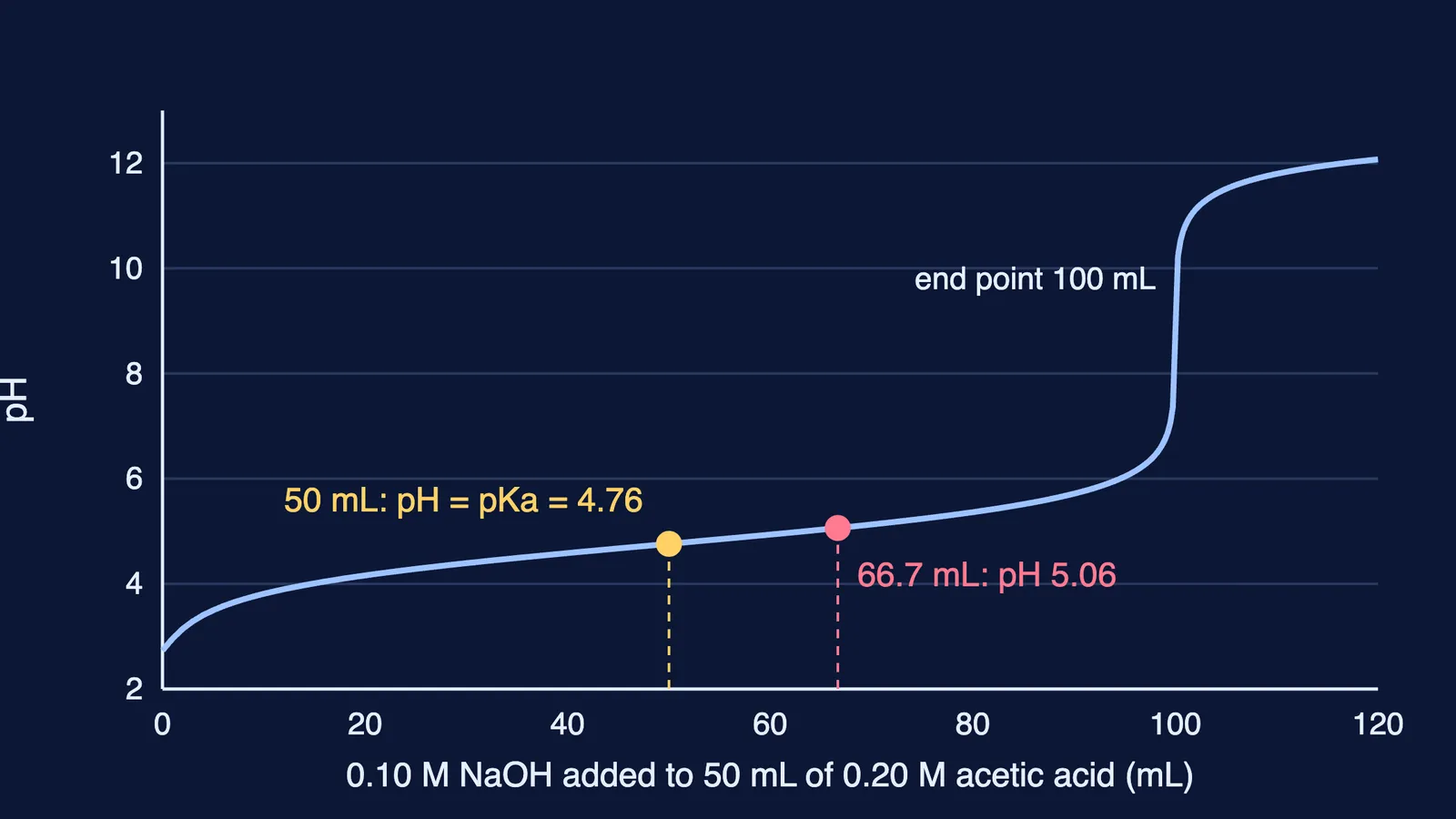
A quality-control lab at a pharmaceutical company in Hyderabad needs an acetate buffer for a tablet dissolution test. The analyst has a stock of 0.20 M acetic acid and a 0.10 M sodium hydroxide solution. The pKa of acetic acid is 4.76; take log 2 = 0.30. The method needs a buffer of pH 5.06, made by partly neutralising 50 mL of the acid.
(i) Which pair can act as an acidic buffer? (a) HCl and NaCl (b) CH₃COOH and CH₃COONa (c) NaOH and NaCl (d) HCl and NH₄Cl
(ii) Find the pH of the 0.20 M acetic acid stock.
(iii) The analyst first adds 50 mL of the NaOH to 50 mL of the acid. What is the pH of the mixture?
(iv) What volume of the NaOH must be added to 50 mL of the acid to reach pH 5.06?
Answers.
(i) (b). A weak acid with its salt of a strong base.
(ii) [H⁺] = √(Ka × c), so pH = ½(pKa − log c) = ½(4.76 + 0.70) = 2.73. The acid is under 1% ionised, so the approximation holds.
(iii) Acid = 50 × 0.20 = 10 mmol; NaOH = 50 × 0.10 = 5 mmol. That leaves 5 mmol CH₃COOH and 5 mmol CH₃COO⁻, so pH = pKa + log 1 = 4.76.
(iv) 5.06 = 4.76 + log([A⁻]/[HA]) needs the ratio 2. If n mmol of NaOH is added, n / (10 − n) = 2, so n = 6.67 mmol, which is 66.7 mL.
How do you attack case-study questions on Equilibrium?
Mark the fixed temperature. K changes only with temperature; concentration, pressure and catalysts do not change it.
Count gas moles before any pressure question. If Δn = 0, compression does nothing and Kp = Kc.
Use Qc against Kc for every "which way" part.
Leave out pure solids, liquids and the solvent when you write Kc or Qc.
In buffer questions, convert to millimoles first. The volumes cancel in the ratio, so the arithmetic stays small.
If you would rather see a shift than read about it, the Fermi Simulation Lab has interactive simulations for the ideas that are easier to see than to read. For a different style of practice, try our assertion-reason questions on chemical and ionic equilibrium.