On this page
Equilibrium is Unit 6 of chemistry in the NEET (UG) syllabus: chemical equilibrium (Kc, Kp, Le Chatelier) plus ionic equilibrium (pH, buffers, solubility product). Every statement below was checked against the NCERT Class 11 Chemistry chapter on Equilibrium (Reprint 2026-27).
How do you answer assertion-reason questions?
Mark each line true or false on its own first. Only if both are true, ask whether R is the direct reason A happens.
Use these keys for Q1 to Q6:
(A) Both A and R are true and R is the correct explanation of A.
(B) Both A and R are true but R is NOT the correct explanation of A.
(C) A is true but R is false.
(D) A is false but R is true.
More on the method: our assertion-reason question strategy.
Assertion-reason questions on equilibrium
Each answer below follows the NCERT Equilibrium chapter.
Q1 (easy). Assertion (A): Once a reaction in a closed vessel reaches equilibrium at constant temperature, the concentrations of reactants and products no longer change with time. Reason (R): At equilibrium the forward and reverse reactions continue at equal rates.
Answer: (A). Both are true and R explains A: each species forms as fast as it is used up, so there is no net change, yet both reactions continue.
Trap: reading "constant" as "stopped".
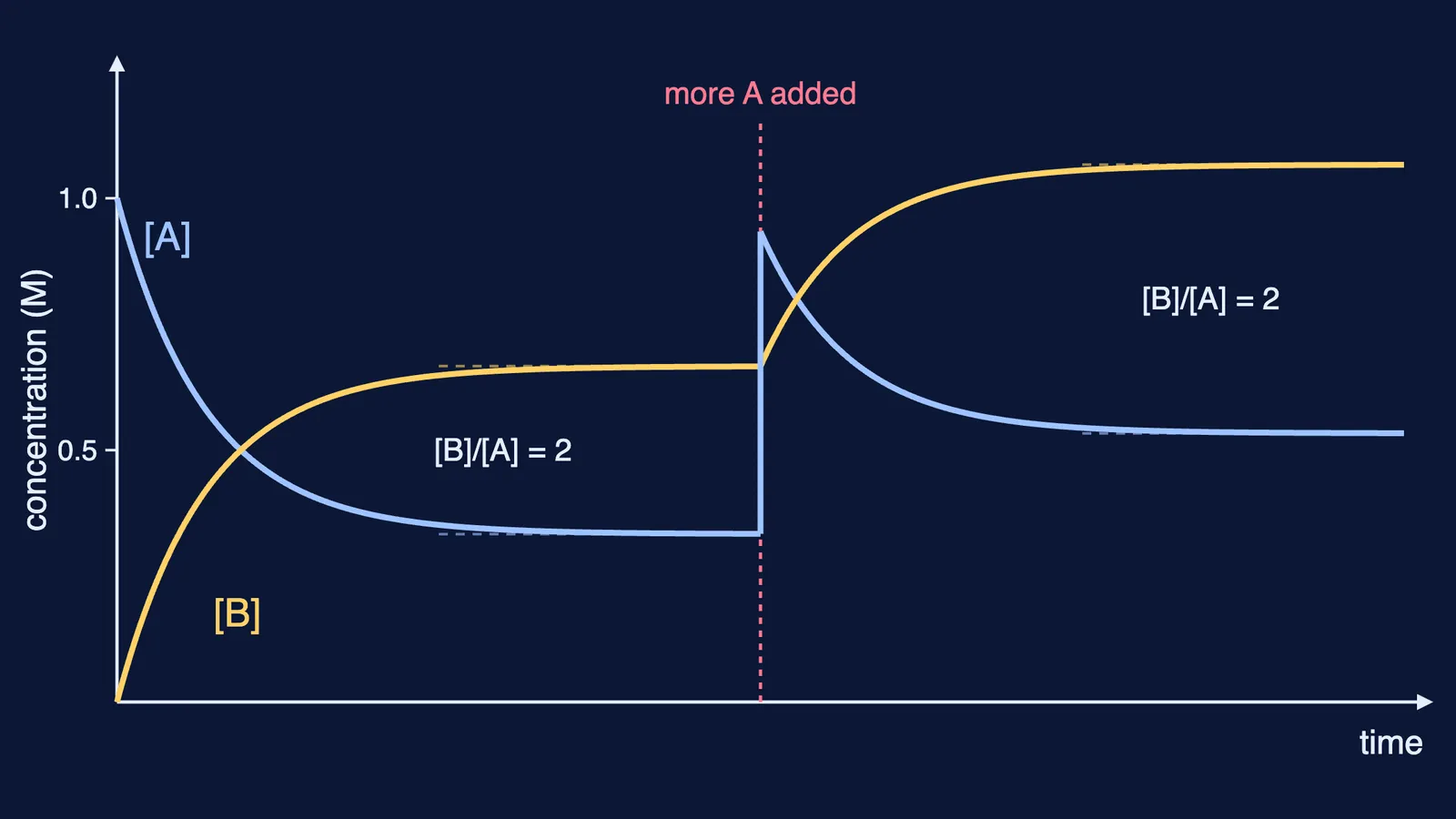
Q2 (easy). Assertion (A): Adding more of a reactant to an equilibrium mixture at constant temperature increases the value of Kc. Reason (R): Adding a reactant shifts the equilibrium in the forward direction.
Answer: (D). A is false: at a given temperature Kc has one fixed value and does not depend on concentrations. R is true; the mixture shifts forward until the ratio again equals the same Kc.
Trap: "more product" is not "bigger K".
Q3 (medium). Assertion (A): For H2(g) + I2(g) ⇌ 2HI(g), Kp = Kc. Reason (R): All the reactants and products in this reaction are gases.
Answer: (B). Both are true, but R is not the reason. Kp = Kc(RT)^Δn, where Δn is moles of gaseous products minus moles of gaseous reactants; here Δn = 2 − 2 = 0, so (RT)^0 = 1. N2 + 3H2 ⇌ 2NH3 is also all-gas, yet Kp ≠ Kc.
Trap: accepting a true fact that sounds related as the cause.
Q4 (medium). Assertion (A): Adding a catalyst to a system at equilibrium does not change the equilibrium composition. Reason (R): A catalyst speeds up only the forward reaction.
Answer: (C). A is true. R is false: NCERT states that a catalyst lowers the activation energy of the forward and reverse reactions by exactly the same amount, so equilibrium comes sooner but at the same position.
Trap: thinking a catalyst raises yield.
Q5 (medium). Assertion (A): An aqueous solution of sodium acetate is basic. Reason (R): Acetate ion reacts with water to form acetic acid and OH− ions, because acetic acid is a weak acid.
Answer: (A). Both are true and R is the cause: acetic acid stays mostly un-ionised, so OH− builds up and pH rises above 7.
Trap: offering "sodium acetate is a strong electrolyte" as the reason. True, but complete ionisation alone gives a neutral solution, as with NaCl.
Q6 (hard). Assertion (A): The pH of 5.0 × 10⁻⁸ M HCl at 298 K is below 7, not 7.3. Reason (R): In such a dilute acid, the H3O+ from the ionisation of water is comparable to the H3O+ from HCl and must be included.
Answer: (A). Both are true and R explains A. Solving x(5.0 × 10⁻⁸ + x) = 10−14 gives x ≈ 7.8 × 10⁻⁸ M from water, so total [H3O+] ≈ 1.28 × 10⁻⁷ M and pH ≈ 6.89.
Trap: writing pH = −log(5.0 × 10⁻⁸) = 7.3, which would make an acid basic.
Statement I and Statement II questions
These also follow the NCERT Equilibrium chapter. Use these keys for Q7 to Q10:
(A) Both statements are correct.
(B) Both statements are incorrect.
(C) Statement I is correct, Statement II is incorrect.
(D) Statement I is incorrect, Statement II is correct.
Q7 (medium). Statement I: The equilibrium constant of an endothermic reaction increases as temperature rises. Statement II: Compressing the equilibrium N2(g) + 3H2(g) ⇌ 2NH3(g) to a smaller volume at constant temperature shifts it towards ammonia.
Answer: (A). Both are correct. K for an endothermic reaction rises with temperature, and compression favours the side with fewer gas moles, here 2 mol of NH3 against 4 mol of reactants.
Trap: assuming temperature, like concentration, leaves K unchanged.
Q8 (medium). Statement I: A buffer containing equal concentrations of acetic acid and sodium acetate has pH equal to the pKa of acetic acid. Statement II: Adding a small amount of HCl to this buffer leaves its pH completely unchanged.
Answer: (C). Statement I follows from the Henderson-Hasselbalch equation, since log 1 = 0. Statement II is wrong: a buffer resists pH change, so pH shifts slightly, not zero.
Trap: reading "resists" as "prevents".
Q9 (hard). Statement I: The conjugate base of a strong acid such as HCl is a strong base. Statement II: For a conjugate acid-base pair in water, Ka × Kb = Kw.
Answer: (D). Statement I is wrong: NCERT notes that strong acids have very weak conjugate bases; Cl− is a much weaker base than water. Statement II is correct.
Trap: assuming "strong" carries over from acid to conjugate base.
Q10 (hard). Statement I: If the reaction quotient Qc is greater than Kc, the reaction proceeds in the forward direction. Statement II: A sparingly soluble salt precipitates when its ionic product is less than its Ksp.
Answer: (B). Both are wrong. When Qc > Kc, the net reaction goes in reverse. A salt precipitates when the ionic product exceeds Ksp; below it, more salt can dissolve.
Trap: the same flipped inequality, twice.
How should you use this set?
Attempt all ten in one sitting without notes, marking each line T or F before choosing a key.
For every miss, note what you misjudged: A, R, or the link.
Redo the misses later, then try our Equilibrium NEET practice questions with solutions.
If Le Chatelier shifts feel abstract, the Fermi Simulation Lab has interactive simulations for the ideas that are easier to see than to read. For a full plan for the chapter, read Equilibrium for NEET: how to prepare, with worked examples.